How optogenetics is moving from brain labs to blindness treatment

The 2026 Nobel Prize in Physiology or Medicine has brought optogenetics into the spotlight, but the technology is already moving beyond the laboratory. Researchers abroad are testing it as a way to restore vision, while scientists in India are using it to understand the neural circuits involved in pain, itch and behaviour.
The prize was awarded on October 5 to American scientist Karl Deisseroth and German scientists Peter Hegemann and Georg Nagel for discoveries concerning light-gated ion channels and optogenetics. Their work helped turn light into a remarkably precise tool for controlling nerve cells.
So what exactly is optogenetics, and how close is it to becoming a treatment rather than simply a research technique?
Dr Arnab Barik, assistant professor at the Centre for Neuroscience, Indian Institute of Science (IISc), Bengaluru, who is one of the researchers in the fast-evolving field in the country, told India Today: “Optogenetics: able to precisely control nerves in the brain and elsewhere with light.”
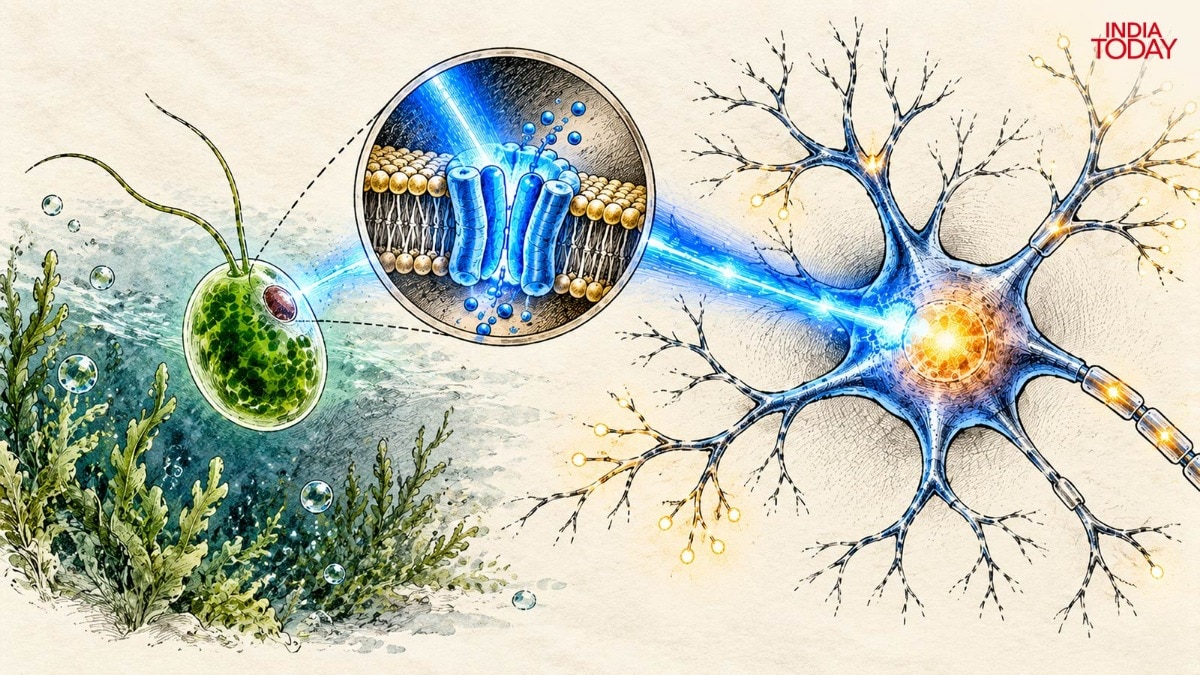
In the technique, genetic engineering is used to make selected nerve cells sensitive to light. Once those cells carry light-sensitive proteins, researchers can use pulses of light to activate or inhibit them and observe what happens.
For example, scientists can target nerve cells involved in hunger and use light to switch those cells on or off. In animal experiments, this has allowed researchers to make mice start or stop eating, helping establish a direct connection between particular neurons and behaviour.
The breakthrough has its roots in studies of a single-celled alga. Hegemann and Nagel discovered channelrhodopsin, a protein that opens an ion channel when exposed to light. Deisseroth subsequently adapted the approach for nerve cells, demonstrating that light could be used to control neural activity in living animals.
Unlike conventional methods that may influence many neurons at once, optogenetics can target defined populations of cells. That ability to ask, in effect, what happens if this precise group of neurons is switched on or off? has transformed neuroscience.FROM LAB TOOL TO TREATMENT
For much of its history, optogenetics has been primarily a research tool. Scientists have used it to map circuits involved in memory, emotions, movement, reward, addiction, pain and several neurological and psychiatric disorders, including Parkinson's disease, epilepsy and Alzheimer's disease.
Its therapeutic potential, however, is becoming more tangible in conditions where damaged or dysfunctional neural cells might be bypassed or controlled.
The clearest example so far is retinal degeneration. Diseases such as retinitis pigmentosa progressively destroy the light-sensing photoreceptors in the retina and can eventually cause severe visual impairment or blindness.
Optogenetic therapy takes a different approach from conventional gene therapy. Instead of trying to correct the particular genetic mutation that caused the retinal disease, researchers can introduce a gene for a light-sensitive protein into surviving retinal cells. Those cells can then respond to light even though the original photoreceptors have been lost or severely damaged.
One such approach, MCO-010, has been tested in people with advanced retinitis pigmentosa. In a Phase 2b randomised trial, the therapy produced statistically significant improvements in visual acuity compared with sham treatment at 52 weeks, with the higher-dose group showing further improvement at 76 weeks.
More recent work has continued to investigate whether such gains can persist over several years. A 2026 report from the developer described four-year follow-up data from its retinal degeneration programme.
Another 2026 first-in-human study of an optogenetic therapy, AGN-151597, is testing a channelrhodopsin-2-based treatment in people with advanced retinitis pigmentosa. It is a Phase I/IIa dose-escalation study, meaning researchers are still primarily establishing safety and looking for preliminary evidence of benefit.
Vision restoration is currently one of the most advanced clinical applications, but it is not the only possibility. Researchers are exploring whether light-controlled neural activity could eventually help with conditions involving abnormal brain circuits, including epilepsy, Parkinson's disease, neuropathic pain and movement disorders. Potential applications have also been proposed for hearing restoration, bladder control and cardiac rhythm disorders.
These treatments, however, are all being studied as part of clinical trials and these therapies have not yet received regulatory approval in any country.
Also, the challenge is not simply finding a neuron that should be switched on or off, scientists must safely deliver the genetic material, reach the correct cells, control them with sufficient precision and determine whether the intervention produces lasting benefits without unacceptable side effects, say experts.WHERE INDIA STANDS
India is not merely watching this technology develop overseas. Optogenetics is already being used in Indian neuroscience laboratories to investigate how specific neural circuits control pain, itch, stress, feeding and other behaviours.
At IISc, Barik's laboratory uses molecular and optical techniques to manipulate and map neural circuits in mice. His work has included optogenetic experiments examining how stress-related brain circuits influence pain. A 2024 IISc study, for instance, used genetic and optogenetic techniques to map a circuit connecting the lateral septum, hypothalamus, brainstem and spinal cord and showed how stress-related activity could influence pain responses.
More recently, researchers led by DR Barik have investigated how stress can suppress itch through specific neurons in the lateral hypothalamus. By artificially activating or silencing these neurons in mice, they were able to demonstrate their role in regulating scratching behaviour.
Dr Barik says the “potential is huge”, but moving from animal experiments to human treatment presents major hurdles.
One of them is ethical: genetically modifying neurons in the human brain so that they express light-sensitive proteins such as channelrhodopsins is considerably more complicated than using the technique in laboratory animals.
India has, however, already featured in the clinical development of optogenetic therapy for blindness.
A Phase I/IIa study of MCO-010 for advanced retinitis pigmentosa was conducted at the JPM Rotary Club of Cuttack Eye Hospital and Research Institute in Odisha. Patients received the experimental therapy through an injection into the eye, with the aim of making surviving retinal cells responsive to light. The study was registered as NCT04919473 and involved patients with advanced retinal degeneration.
A subsequent long-term follow-up reported five-year safety data from participants in that early study, with no new serious safety signals reported.PROMISES AHEAD
The promise of optogenetics lies in its extraordinary precision.
The brain contains billions of neurons, but different groups perform very different jobs. If researchers can identify the cells responsible for a particular symptom and selectively control them, they may be able to intervene in disease at the level of the neural circuit rather than simply treating symptoms.
The next frontier is translating these into safe treatments that can transform care for many conditions.
For retinal disease, the path may be relatively straightforward because the eye is accessible and treatment can be delivered locally.
In the case of the brain, the hurdles are much greater: genetic modification, delivery of light to deep tissue, long-term safety and the ethical implications of altering neural circuits all need to be addressed.- Ends
Sumi Sukanya Dutta writes on health and pharma for India Today - Health and Wellness. With over 17 years of experience in journalism, she has extensively covered a wide spectrum of issues-from pandemics and public health crises to the growing obesity epidemic and advancements in medical science.
Prior to her current role, Sumi held reporting positions at ThePrint, Moneycontrol, The New Indian Express, The Telegraph, and The Times of India, where she focused on governance and public policy at both state and national levels. She has also contributed to The British Medical Journal (BMJ).