How Social Posts Made in China Sparked Anti-U.S. Protests in America - Newsweek
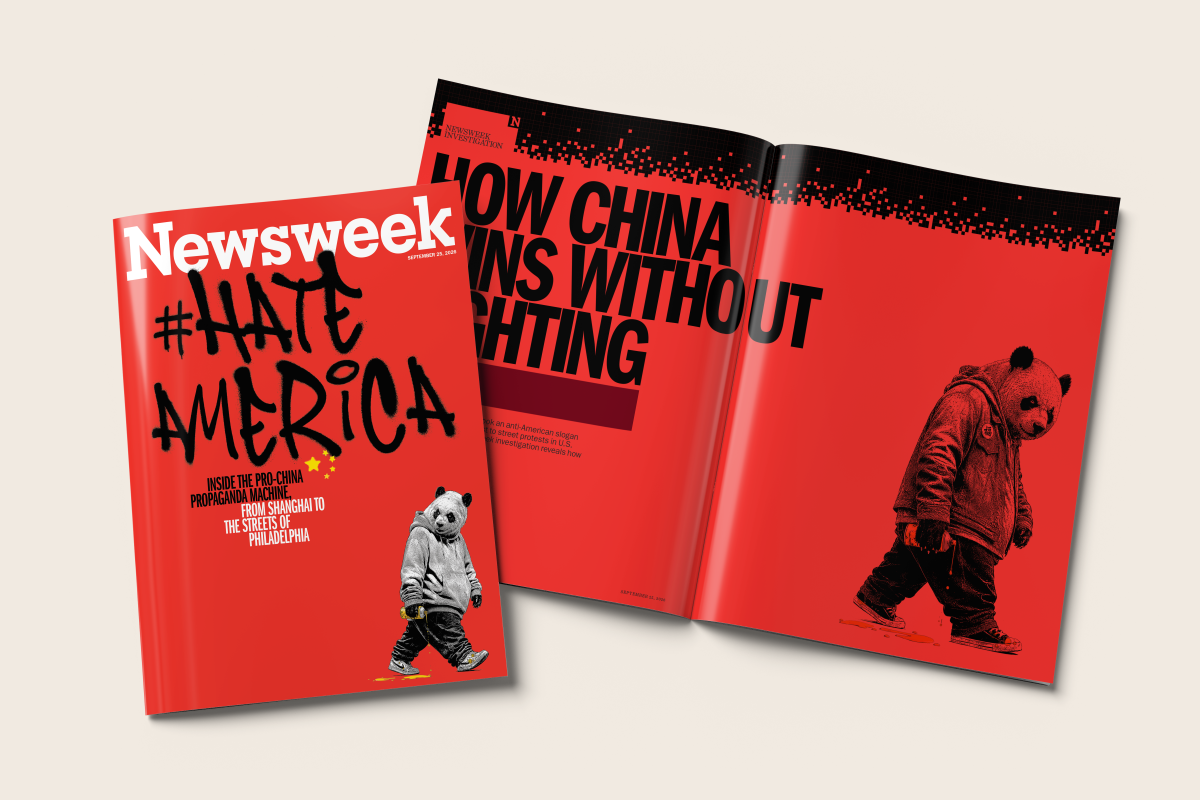
In early March, a three-word slogan appeared on X: “Hands Off Asia!”
It was a single post, one of millions that day, published on the X account of Vijay Prashad, the director of Tricontinental: Institute for Social Research—a U.S.-registered political network funded by the American tech millionaire Neville Roy Singham, who is based in Shanghai.
That was just the start of the political warfare.
By the end of April, the slogan had a launch event chaired in Beijing. A conference in Colombo, the capital of Sri Lanka, turned it into a signed declaration in July. From there it spread to the U.S. where, in August, activists held public rallies and closed-door political meetings in Philadelphia and New York, following a late-July event on “insurgency” requiring participants to wear masks—perhaps not to limit the spread of disease, but so they could not be identified.
Slogans can travel fast, but a Newsweek investigation has found that this one did not travel around the world—and end up in America—on its own. Our investigation reveals:
Political warfare has been researched and taught inside the ruling Chinese Communist Party and the People’s Liberation Army for decades and is regarded there as the highest form of warfare: how to win without fighting. Our investigation shows that doctrine operating in practice—on American allies, on the world’s biggest short-form video platform, on American streets.
The U.S. was once good at this too, but it let its political warfare capability wither at the end of the Cold War. Analysts and officials who study the problem say America is now unequipped to answer this massive new threat, that it has become merely reactive and not proactive, and—according to a review by the U.S. House Permanent Select Committee on Intelligence—its counterintelligence capabilities are “too little too late.”
The official launch of the campaign against U.S. military bases in allied Asian nations, such as South Korea, Japan and the Philippines, was marked on April 30 with a webinar titled: “HANDS OFF ASIA! Peace, Sovereignty and Anti-U.S. Militarism.”
Chaired in Beijing by Tings Chak, Tricontinental’s Asia co-coordinator, the timing was a deliberate poke in America’s eye—the 51st anniversary of the fall of Saigon that marked the U.S. defeat in the Vietnam War.
“The U.S. military presence does not mean protection for any of the peoples in the region,” Chak said of the Middle East, highlighting “an arc of military infrastructure stretching from Japan to South Korea to the Philippines, Guam, Australia, to Diego Garcia and the Gulf states.” From Vietnam, Luna Nguyen, who describes herself as a “Marxist-Leninist content creator,” warned participants against “U.S. imperialism.” From Iran, the scholar Setareh Sadeqi echoed Chak: “U.S. bases do not simply deter conflict. They also import conflict.”
Things went IRL in mid-July in Colombo, where a conference attended by scores of activists from the U.S. and Asia produced a Colombo Declaration for People’s Sovereignty and Solidarity that said: “The enemy is one and indivisible. So must our answer be. Hands off Asia!” The campaign excoriates “the enemy” militarily, economically and politically, and for what it calls “brain capture,” or ideological control.
By August, the action had reached Philadelphia and New York, where a clutch of established or new “anti-imperial” groups, including the Anti-Imperialist South Asian Alliance and pro-North Korean activist group Nodutdol (“stepping stone” in Korean), which campaigns against U.S. bases in South Korea, held closed-door meetings and public rallies transmitting aligned messages. The overarching aim is “America skepticism,” according to experts of Chinese political warfare.
Dig, and a pattern emerges: a carousel of groups and grievances; an echoing ecosystem of online and offline hybrid events, hashtags and narratives; a massive, overlapping, globalized Venn diagram of organizations and people all effectively bearing the same message: Hate America.
There are hundreds, perhaps thousands, of organizations involved. Many connect back to Shanghai-based Singham, who has heavily funded key groups including Tricontinental and the main Colombo Declaration organizer, the International Peoples’ Assembly. The latter’s Instagram page says: “We are a network of 200+ people’s organizations, social movements, political parties & trade unions.”
All amplify the same CCP talking points, propaganda and geopolitical goals. Such as, that Taiwan is part of China. That Japan is dangerously remilitarizing. That the U.S. is a hegemon that must be evicted from Asia. The quiet part doesn’t get said out loud—that China seeks to replace it as hegemon. The CCP speaks of gaining global preeminence by 2049 at the latest, code for becoming the world’s dominant superpower. It makes no bones that it believes the U.S. is unfit for the role.
In Shanghai, the activist funder Singham regularly meets and appears in public with CCP ideologues and propagandists from universities, companies and local government to promote joint projects, including a major meeting of the Shanghai-based Global South Academic Forum last November.
In a Tricontinental publication tied to that event he appeared to compare Western democracy to fascism, saying that it was a “liberal fiction” to see democracy, fascism and communism as three competing systems. Fascism, he said, was “capitalism in crisis,” and: “The real struggle was never between three systems but between two: socialism and capitalism.” The U.S., Singham seems to suggest, is fascist.
So far, so divisive. But then, you might reasonably respond, the U.S. is a democracy. Messy. Hard to manage, often exasperating. But free. And under a divisive American president, who has launched attacks on Venezuela and Iran and alienated even close allies such as Canada, maybe there is some truth to it.
“The U.S. is easy to criticize under Trump,” said James Lewis, of the Center for Strategic & International Studies in Washington, D.C. Yet there is reason to think something else is going on, according to political and intelligence analysts and to deep technical research of social media. Something far more organized: political warfare, a term most Americans probably haven’t heard since the end of the Cold War, when the West faced and fought it from the Soviet Union. For a lot of people that means never, since the Cold War ended in 1989.
Intelligence analysts look for patterns. The pattern—hundreds of interconnecting groups with overlapping leadership and membership pushing the same messages across different regions—is clear. “The goal is to create a persuasive narrative that undercuts support for an opponent and builds support for you,” said Lewis. “Quantity of messaging and constant repetition can compensate for accuracy, so while it helps to have some facts, it’s more important that the propaganda aligns with existing beliefs or suspicions.”
Yet there is also evidence that the online spread of the Hands Off Asia! campaign is being manipulated to spread faster and further, to reach far more people than it would normally.
According to an exclusive analysis shared with Newsweek by Israeli tech startup SpringAI, which seeks to create transparency around the algorithms that dominate social media, the campaign is being boosted unnaturally on TikTok in at least three Asian nations, exhibiting astronomical bias in how it amplifies specific messages that further the campaign. They have spread to the U.S. via geopolitical arguments on X, Instagram and TikTok.
TikTok was founded by the Chinese company ByteDance. In the U.S. it is owned mostly by a consortium of U.S. companies after President Donald Trump forced divestment, but ByteDance still owns the algorithm and nearly 20 percent of the company. Outside the U.S., for example in Asia, where this campaign appears strongest, TikTok is fully owned by ByteDance. SpringAI also said it found evidence of algorithmic promotion of anti-Trump content in the U.S. on TikTok. Newsweek contacted ByteDance for comment.
Newsweek has identified scores of social media accounts, websites, videos and photographs of events that corroborated the findings of SpringAI, which last month identified a global, coordinated, online and offline campaign. The overall aim of this and other “America skeptic” campaigns is to undercut support for the U.S. everywhere. To weaken it from without and to split it from within and to attack it from within and without, experts say. Or to “win without fighting,” as Chinese political warfare doctrine goes.
“The Chinese, with their Leninist background, put a huge emphasis on capturing the narrative,” said Lewis. He pointed to how in the U.S., the CCP has also made efforts to find allies among the Democratic Socialists of America, a political organization that is fielding candidates for election and having success—most notably with the election of democratic socialist Zohran Mamdani as New York City mayor in 2025.
Newsweek has previously reported on close ties between the DSA and the CCP, including through its International Committee which maintains close ties to the CCP and takes advice from key parts of the Singham network. That includes the organization CodePink, cofounded by Singham’s wife, Jodie Evans. Influential caucuses within the DSA such as Red Star push the same agenda. The DSA’s International Committee has been active in organizing opposition in the U.S. and in Japan to U.S. bases there.
“There are a wide range of CCP United Front, Marxist and other radical leftist groups operating against the U.S. and its interests in Asia,” Kerry Gershaneck, a visiting scholar at Taiwan’s National Chengchi University and a counterintelligence and political warfare expert who has spent decades examining the topic, told Newsweek. “Ultimately, they seek the destruction of the U.S. and our belief system, through psychological warfare, disinformation, cognitive attacks and violence designed to shred our national identity and cohesion,” Gershaneck said.
“If China follows through on its threats to use military force to annex Taiwan and the territory of our allies in Asia such as Japan and the Philippines, expect these groups to go on steroids as they engage in propaganda campaigns, riots and other disruptions to block [an] American response,” he said.
It sounds extreme, perhaps. But a recent bipartisan congressional report reached similar conclusions. “Our nation’s adversaries are actively exploiting our free and open society and are working in imaginative ways to achieve their strategic objectives,” said the 9/11 Commission Report Review published on August 31 by the House Permanent Select Committee on Intelligence. By now, a wealth of evidence points to China as the key actor alongside Iran and Russia.
This sprawling effort exploits genuine domestic opposition to hot-button social issues such as data centers, too. Illustrating one major money flow, a report by Fox News Digital earlier this year said that Singham’s networks alone had contributed $591 million between 2017 and 2025 globally to diverse causes, “through five concentric rings of an ideological pipeline that spreads pro-China propaganda.”
Eleven U.S. nonprofit organizations formed the core hub of the network, with a total of about $401 million flowing from Singham and his network into these organizations, Fox reported. The Department of Justice is investigating if any financial crimes are taking place. Congress has subpoenaed key members of the network including Tricontinental. The Chinese embassy in Washington, D.C., did not reply to a request for comment.
It’s a truism of intelligence and propaganda studies that the most effective influence operations contain a kernel of truth. The Soviet Union’s intelligence agencies often worked off that principle in their disinformation and “active measures.” Hands Off Asia! does that too.
There are genuine local grievances, for example, in Japan’s Okinawa, which hosts multiple bases including Kadena Air Base, known as the “hub of airpower in the Pacific.” Complaints include military accidents, soil and noise pollution, and crimes, with U.S. servicemen afforded certain protections. Local nationalism and ethnic issues also cause tensions over U.S. bases in South Korea and in the Philippines. In that Southeast Asian nation, discontent over economic conditions is genuine. In Sri Lanka, a hub for the campaign with its Colombo Declaration, there is concern over crippling international debt, though China is a major creditor.
But somehow, China is never mentioned as a problem. Always only America. Gershaneck knows firsthand from Japan and the Philippines that local complaints are real and can be serious. “Yes, there are always legitimate grievances,” he said. “It’s the way they are amplified and manipulated, that’s what it’s all about. This is about exploiting grievances. About overpowering the narrative that says anything good about America.”
Inside the U.S., the situation reflects that. A three-hour evening meeting called “Asia Rising” was co-organized on August 14 in Philadelphia by the Anti-Imperialist South Asian Alliance and the Pakistan-connected Haqooq-e-Khalq Party, an affiliate of the International People’s Assembly—organizer of the Colombo Declaration conference—which is in turn connected to Tricontinental. In social media posts, the group acknowledged existing “authoritarianism” in Pakistan, India and Kashmir.
Still, somehow, everything is America’s fault: “We live within the country whose foreign policy, arms agreements, and lending conditions define the terrain these movements operate on. It is imperative therefore to close the gap between these struggles back home and in the diaspora”—meaning, people from those countries who live in the U.S.—according to a social media post by the account aisaaphilly, an on-the-ground organizer.
In parallel to that, the Philadelphia Alliance Against Imperialism was running another campaign, “Hanwha out of Philly!” to kill two birds with one stone: organize resistance to a major South Korean corporation, Hanwha, which operates the Hanwha Philly Shipyard, and expose its “ties with the U.S. Empire.”
In Philadelphia, there is evidence that some groups may be getting ready for action. In late July, the Philly Action Readiness Collective, or PARC, held the educational event on “Insurgency and Counter-insurgency.” Masks were required and provided, the group said. “This is not a COVID precaution; it is a counter-surveillance measure at a domestic U.S. political event,” according to an analysis of the event by SpringAI. Protest groups commonly share advice on using masks or other kinds of face or head cover to avoid identification, as a separate report from Philadelphia showed.
PARC’s New York sister group, Action Readiness Collective of New York City, or ARCNYC, describes itself in an Instagram post as a “revolutionary skill sharing group” for the “communities we live, learn and organize in.”
Newsweek approached the groups named in this story for comment about their activities and networks but none responded.
SpringAI’s Yehonatan Dodeles and Omer Kafri examined the Hands Off Asia! campaign in three Asian countries on TikTok for months, from their offices near Tel Aviv and on the ground in Asia. They found seven narratives frequently promoted by the campaign that showed high to astronomical algorithmic bias.
The most common were: U.S. bases are tripwires; the U.S. manufactures Asian threats; the South China Sea belongs to China; and the U.S. propaganda war on Asian minds.
The methodology is complex and involves running a parallel app, and human and bot panels. From April 30, the date of the formal online launch in Beijing, to September 7, SpringAI found that tens of thousands of videos transmitted the seven specific messages associated with the campaign. Its core narrative, which argues that U.S. bases are a liability and not an asset, was served to about 450 bot users more than 300,000 times, SpringAI said.
What it translates into is videos promoting each of these narratives are vastly overserved, appearing in TikTok’s personalized “For You” feed far more often than they should. Peak bias showed 9.5 standard deviations. That means if you have a coin and flip it 100 times, it will virtually only show heads—so unlikely that it is considered statistically impossible. Of nine individual U.S.-critical narratives that the company tracked, seven showed bias of over 5.6 standard deviations, or 78 heads out of 100 flips.
Kafri, the CEO and cofounder of SpringAI, has watched the behavior of the algorithm through the data collected by his tool and is convinced that it is being used by Chinese interests “for control all over the world.”
The company has a laser focus on algorithms, and says its mission is “to uncover the hidden mechanics of social media algorithms in order to defend democracies from weaponized AI.”
“It’s a very, very strong tool,” said Dodeles, the startup’s chief technology officer. “It’s [a] much stronger tool than a bot campaign or just a campaign trying to get money to achieve a specific goal. In this specific case, it’s a more multilayered campaign containing that algorithmic manipulation,” he said.
Dodeles said SpringAI wasn’t accusing TikTok of deliberately running such a campaign. “We don’t claim intent. The claim that the data supports is that there is amplification that the content’s own engagement performance does not explain. Either way, responsibility for the system’s behavior sits with the platform,” he said.
Dodeles said the investigation had shown that the manipulation was coming from inside the TikTok platform, though they have not pinned down where. “Our technology will only detect manipulation if it’s coming from inside the platform,” he said. If the algorithm is making mistakes, then “all of the mistakes are highly aligned with CCP values,” he said.
Newsweek asked an independent expert to assess the claims. “It looks like the claim that is supported is that the algorithm serves content from this campaign more than would be reasonable given its engagement metrics,” said Tim Niven, a Taiwan-based AI and information threats consultant who has extensive experience in Chinese political and technological warfare, and has published on how CCP propaganda outlets push content on X.
Niven based his remarks on an assessment of the findings but without access to additional data.
“Or, in simpler terms, the algorithm serves this campaign content way more than expected, way more than is normal,” Niven said. He also cautioned that SpringAI’s findings did not prove intent.
TikTok has previously called SpringAI’s work “bogus,” with “faulty research that is not based on any form of reality.”
Separately, in early September, TikTok declined to appear at a public congressional committee hearing to answer questions on China’s influence over its algorithm.
The PLA has publicly used the term “social media warfare” since at least 2015, said Gershaneck, who has an upcoming book on the topic. “To the PLA, social media is a weapon, and weapons are employed to win confrontations,” he said. Gershaneck testified in Congress during the Biden administration on the challenge that he believes that the U.S. faces from China.
“The CCP is waging relentless and massively resourced propaganda operations against the U.S. as part of its all-encompassing political warfare. We’re No. 1 on the hit parade. Because we’re the hegemon that you have to overthrow, to become the hegemon,” he told Newsweek.
The Chinese government has often said it seeks to rise peacefully, does not want to be a hegemon and instead seeks a multipolar world order. It has put forward an extensive set of global “initiatives”—in development, security, civilization and governance—to achieve that. But Chinese leader Xi Jinping has also called for “targeted communication” tailored to “different regions, countries and demographic groups,” to achieve the “segmented dissemination of “China’s stories and China’s voice.”
In a 2024 article in Military Digest, researcher Chen Changxiao at the PLA Air Force’s Early Warning Academy laid out the use of online algorithms to “guide public opinion warfare.”
America, says Gershaneck, is completely unprepared and unequipped to deal with the rising challenge.
Lewis agrees. “The U.S. dismantled most of its political warfare efforts at the end of the Cold War and hasn’t replaced them. There’s a little hubris behind this and it’s something the U.S. needs to change,” he said.
America was once good at political warfare, said Gershaneck. That helped to win the Cold War. It needs to start pushing back, seriously, he said, adding: “We are under no obligation to commit national suicide.”