
How South African women are producing Shelterbags for the housing insecure - IOL
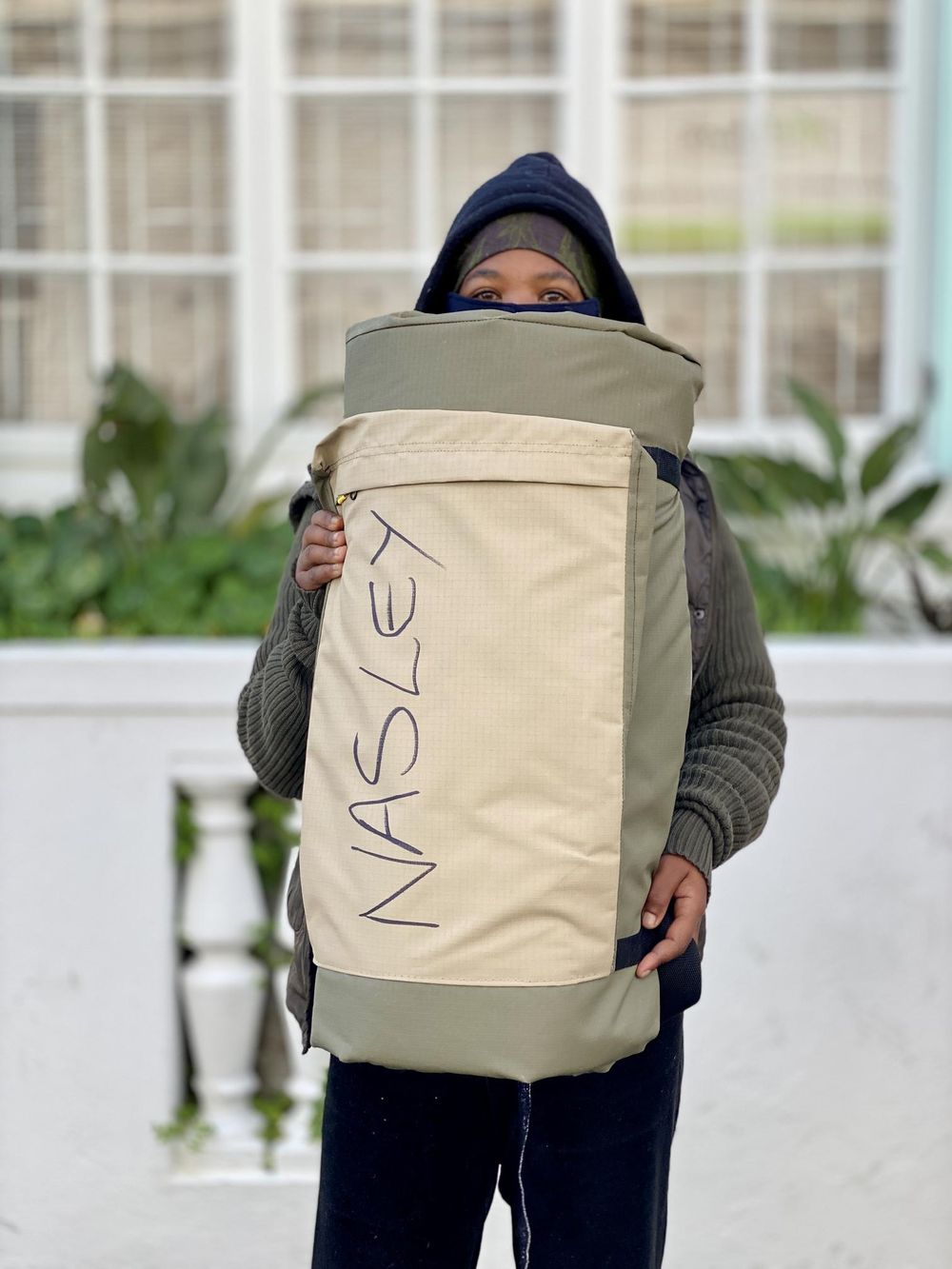
More than emergency shelter: The durable Ripstop Shelterbag rolls into a lightweight, portable duffel bag built for daily mobility.
A Cape Town-based non-profit organisation is producing weatherproof Shelterbags for people who sleep outdoors, while creating jobs and business opportunities for women in the Western Cape.
The Shelterbag is a South African adaptation of the Sheltersuit, a protective garment developed by Dutch fashion designer Bas Timmer after the father of a friend died of hypothermia while sleeping on the streets of Enschede in 2014.
Unlike the original Sheltersuit, which combines a waterproof jacket with a zip-on sleeping bag, the Shelterbag is designed as a portable sleeping system.
It includes an insulated mattress, attached hood, storage space and a carry pack.
When Timmer later brought his advocacy to South Africa, he met Lyn Render, a local Rotary Club member with three decades of experience in corporate data analytics and community development.
Their meeting led to the launch of the Sheltersuit South Africa Foundation.
In 2021, the foundation became a registered NPO, operating as a non-profit organisation in the Western Cape.
The South African foundation adapted the concept into the Shelterbag, a waterproof sleeping system designed for people living on the streets and others who sleep outdoors.
“He’s been to Cape Town several times, and I’ve been to the Netherlands several times,” Render says of Timmer. “He’s a crazy, mad dude. He is full of life and is just so creative.”
For Render, it was not only Timmer’s energy that stood out, but also the organisation’s operating model.
“The energy of the company really is phenomenal, in the way that it is a business for purpose, which is a fantastic combination,” she says.
Seeing an opportunity to adapt the model locally, Render made Timmer a direct proposal.
“I said, listen, what you are doing in the Netherlands, we can do in South Africa, and we can help you to distribute throughout the world,” she says.
The foundation’s work comes as South Africa continues to grapple with homelessness and housing insecurity.
Render says she encountered stigma when approaching corporate social investment departments to fund the factory.
“I was told, ‘You can use the money in your foundation, but we do not want to be connected to homelessness,’ and it deeply broke my heart,” she says.
R1,000 manufactures one life-saving Shelterbag. A look at finished units stacked and ready to bring warmth to local communities.
Producing a Shelterbag is not a makeshift operation. The process resembles a commercial manufacturing line.
“Much like when they produce a car, it goes through an assembly line,” Render says.
Creating one bag requires the cutting of 45 separate pieces. Once cut, the pieces move from one workstation to the next.
One machinist constructs the hood, another sews in the fleece liner, and a third attaches the completed hood to the main body of the bag.
The seams are then finished before the final machinist installs the drawstrings and labels.
The factory does not rely on a single quality-control inspector at the end of the production line. Instead, each machinist checks the work completed at the previous station.
The end result is what Render calls a “sleeping bag on steroids”.
The foundation says the bags cost about R1,000 to manufacture and are designed for long-term use.
The durable Ripstop Shelterbag rolls into a lightweight, shoulder-slung duffel bag, offering portable shelter for people living outdoors.
The production team is women-led, with many workers bringing experience in textiles, sewing and craft.
Some had been out of the workforce for between 15 and 20 years. When the foundation launched, an initial group of 30 women joined as trainees.
Render also recruited experienced machinists, including women who were between 60 and 65 when they started and who continued working into their seventies.
“These women could have just sat back and done nothing,” she says. “When we went to them, they said, ‘We’d love to be part of this. This is a beautiful journey that we’d love to be part of because we love this product’.”
The foundation’s employment model has also developed into a pathway to independent business ownership.
Render recently helped the factory’s chief supervisor, Dorothy, move from being an employee to running her own manufacturing company.
Dorothy registered her business and now produces batches of Shelterbags for the foundation when orders are placed.
“She’s gone from earning a salary to being a business owner,” Render says. "To me, that is the greatest measure of success. You take somebody from employment to self-employment to business owner, and eventually, I’m going to teach you to become an investor."
Cape Town’s winter weather can bring persistent rain, cold temperatures and strong winds. For people sleeping outdoors, staying dry is often as important as staying warm.
Render says that "ordinary donated blankets can become waterlogged during storms and lose their insulating value".
“How many people do we walk past every day who are sleeping on the streets at night, or knock on a person’s door to ask for a blanket in winter?” she asks. “A wet blanket is a waste of resources. It just makes that person even more hopeless.”
The Shelterbag is made from heavy-duty Ripstop fabric, which the foundation says is intended to provide protection from rain and wind.
“They’re fully waterproof. They’re fully windproof,” Render says.
Distribution of Shelterbags. Distribution sites are kept anonymous, as a cause of the local community not supporting the practice of donating Shelterbags in certain areas.
Shelterbag South Africa supplies bags to Working on Fire crews and anti-poaching units whose members sleep outdoors.
The Cape Town hub also exports bags to Australia and New Zealand, as well as to disaster-affected areas in Ukraine and Poland, according to the foundation.
The organisation says its Australian partnership operates on a sustainable-margin model.
Render says that the foundation’s focus remains South Africa, particularly the role Shelterbags could play in supporting social workers.
Instead of approaching a vulnerable person with little more than a clipboard, she believes a social worker carrying a Shelterbag can offer immediate practical assistance.
“You can have a Shelterbag with you and say, ‘Here’s a Shelterbag for you. It’ll keep you warm. It’ll keep you dry. I’ll see you next week’,” Render says. “That will create a different relationship with the person.”
A Shelterbag cannot replace permanent housing, shelter services or long-term support. What it can do is provide temporary protection while organisations work with people facing housing inequality and displacement.
Field testing: An Operations Manager from Working on Fire tests the Shelterbag sleeping system before deployment to outdoor crews.
For Render, the project represents both emergency relief and economic opportunity.
“If we sit back and wait for the Union Buildings to make decisions that are going to improve our lives, the next generation are going to experience what I’ve experienced, what my parents have experienced and what my grandparents have experienced with poverty,” she says.
“We need to find a different way to do this.”
The founding team of local machinists and trainees who launched the Sheltersuit South Africa Foundation production line in the Western Cape.


