How street bystanders view the 54th Martial Law commemoration protest - Rappler
Already have Rappler+? Sign in to listen to groundbreaking journalism.
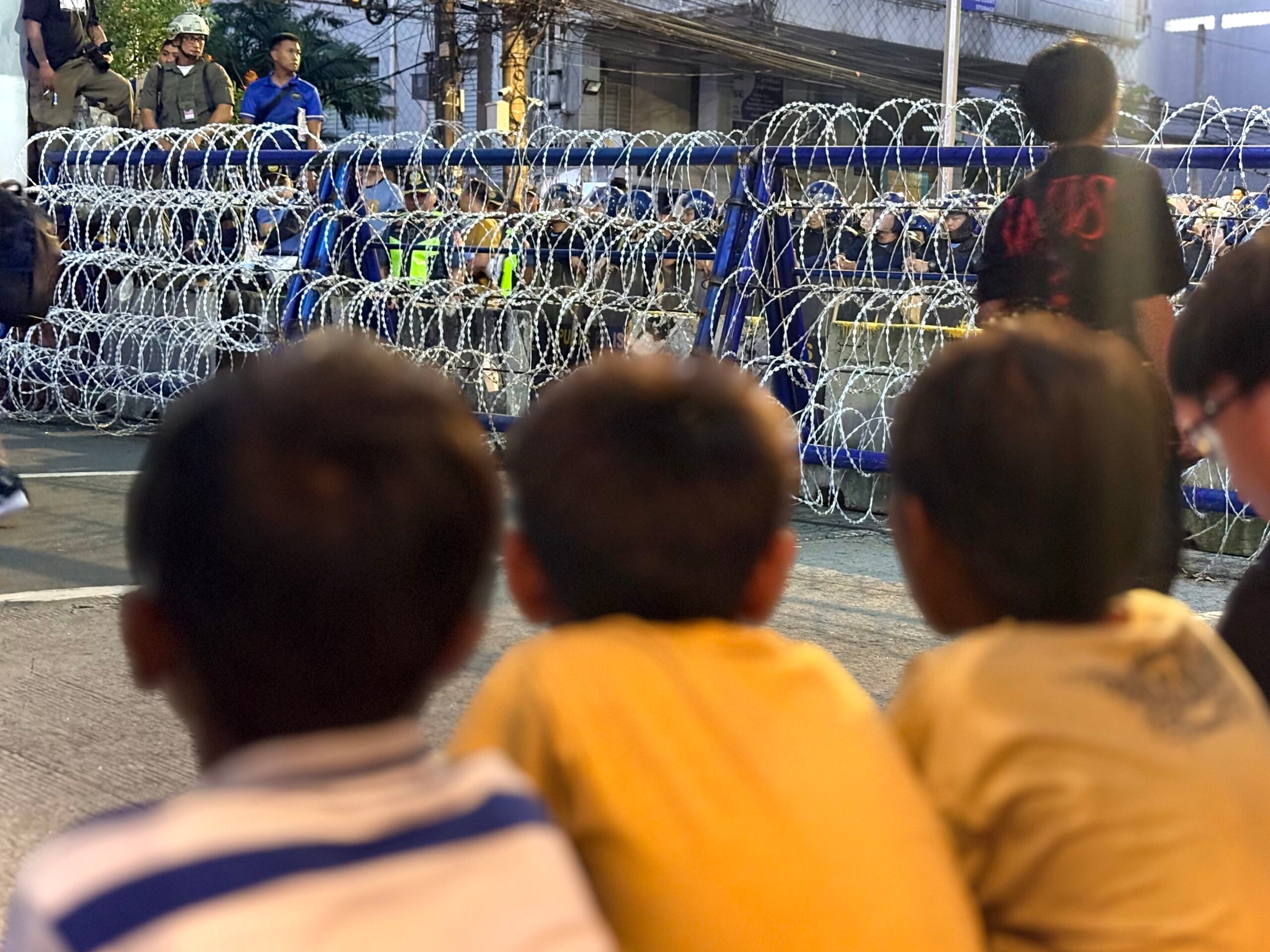
STREETS TURNED CLASSROOM. Three young boys sit on the sidewalk and quietly observe a Martial Law commemoration rally along Mendiola in Manila on September 21.
This is AI-generated. Read the article for full context. Report any errors.
MANILA, Philippines — “Mga korap, pahirap sa bayan!” (Corrupt people are a burden to the nation!)This phrase echoed down Mendiola on Monday, September 21. But one of the voices who kept repeating it did not come from the organized lines of protesters, but from 11-year-old Dwin (not his real name), who picked up the phrase from the crowd.
Dwin came along with his two other friends, 11-year-old Fred and nine-year-old Ken (not their real names). The three were among the everyday bystanders who witnessed the 54th anniversary of Martial Law commemoration in Manila, where groups and individuals marched toward historic Mendiola to call for government accountability and action.
The demonstrations came amid national issues, including the flood control scandal, Pax Silica, education budget cuts, and rising oil prices.
But for those who live, work, or simply pass through the streets where rallies take place, the demonstrations can have meanings that extend beyond these protest calls.
Along the march, people of different ages and backgrounds gathered along the streets to watch the mobilization.
While some children walked hand-in-hand with their parents, others wandered over simply out of curiosity and search for “something to watch” during their playtime just like Dwin, Ken, and Fred.
“We saw there were many people, so we got excited and decided to watch. It is not our first time, but we only watch occasionally,” Dwin said in Filipino when asked why they were there.Their spontaneous walk quickly turned into an unexpected learning experience for them.
Aside from public awareness, vendors on the streets also welcome rallies due to the heavy foot traffic.
For 24-year-old water vendor Leonardo Tamayo, who has been selling in Manila for years, rallies mean an increase in his daily income.
“We are okay with rallies because we get to sell our products. Water is essential, and people naturally buy when crowds gather under the heat,” Tamayo explained in Filipino.
He and his fellow vendors followed the crowd from Liwasang Bonifacio to Mendiola just to sell.
Tamayo, however, admitted that he does not keep track of every specific call during the rally, choosing instead to focus on making a living. Still, he said he respects the cause, pointing out that working-class sectors like transport workers are fighting for survival, much like he is.
Transport groups like PISTON joined the rally, taking to the streets to reiterate their demands, particularly regarding the recent oil price hikes driven by global issues.
Starting Tuesday, September 22, just a day after the rally, fuel prices were set to increase again.A few steps away, local shop worker Ray (not his real name) watched the scene unfold from behind his storefront counter.While he acknowledged that the event brought a surge in foot traffic, he clarified that his political leanings might not align with the calls of the rally.
For Ray, watching from a distance is simply part of a normal business day — one that, fortunately for him, yields positive sales.
For older bystanders like tricycle driver Ariel Makirang, this year’s rally was safer and calmer compared to the history of rallies in Mendiola.Mendiola has long been a witness to violence, including the 2025 Martial Law commemoration rally where one person was killed, and several were injured and arrested, as well as the Battle of Mendiola in 1970 and the Mendiola Massacre in 1987.
Makirang, who has been driving for three decades, recalled having to pull his vehicle to the side during the 2025 event when sudden chases and clashes broke out. This time, Ariel said he watched comfortably while parked on his tricycle right in front of the mobilization.He noted that he prefers to watch from a distance because joining is exhausting. He also observed how access has changed over time, whereas protesters could once surge forward freely in Mendiola when there were no barricades.
Now, police forces maintain a structured perimeter.
Despite keeping his distance, Makirang expressed support for the cause, noting that he agrees with many of the advocacies raised by the group.
“What they are shouting is true… but unlike before, there is no chaos today,” Makirang shared in Filipino.
Ahead of the September 21 rallies, Palace Press Officer Claire Castro appealed in a press briefing on September 16 for an orderly demonstration.Even from a distance, the message — whatever it may be — still reaches bystanders like Makirang. –Rappler.com
Lyndee Buenagua is a journalist who primarily covers Bicol and Baguio City. She is also an alumna of Aries Rufo Journalism Fellowship of Rappler for 2024 and a MovePH intern.