How Trump’s New Greenland Security Deal Compares to 1951 Defense Treaty - Newsweek
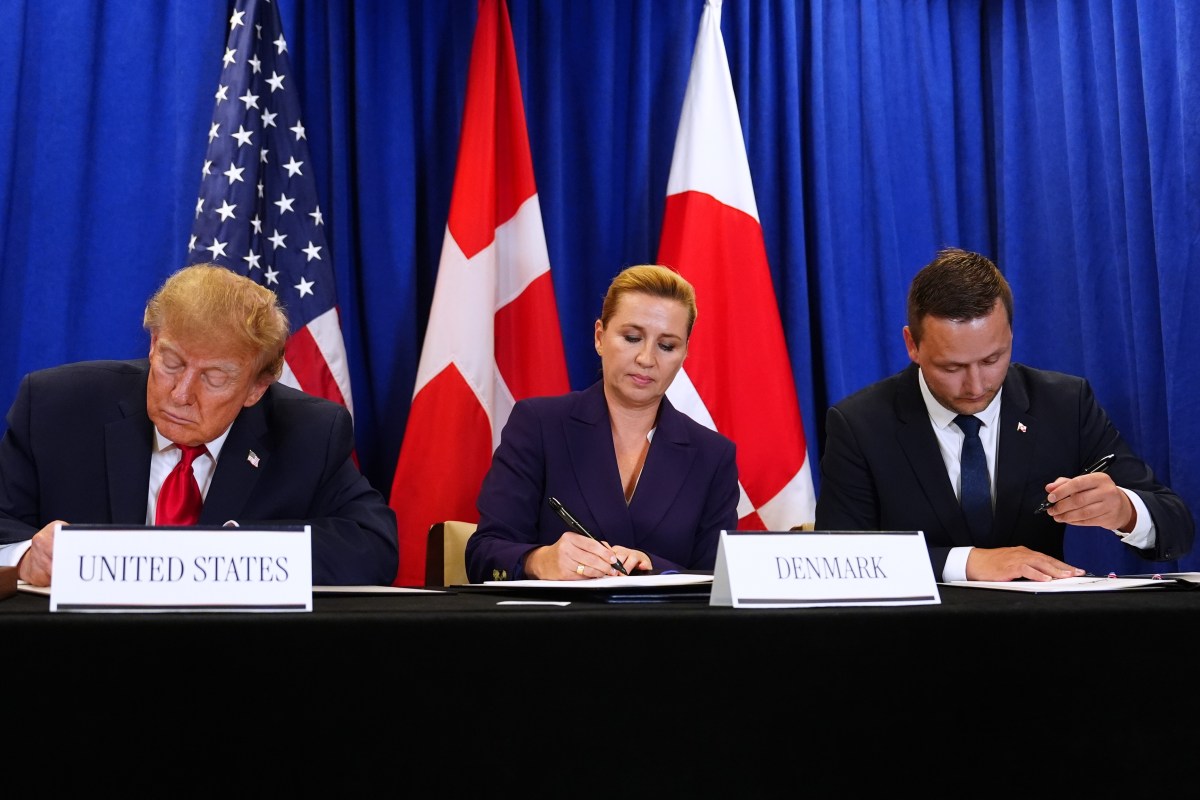
President Donald Trump has signed a new security agreement with Denmark and Greenland that expands the U.S. military presence on the Arctic island, building on a defense treaty that has governed American military access there for 75 years.
The agreement, signed Tuesday on the sidelines of the United Nations General Assembly in New York, adds new American defense sites and gives Washington a long-term role in Greenland's security. Unlike the 1951 U.S.-Danish Defense Agreement, the pact also includes Greenland and grants the U.S. veto power on certain sensitive foreign investments in the region.
The security deal follows months of tension over Trump's demand that the United States acquire the territory.
Trump described the agreement in his U.N. speech as giving the United States "permanent control over security and all other needs" in Greenland.
"No U.S. adversary will ever be permitted to establish a military presence in Greenland any more, or make sensitive investments there without our express written approval," he continued. The president also announced that the U.S. would build two "very major military bases" on the Arctic island, which remains under Danish control.
Denmark has said the arrangement recognizes the sovereignty and territorial integrity of the Kingdom of Denmark and the Greenlandic people's right to self-determination, while giving Washington a larger military role in Greenland.
The original U.S.-Danish Defense Agreement was signed in 1951 as part of the NATO security framework.
It allowed the United States to establish defense areas in Greenland and gave American forces extensive rights to build and operate military facilities, station personnel and conduct military activities within those areas. The treaty also preserved Danish sovereignty over Greenland.
The United States eventually operated numerous military installations across the island during the Cold War. At its height, the American presence included 17 installations and more than 10,000 personnel. Today, the U.S. presence is centered on Pituffik Space Base in northwestern Greenland, where roughly 150 American military personnel are stationed.
The 1951 agreement was amended in 2004, bringing Greenland's Home Rule government into the defense arrangement.
The most visible change will be the expansion of American military infrastructure. The United States plans to reopen Narsarsuaq, a former Cold War-era American base in southern Greenland, and establish a military presence at Mestersvig on the island's east coast.
Narsarsuaq was once home to the U.S. base known as Bluie West One, which the American military closed in the 1950s. Mestersvig is currently used by Denmark's Sirius Dog Sled Patrol, a Danish special forces unit.
Trump told the U.N. General Assembly that the United States would "immediately begin the process" of developing a larger military presence. "We will be building two very major military bases," he added.
The agreement also allows the United States to expand operations at Pituffik and permits the establishment of a Golden Dome missile-defense system in Greenland. The United States also already has a substantial long-term maintenance commitment at Pituffik. A Defense Department contract awarded to Greenlandic company Inuksuk A/S in 2023 was valued at up to $3.95 billion over the life of the contract, through 2034, for operating and maintaining the base.
The agreement also blocks non-NATO countries from establishing a military presence in Greenland. That provision is significant because the Arctic has become an increasingly important area of competition involving the United States, Russia and China.
The new arrangement therefore goes beyond simply adding American troops. It establishes a framework intended to prevent rival powers from gaining military or strategic footholds in Greenland.
Trump used his U.N. speech to frame the agreement as a direct response to what he described as threats from other powers.
Trump has said the agreement would come at "NO COST to the United States."
However, the pact itself does not mean that expanding the U.S. military presence will be free for American taxpayers. The United States will have to pay for whatever American construction, personnel, equipment, transportation and operations the Pentagon undertakes unless those costs are shifted to Denmark, Greenland or other NATO partners.
There is no public dollar figure yet for the construction of the two new bases or the broader expansion.
Danish Prime Minister Mette Frederiksen presented the agreement as a security arrangement rather than a change in Greenland's sovereignty.
At the signing, Frederiksen said the deal could "last forever" and emphasized NATO's role in Arctic security. She also said the agreement respects Greenland's right to self-determination—a point that has been central to Denmark's position throughout the negotiations.
Even after Trump announced the deal on September 18, Danish officials stressed that the agreement would preserve Danish sovereignty and require parliamentary approval before going into effect.
Frederiksen had previously described the agreement as strengthening security for Greenland, Denmark, the United States, NATO and Europe.
She said, "The reason why we can conclude this agreement ... is that it is a matter of security policy."
Greenlandic Prime Minister Jens-Frederik Nielsen also emphasized NATO rather than American ownership.
"We believe that it is vital to keep NATO strong, also in the Arctic, where the alliance has a key role to play," Nielsen said at the signing.
Greenland's government had previously described the agreement as recognizing the island's interests and place in international cooperation.
Nielsen called the arrangement a "win-win-win" for Greenland, Denmark and the United States: Trump gets the expanded American military presence he has sought, Denmark retains sovereignty over Greenland, and Greenland gets a direct role in a security arrangement affecting its territory.
The new agreement is also designed to address a question that the 1951 treaty did not have to confront in the same way: Greenland's possible independence. The agreement is expected to remain in effect even if Greenland becomes independent, provided it remains within NATO.
The agreement brings a close to the tensions between the U.S. and Greenland, Denmark and other NATO members after Trump repeatedly threatened to take control of the Arctic island—with or without its consent.
In January, Trump said the United States would "do something on Greenland whether they like it or not," adding that Washington would pursue the island "either the nice way or the more difficult way."
Trump later said he was not ruling out economic or military pressure to achieve his objective.
Greenland's government consistently rejected the idea that its future could be decided by Washington. Nielsen said Greenland would not become part of the United States and stressed the island's right to determine its own future.
Denmark likewise insisted that Greenland was not for sale and that its sovereignty could not simply be transferred to another country. The dispute also became a problem for NATO.
NATO Secretary General Mark Rutte acknowledged the underlying U.S. security concerns about the Arctic, particularly the growing activity of Russia and China, while pushing the issue into an alliance framework. NATO subsequently increased its focus on Arctic security through its Arctic Sentry operation, involving the United States, Canada and European allies.
By the time negotiations produced the new agreement, the emphasis had shifted from whether the United States could take control of Greenland to how the United States, Denmark and Greenland could strengthen the island's defenses.
NATO now has a stronger U.S.-European security framework for the Arctic that does not concede to Washington's threats to make Greenland an American territory.
Contact Newsweek editors on this story: Samantha Beech and Shakeema Edwards.