How US and Canada Militaries Compare as Carney Says He Studied Invasion Risk - Newsweek
Canada's prime minister, Mark Carney, said Ottawa has examined the possibility of a U.S. military attack on Washington's northern neighbor after President Donald Trump repeatedly referred to Canada as the U.S.'s 51st state.
Trump has stewarded U.S.-Canadian relations to one of their worst ebbs in modern history, embroiling the two nations in a tumultuous trade war while Ottawa sidled closer to its European friends in NATO.
The Trump administration's frequent christening of Canada as the U.S.'s 51st state has been sharply criticized by Ottawa, as concerns over whether the U.S. would launch military action against fellow NATO member Denmark for control of Greenland forced American allies to re-evaluate whether the U.S. could turn its military might on them—a previously unfathomable prospect.
Carney, who has a strained relationship with Trump since sweeping to power on the back of anti-U.S. sentiment in March 2025, said during an interview with the New York Times he had prepared for the "extreme tail risk" the Trump administration could greenlight military action against Canada.
It would "be irresponsible not to," the Canadian leader added in the interview published on Wednesday.
Military planners are expected to prepare for a whole range of scenarios, including events they deem almost impossible or extremely unlikely.
In 1930, U.S. military strategists devised War Plan Red, which plotted targets in Canada the U.S. could strike during a hypothetical conflict with the U.K. Then, in January this year, the Globe and Mail, a Canadian newspaper, reported the Canadian military had modeled a U.S. invasion of Canada—and how Ottawa would respond—for the first time in a century.
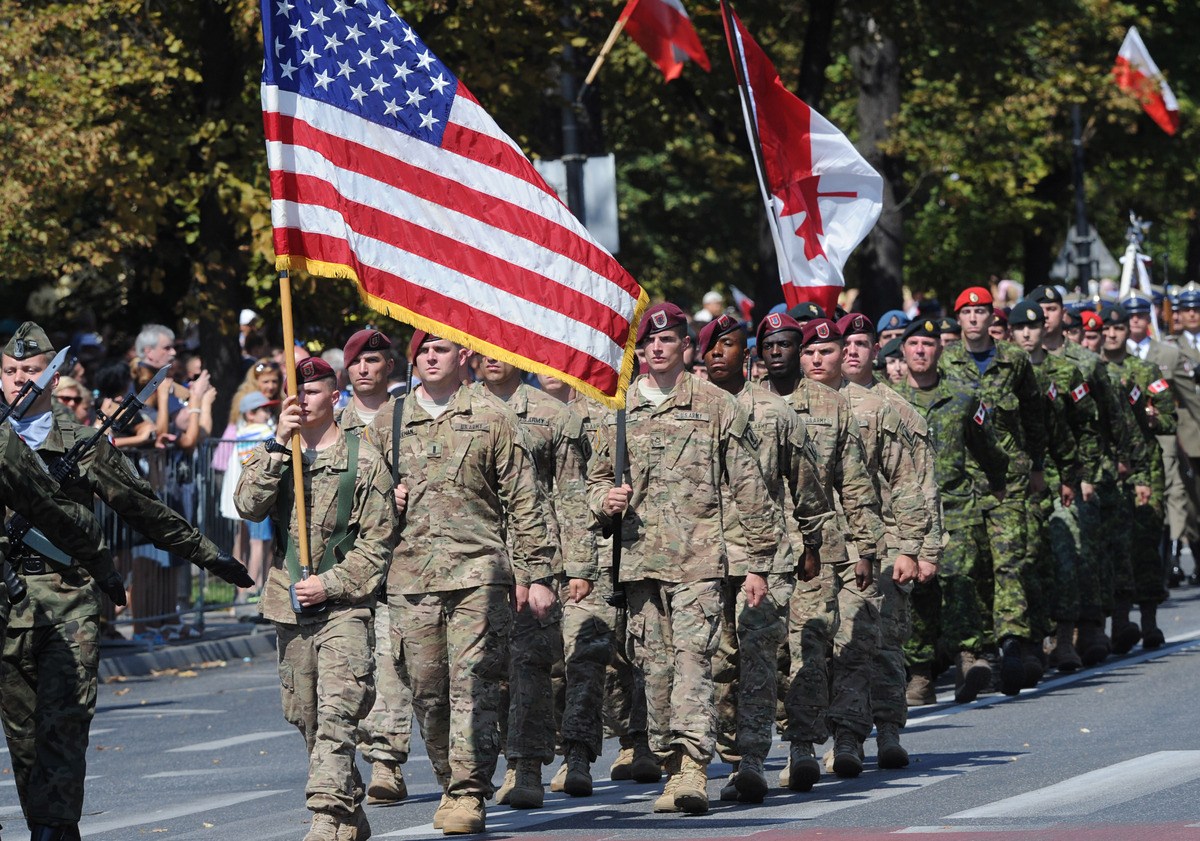
The Canadian military is closely enmeshed with the U.S. armed forces. Canada operates American-made equipment, while Ottawa and Washington are both part of the Five Eyes intelligence network for information sharing.
The two bordering countries even have a binational command: The North American Aerospace Defense Command (NORAD). Among its responsibilities, NORAD is tasked with making sure no long-range ballistic missiles from countries like Russia can reach North America.
But the U.S. military dwarfs Canada's. While the U.S. aims to make its presence felt across the world with its vast footprint, Canada's armed forces are geared more toward defending Canadian territory and contributing to NATO missions.
The U.S. is the world's largest military spender, and the White House has asked Congress to boost this further to reach $1.5 trillion in defense expenditure for the 2027 fiscal year—a further surge of nearly 50 percent.
Canada, meanwhile, has been criticized by the U.S. for its low defense spending and an overreliance on U.S. forces, as have many European members of NATO.
NATO nations, including Canada, committed last year to dedicate 5 percent of their gross domestic product (GDP) to defense by 2035 after sustained pressure to surge military spending from the U.S.
Carney said in May Canada expected to spend 4 percent of its GDP on defense by the end of this decade. NATO statistics show Canada is expected to spend around 2.13 percent of its GDP on the military in 2026.
The U.S. is also a major nuclear power, unlike Canada. The U.S. can launch nuclear weapons at any target in the world from land, sea or air, but Ottawa neither develops nor hosts any nuclear weapons.
While Canada cultivates elite special forces, the U.S. has a much larger pool of special forces to pull from for its military operations.
At the end of 2025, Canada had just over 63,000 active-duty personnel, according to numbers from the U.K.-based International Institute for Strategic Studies (IISS).
Just over 28,000 of these personnel were in the army, followed by just under 16,000 listed under the Royal Canadian Air Force, and 8,400 sailors in the Navy. Another 28,600 are registered as reservists.
Canadian government figures from the end of July 2026 said its regular forces had 68,473 members, falling just over 3,000 people short of its "authorized strength of 71,500."
U.S. military databases show that there were 1,318,300 active-duty U.S. military personnel in the U.S. Army, Marine Corps, Navy, Air Force and Space Force as of July 31, 2026. Another 44,000 make up the U.S. Coast Guard.
The U.S. Air Force comprises 324,683 active-duty members, according to publicly-available information published by the Pentagon.
The IISS numbers show Canada had just over 100 combat-capable aircraft at the end of 2025, including 89 fighter jets designed to attack targets on the ground. Canada's main fighter jet is its adapted version of the American F/A-18 Hornet.
But Ottawa is currently buying up to 88 U.S.-manufactured F-35 fighter jets from the U.S., although the deal was thrown into jeopardy last year as the Canadian government said it was reviewing whether purchasing its entire new fleet from the U.S. was the best security move for the country. It's still not clear whether Ottawa will buy all 88 F-35s or instead opt for another, non-American aircraft.
F-35s are fifth-generation jets, the most advanced set of fighter aircraft currently in use. There's no real alternative to the Lockheed Martin-made F-35 for Western militaries looking for fifth-generation jets.
The U.S. Air Force, meanwhile, already operates two types of fifth-generation jets: the F-35 and the F-22.
Overall, the U.S. Air Force had an estimated 1,435 combat-capable aircraft of all types at the end of 2025. Of these, roughly 165 of these were F-22s, and nearly 400 were F-35s.
Both the U.S. and Canada are looking at possible sixth-generation jets, which will be harder to detect, able to travel longer distances, make heavy use of drones and carry weapons that can be launched at targets further away.
While the U.S. is developing its own sixth-generation jets, and has indicated it would sell them to allies, Canada said in July it was instead becoming the first "observer nation" to the joint British, Japanese and Italian competitor program.
These jets are expected to come into service from roughly ten years' time.
Canada doesn't have a dedicated Space Force comparable to the U.S. Space Force. Instead, its space arm is built into the broader air force.
Little over 10,000 U.S. active-duty personnel make up the U.S. Space Force, but it has attracted increasing attention over plans for the U.S. to build a so-called "Golden Dome" missile defense shield, while the U.S. acknowledged for the first time this month it had deployed weapons in space. Top U.S. officials have pledged to double the size of the Space Force over the next five years.
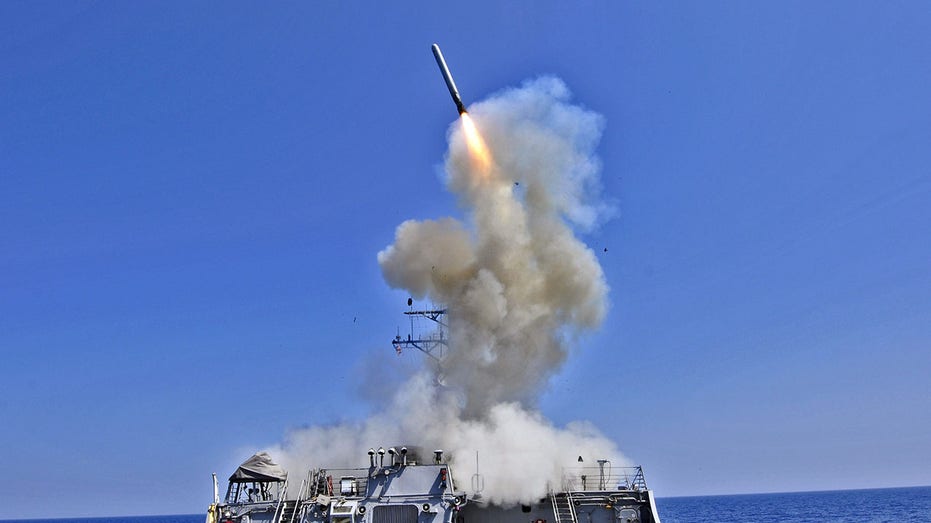
The U.S. Navy is a formidable power, with a total of 64 submarines—including 14 capable of launching nuclear weapons—and 11 aircraft carriers. Canada's navy currently doesn't have any aircraft carriers.
The U.S. also has nine cruisers that launch guided missiles, and 74 destroyers. It has more than 100 patrol ships and dozens of amphibious ships, capable of transporting thousands of troops and heavy equipment, like tanks, for land attacks.
The Canadian Navy has 12 frigates, five ships classified as patrol or coastal combatant vessels and four submarines—although the Canadian government has said just one of these submarines is seaworthy. In July, Ottawa announced it would buy 12 new submarines in the biggest defense procurement deal in Canada's history.
But the U.S. Navy is overstretched, despite Trump administration pledges to beef up U.S. naval power.
U.S. Navy ships are frequently taking on longer deployments as the service is pressured by commitments and operations around the globe. This follows years of delays in American shipyards tasked with churning out new vessels, as well as ballooning costs of new ships and a shortage of skilled workers to carry out construction and maintenance.
Fresh attention was piled on whether the U.S. Navy can sustain its operations abroad as the USS Abraham Lincoln aircraft carrier forged on with a record-breaking and repeatedly-extended deployment as it backed up U.S. forces in the Middle East from January this year.
The Lincoln, and the thousands of sailors and Marines traveling with the ship, made a brief port call in Thailand earlier this month ahead of its return to the U.S. amid concerns over living standards, supplies, and reports of plummeting mental health among service members aboard the carrier.
The U.S. Army is the largest branch of the U.S. military, and has the equipment to match. The U.S. Army has more than 2,600 main battle tanks, namely different variants of the M1 Abrams, and thousands of its Bradley infantry fighting vehicles, according to the IISS.
Some vehicles are in storage, and it's not always clear how many would be immediately ready for deployment in a conflict zone or for drills.
Canada's inventory featured 74 main battle tanks at the end of 2025, including 20 German-made Leopard 2A6M, according to the IISS numbers.