How workers' wage protest threatens Bangladesh's $40 bn garment industry
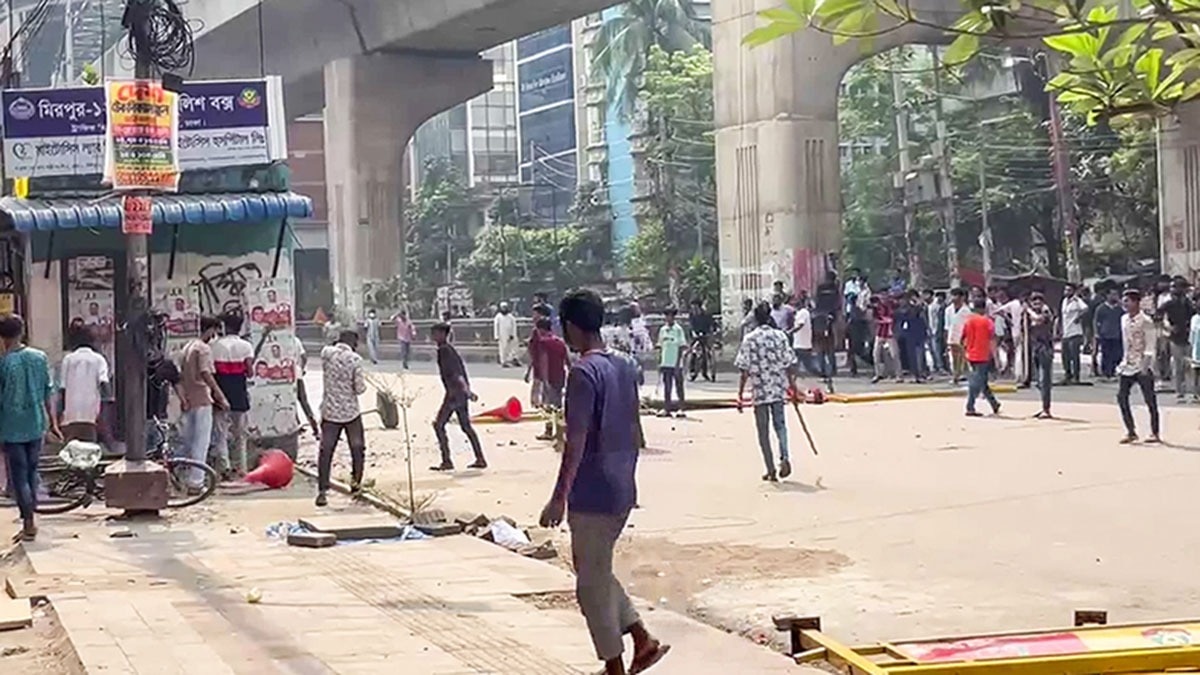
The Bangladesh economy is likely to take a hit after hundreds of garment factories were forced to suspend operations as workers continued to take to the streets demanding higher wages.
According to reports in Bangladesh’s leading Bengali daily Prothom Alo, operations were suspended in 414 factories across Gazipur and Savar in Dhaka district. Some other estimates suggest that the number could have risen to 500-600 factories. The protests turned violent, with reports of intense clashes between police and protesters and incidents of vandalism in Gazipur, Mirpur and Savar.
At least one worker, 21-year-old Toufiq Sheikh (also reported as Toufiq Hossain) of Laila Garments, died from severe injuries after being attacked while filming vandalism during wage protests in Gazipur, according to reports.
The nearly $40 billion readymade garment (RMG) industry, which accounts for roughly 80-84 per cent of Bangladesh's total export earnings, contributed 8.5 per cent to the country's nominal Gross Domestic Product (GDP) in FY25, according to Bangladesh Bank's quarterly review. It sustains around four million workers.
On November 3, the fourth day of protests demanding a hike in minimum wages from Tk 12,500 to Tk 30,000, protesters obstructed the Dhaka-Tangail highway. On November 1, the Bangladesh government had constituted a wage board to review garment workers' pay and urged employees to return to work.According to workers, their demand stems from the severe inflation that has hit the country. “How are we supposed to run our families with such paltry wages when the cost of living has skyrocketed,” said Mahin Hossain, a protesting worker.
As of September, the country's point-to-point annual inflation stood at 8.34 per cent, slightly higher than the 8.26 per cent recorded in August. While lower vegetable prices helped keep inflation in food and non-alcoholic beverages at 7.22 per cent, protein-rich foods and daily essentials remained costly. Additionally, higher energy and fuel prices kept non-food inflation elevated at 9.22 per cent.
The government has constituted a six-member Minimum Wage Board, following which it urged workers to return to work. The board includes representatives of employers and workers, with Babul Akhter appointed as the workers' representative. The board has announced that it will finalise a new wage structure by December and that will come into effect from January. However, it has done little to put an end to the protests.
Factory owners have sought stronger security guarantees from the home ministry while workers' representatives have demanded an early meeting of the board and assurances that workers will not face harassment or arbitrary arrests for participating in the agitation.
The demand for a nearly 140 per cent increase in the existing minimum wage, however, has also raised concerns about its economic feasibility. “From Tk 12,500 to Tk 30,000 is a ridiculous ask,” said Ahsan Mansur, former governor of Bangladesh Bank, the country's central bank. “If this demand is admitted by the government, it would be an economic blunder. Some middle ground needs to be reached through tripartite meetings.”
Mansur pointed out that the former Awami League government had, at one point, considered a mechanism for increasing minimum wages by a cumulative 13-14 per cent every year. “That is impractical. Such hikes impact the economy adversely,” Mansur said.
The timing of the agitation is particularly significant for an industry that depends heavily on international orders and tightly scheduled production cycles. The current disruption comes at a critical point in the production cycle for spring and summer export orders. Bangladesh is a major supplier to global fashion retailers, including H&M, Zara, Walmart and Primark. A prolonged disruption could prompt international buyers to reconsider their sourcing arrangements or shift orders to competing manufacturing destinations.
Industry sources have also expressed concern about their ability to meet bank repayment obligations and pay workers if the closures continue. The Bangladesh Garment Manufacturers and Exporters Association (BGMEA) has warned that factories may be forced to invoke the ‘no work, no pay’ provision if production cannot resume.
According to Md Mohiuddin Rubel, former director of the BGMEA, it is too early to assess the extent of the economic damage. “But it is quite natural that the closure of a day's operation in any factory has its impact. However, if it is for a shorter number of days, the losses could be recovered,” Rubel said, adding that there has been no blanket shutdown of factories. “Factories in areas where clashes are erupting are being closed due to security reasons,” he said.
The demand for higher minimum wages is not new in Bangladesh. The country witnessed a similar, and equally violent, wave of garment workers' protests in November 2023, during the tenure of the Sheikh Hasina government. Four workers died during the agitation, three of them allegedly in police action and one in an arson incident. On November 7, following the recommendations of the wage board, the government revised the minimum monthly wage from Tk 8,000 to Tk 12,500, an increase by over 50 per cent.
The interim government led by Muhammad Yunus also attempted to address workers' grievances, although it stopped short of revising the basic minimum wage. In January 2025, it increased the annual wage increment for garment workers from 5 per cent to 9 per cent. The minimum monthly wage, however, remained at Tk 12,500.
The recurring protests point to a deeper structural problem in Bangladesh's garment economy: the widening gap between the country's dependence on low-cost manufacturing and the rising cost of sustaining the workforce that powers it. While manufacturers argue that a sharp increase in wages could compromise their ability to compete internationally, workers contend that the existing wage structure has become increasingly inadequate in the face of inflation.
The Awami League and its leaders have been projecting these protests and the police action against them as the failure of the Bangladesh Nationalist Party government. For the government, the challenge is to negotiate a settlement that does not drive manufacturers away or push workers further into economic distress. A prolonged confrontation could prove costly for both. Workers stand to lose their daily earnings, while factory owners risk losing production, export orders and, eventually, the confidence of international buyers.
Arkamoy Datta Majumdar is an Assistant Editor with India Today magazine, based in Kolkata. He writes about politics, international relationship, football, and society, with a particular focus on eastern India and the political transformation of West Bengal. He oversees the editorial operations in the eastern states of West Bengal, Odisha and Sikkim.
His reporting sits at the intersection of politics and everyday life. He covers elections and political parties, governance and public policy, political movements, identity and cultural politics, federalism, border issues and the changing relationship between the state and its citizens. In West Bengal, his work has closely followed the rise of the BJP, the evolution of the Trinamool Congress, the Left and Congress, electoral politics, voter-list and citizenship questions, welfare politics and the ways in which political competition increasingly plays out through culture, religion, education and public institutions. He has covered the crucial Bangladesh elections of 2026 from Dhaka.
He also follows the wider politics of the eastern region, particularly where questions of borders, migration, regional identity, security and diplomacy intersect with domestic politics.
For Arkamoy, political journalism is as much about understanding people and places as it is about following politicians. He is interested in what happens between an announcement and its implementation, between a political slogan and its impact on the ground, and in the quieter social and cultural shifts that often reveal where politics is heading.