Humans and Algorithms - The Express Tribune
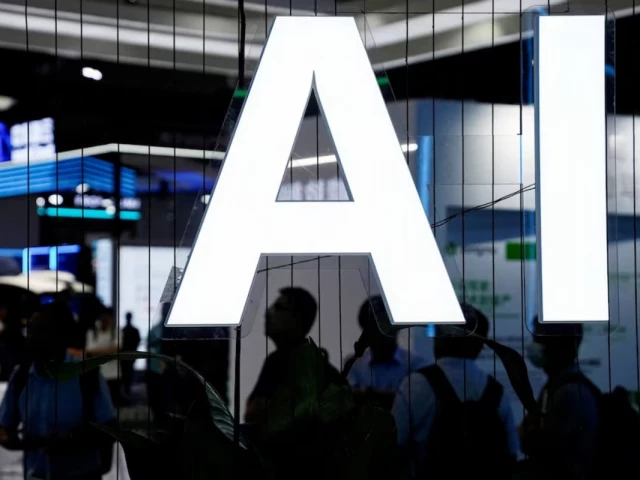
An AI (Artificial Intelligence) sign is seen at the World Artificial Intelligence Conference (WAIC) in Shanghai, China. REUTERS
What if I tell you that I have used Artificial Intelligence to draft this article? Would you take out your precious time to read it? The answer is yes! Because today, AI is the new hero. It has made it easier for us to complete our tasks but has made it difficult for us to think. Indeed! We do not think anymore, but outsource thinking, outsource ideas, and outsource research to this software. Such everyday tasks, and completing them through AI without challenging its conclusions, still feels like an accomplishment, while satisfying our inner selves; it subsequently pushes us into a whirlpool of Dependency. Our ancestors might have imagined this age, while scribbling through works of Science Fiction. Which, well-nigh at every instance, covertly criticised such rapid and unharnessed technological advancements. All that stuff which startled us to the core, be it robots taking over the world, humans killing self-improving machines, or extremely intimidating surveillance societies. AI somehow lays a similar, more familiar perception as it has both muscles and a brain. A brain which is simply lethal when controlled by some selfish group of humans.
To support the latter thesis, I would like to quote a Cambridge Professor, Michael Barrett, “AI will only be as good or as bad as the information fed into it.” The fundamental question is whether Pakistan possesses a clear and concrete statutory framework capable enough to regulate and harness such rapid growth of Artificial Intelligence? Apart from Nation Artificial Intelligence Policy, it has nothing on the table. This regulatory vacuum is profoundly alarming, Especially, when AI researchers like Jacob Coxon publicly warn that unchecked AI is ‘gambling with our lives.’
Every day our educational system grows more reliant on AI. From classroom interactive learning to homework completion, students are using it at every step. What does it bring to them? Nothing but destruction. Although the words may seem harsh but are unfortunately true. Cognitive development is a vast subject. A child’s cognitive growth is multi-factorial; a plethora of things contribute to shaping it. A student cultivates vital skills like multi-tasking, problem-solving, and critical thinking by constantly questioning, researching, and learning from failures. Let’s take an example of JK Rowling, a distinguished literary figure. She wrote Harry Potter out of her true imagination; she kept herself indulged in research and thinking for ages before producing the first draft of the book. Her literary skill set is based on years of reading and analysis of fiction. Her extraordinary piece of work epitomises the value of critical thinking, analysis, and creativity, which over-interaction with machines discourages in young minds. Are we even asking ourselves why these societies are no longer producing a Mirza Ghalib or Allama Iqbal in the East, or a J.K. Rowling or Shakespeare in the West? Why do we not see any student criticising political ideas through their own peculiar but well-thought political philosophy at the corners of streets? The answer is straightforward: we are too distracted by the digital toys billion-dollar industries have given us to play with.
Especially in a country like Pakistan where the education system is already bifurcated and non-uniform, such irresponsible and unchecked use of Artificial Intelligence would only produce Circus Lions. Such lions would only perform at the crack of the whip but would never understand their true potential. According to Higher Education Policy Institute’s SGAI UK Survey 2026, 95% of students are using AI in their academic work. I am talking about a country that is one of the most powerful global economies, has made 63 National strategies and policies for AI, which include 24 Governance policies, and is spending tonnes of money to regulate Artificial Intelligence. It also has a zero-tolerance policy across UK universities to lower the usage of generative AI in assessments. Now think about Pakistan, where an already fragile education system is incubating a new menace – Jeopardising its entire nation. It is not Brain Drain; it is Brain restraint. Students making their entire assessments through AI, then humanising that text through AI, using chatbots for emotional support, and falling victim to AI hallucinations is understandably alarming. As we talked earlier, AI can be used to build narratives, monopolies, and may change human perspectives through its information. Biometric Categorisation and Predictive Policing are other concerns which are not the topic of discussion today but may impair our social structure in the future. EU AI Act 2024, a disruptive AI framework applying extraterritorially, strictly prohibits the latter through its Article 5.
The more AI gains power, the more it will stifle students' academic and intellectual prowess. Remember, we must cultivate mindsets, rather than outsource them. That is why the Pakistan government must move from Aspirational policies to legally binding frameworks. EU AI Act 2024 is exemplary in this regard. The government must enforce a uniform zero-tolerance policy across universities against the irresponsible usage of Generative AI. The policies should be governed by dedicated problem-specific institutions. Pakistan should also promote AI Literacy among students and instructors. There must be regular checks and balances on institutions and students; on the other hand, educational institutions must promote collaborative learning, research skills development, and ensure that students' cognitive development is in accordance with the laws of nature rather than the laws of machines. Government should also adopt a Risk-based regulatory approach against high-risk AI systems. Each AI product should be listed under distinct tiers and should be governed as per the risk it may pose. There should be parliamentary oversight over high-stakes institutions using AI in their systems.
Technological Development is not bad in its true essence but must not go unchecked in any era. As the great scientist Albert Einstein said, “The human spirit must prevail over technology.” We must keep this in mind if we aim for sustainable growth in an age of rapid technological developments.
The writer is an A-level student at Lahore Grammer School (Lahore).
Comments are moderated and generally will be posted if they are on-topic and not abusive.