Hundreds of US Troops Sent to Mexico Border Amid Alleged Cartel Violence - Newsweek
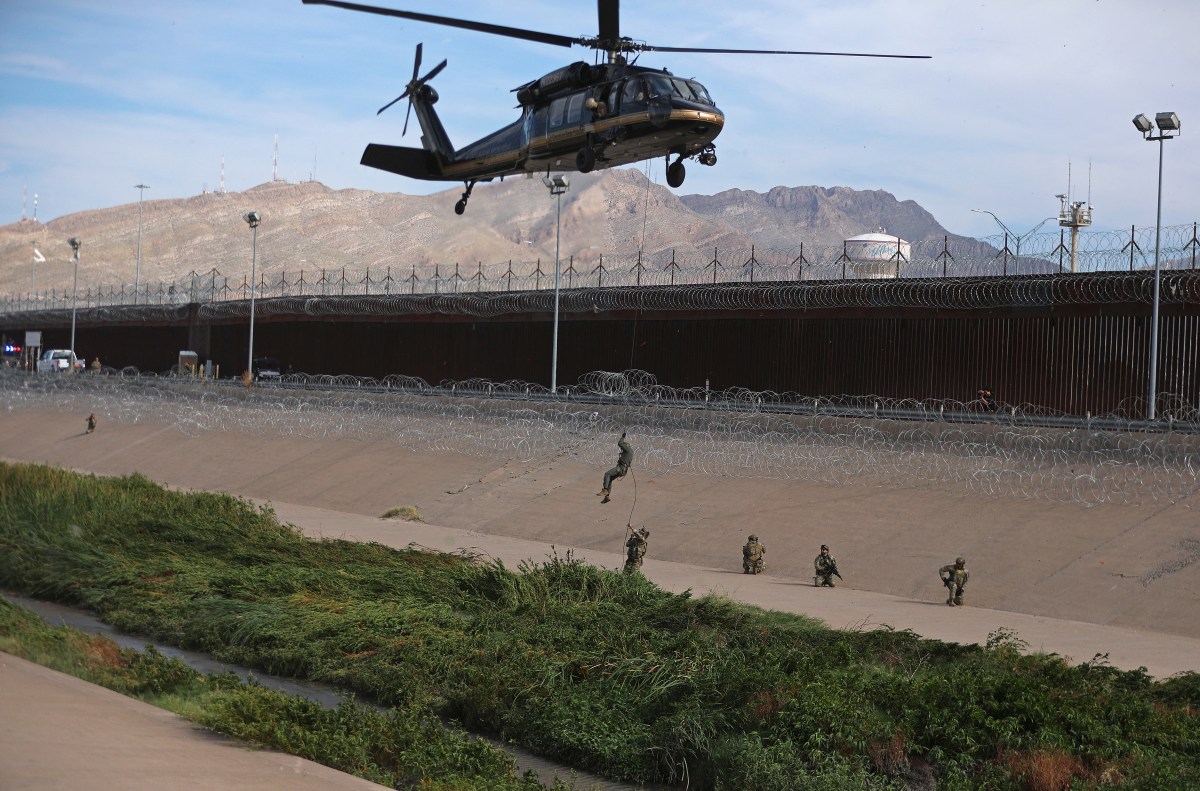
A new military operation that sent hundreds of troops to the Rio Grande Valley amid ongoing reports of cartel violence at the U.S.-Mexico border was confirmed to Newsweek on Friday.
The U.S. Northern Command said that Operation Unified Response was an effort to "rapidly reinforce" forces and federal agents working in the Rio Grande Valley in South Texas.
The operation is meant to "strengthen border security operations, increase the joint force’s ability to respond to threats and support federal law enforcement partners operating along the Rio Grande," a spokesperson for U.S. Northern Command said.
"Operation Unified Response will increase patrol capacity, reinforce key areas, provide additional monitoring and detections capabilities, and reinforce security of critical location in support of the Department of Homeland Security and U.S. Customs and Border Protection."
The increase in U.S. troops in the area comes after a shooting incident involving the U.S. Coast Guard near Garceno, Texas, on Saturday, which the U.S. Coast Guard confirmed to Newsweek on Friday.
Newsweek reached out to the Texas Military Department and Mexican President Claudia Sheinbaum for further comment Friday afternoon.
The troops were deployed Friday, the Northern Command spokesperson said.
"The operation is part of the ongoing Operation Ardent Vanguard, through which Joint Task Force-Southern Border continues to provide military capabilities in support of protecting U.S. sovereignty at the Southern Border," the spokesperson said.
According to NewsNation, the move was in part fueled by the reported shooting incident in which Coast Guard officers encountered gunfire from the border.
The Department of Homeland Security (DHS) confirmed the incident to Newsweek on Friday, with a spokesperson saying that the gunfire came while the Coast Guard was carrying out operations in the Rio Grande.
"The Coast Guard works closely with U.S. Border Patrol, the Department of War and the Texas Military Division to secure the border, disrupt illicit activity and protect the American people," the DHS spokesperson said. "We will continue to leverage a layered, integrated approach to control, secure and defend the border that strengthens our collective ability to counter illicit activity and safeguard our personnel and the communities we serve.
"Threats to Coast Guard members and our partners are taken extremely seriously. The circumstances surrounding the incident remain under investigation."
It was not immediately clear whether Mexican authorities were also involved in the latest operation.
The valley covers the South Texas border region, including the cities of Brownsville, McAllen, Mission, Rio Grande City and Roma, many of which sit directly across the border from Mexican cities.
Unlike remote stretches of the border elsewhere in Texas or in Arizona, many border communities sit directly across from cities that have experienced ongoing cartel conflict, including gunmen operating close to the river and the use of drones to attack Border Patrol and other U.S. forces.
The U.S. Border Patrol's Rio Grande sector covers roughly 320 river miles, with agents dealing with some of the busiest smuggling corridors on the entire southwest border.
Immigrant crossings have fluctuated dramatically in the region, but even when numbers have fallen, CBP has maintained that cartel-linked activity continues, including human smuggling, drug trafficking and surveillance of law enforcement.
One of the most prominent cartels operating in the area is the Gulf Cartel, which has historically had strongholds in Matamoros and Reynosa, directly across the border from Brownsville and McAllen.
While not as well-known as the Sinaloa or Jalisco New Generation cartels, the group has deep roots in northeastern Mexico and has been linked to human smuggling, drug trafficking, kidnapping, extortion and weapons trafficking.
The U.S. State Department designated the Gulf Cartel as a Foreign Terrorist Organization in 2025, along with several other groups, allowing the U.S. to take tougher action against members.
One of the biggest difficulties for U.S. and Mexican law enforcement is the ever-changing nature of where and how cartels operate. Texan and federal forces may shut down a particular trafficking route, only for another to be forged elsewhere along the border.
The Rio Grande Valley is also an attractive area for cartels to operate in due to its dense population—which allows cartel members and those they are smuggling to blend in—the extensive river frontage and the major cross-border trade infrastructure, such as the bridges in Brownsville, Hidalgo and elsewhere.
Contact Newsweek editors on this story: Gabe Whisnant and Dave Siminoff.