I had guts: Amala Paul on navigating sexualisation, stereotypes in film industry
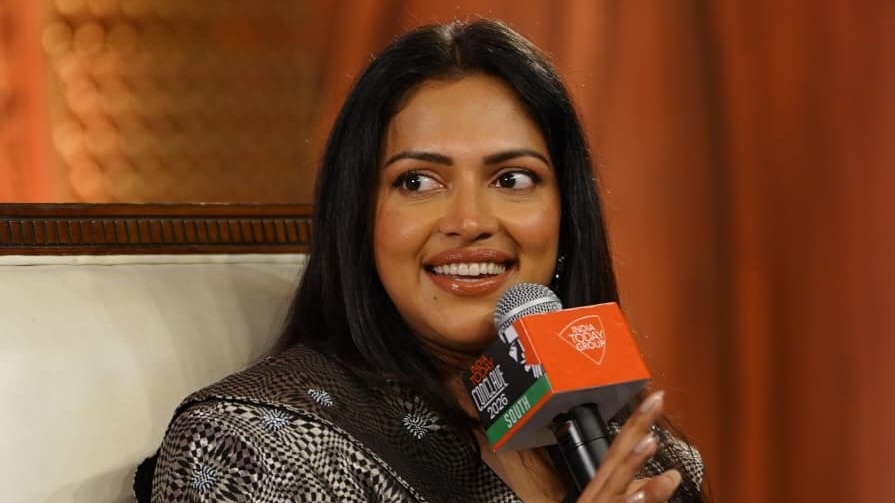
The easiest way for an actor to build a career can also be the most limiting one: find what works, repeat it and gradually become associated with a particular kind of role. Breaking that pattern requires a willingness to keep choosing the unfamiliar, even when it comes with the risk of alienating an audience or disrupting an established image. For Amala Paul, that instinct has been at the centre of her career, from Mynaa to the more unconventional choices she has made since.
At the India Today South Conclave 2026, Amala spoke about her approach to scripts, the need to break stereotypes and why she has never been particularly interested in repeating herself.
“You attract what you are. I think I have always been ‘crazy’ when it comes to choosing scripts, my thought process has been slightly different. I never like to repeat something I have done in the past. I am always thirsty for different kinds of roles. It is a little difficult to satiate me when it comes to characters and scripts, and that is why I feel these unique characters come to me and I feel very grateful,” she said.Aadai: The risk of choosing vulnerability
One of the clearest examples of that approach was Aadai, the 2019 Tamil film in which Amala played a woman who finds herself trapped in an abandoned building and is forced to confront an extremely vulnerable situation. The film demanded that the actor appear nude for most of the story, making it a particularly risky choice at a time when questions around an actor's image and audience perception can often influence career decisions.
For Amala, however, the challenge was not simply about what the role demanded physically. She wanted to be certain that the film was approaching its subject as a piece of cinema rather than using nudity as its primary selling point.
“The interesting part is this is also a girl who talks about freedom and says that clothes aren’t a big deal, someone who talks big and when she lands in a situation like that she has to face the dark truth. I had a lot of apprehension because it was a very vulnerable spot I was putting myself in,” she said.
Amala took her time before committing to the film. Rather than immediately accepting the role, she spent time with the director and the cinematography team to understand how they intended to approach the material.
“I needed to trust the director and the cinematographer. My whole thinking was, are these people up for making an aesthetic film where it is emotionally driven or is it about nudity?” she said.
She travelled with the team and took almost two months before saying yes to the project.
“It was not immediate. Once I had the trust and was convinced that this was going to be creatively shot, it was a very beautiful creative process for all of us. They made me feel comfortable with minimal people on set. I was pretty kicked about this whole experience, which was so realistic,” Amala recalled.When breaking stereotypes comes with a price
Taking a role like Aadai also meant confronting a fear that actors often have when they choose something drastically different from what audiences expect of them: what happens if the role becomes the new stereotype?
Amala admitted that she worried about exactly that.
“I had all these thoughts and I was scared about my image. I did not want to be stereotyped and do more such films,” she said.
Looking back at the decision years later, however, she sees a younger version of herself who was willing to take a risk without knowing exactly where it would lead.
“When I look back at that Amala I am like, ‘Bro, you had guts’,” she said.
Interestingly, Amala believes she may not make the same choice today.
“If you ask me to do an Aadai right now, I don’t think I would do it. It is not only about confidence but also about becoming a little wiser. Experience teaches you a lot. However, I am grateful about the experience,” she said.
That reflection perhaps captures the difference between simply chasing unconventional roles and understanding why an actor chooses them.
For Amala, the ultimate validation of Aadai did not necessarily come when it released. It came later, as the film continued to be discussed as an example of an actor taking a risk at a particular point in her career.
“Cinema is timeless. The kind of films that you have seen before, the really adventurous and experimental films, when you think, how did he or she do that? I think that is the response I am getting for Aadai now. So I feel like it was all worth it,” she said.Malayalam cinema, experiments and guts
Malayalam cinema has increasingly found appreciation beyond Kerala for its willingness to experiment with stories, characters and storytelling formats. Amala Paul, who has been part of several such Malayalam films, was asked what sets the industry apart and gives it the confidence to take unconventional creative risks.
“If I had to answer in one word, I would say it’s the guts. Malayalees really have the guts, and I think we have always been like that, if we go back to the ’70s and ’80s. It is about characters that we can never really imagine as a hero. I feel any normal industry wouldn’t take such a step. Everybody naturally tends to have a male protagonist who is over the top, someone special. But in the Malayalam industry, you can see the most normal and rooted people who we see in our real life. I think that is what is interesting when you see that with such subtle and realistic performances."
She added “I always have these meters. In Tamil, there is an acting meter; in Telugu, the meter is different based on the director and the culture. In Malayalam, there is no meter. You have to be the character, and there is no other way.”
From the commercial success of Velaiilla Pattadhari (VIP), Thalaivaa, Vettai and Hebbuli to more unconventional films such as Aadai, Mili, The Teacher, Level Cross and Aame, Amala Paul has moved between mainstream and experimental cinema without allowing herself to be confined to one space. Ratsasan also sits somewhere in between, combining the framework of a mainstream thriller with a more substantial role for the actor.- EndsALSO READ | I've experienced discrimination: Actor Gouri Kishan on cinema's gender problem