I replaced my cabin filter, but why is my heater so noisy now? - Toronto Star
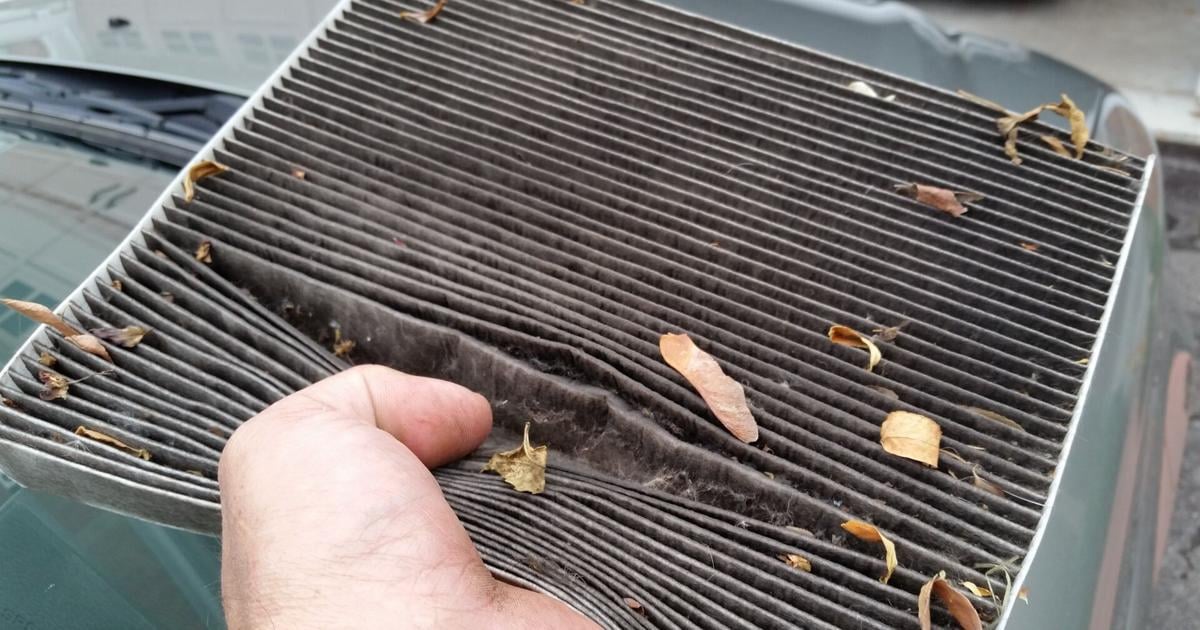
This simple maintenance service can sometimes result in a loud heater.
Cabin filters can get surprisingly dirty in a relatively short period of time – this one had under 20,000 kilometres on it. It’s quite common to find small leaves and maple keys in these filters.
A couple of weeks ago I replaced the cabin filter in my 2023 Toyota 4Runner. Ever since then the heater fan has been noticeably louder. I pulled the new filter out to check that it wasn’t hitting anything, and it looked fine. I even tried running the fan with the filter removed to see if I’d missed something. It still rumbled.
Admittedly, the old filter was shockingly dirty, but what could I possibly have damaged just replacing a simple paper filter? Or is it something else and I’ve only just noticed it? While it’s out of warranty now, it seems unlikely that the fan would already be bad in a car with less than 80,000 kilometres on it.
Do you have any suggestions of what else to check?
Toyota made very few external changes to its 5th generation 4Runner between its 2014 mid-cycle restyle and its final production year of 2024, so the Reader’s 2023 model will look quite similar to this 2020 truck.
Having encountered this issue more than once, and since you mention that it was quite dirty, I’m going to guess that you did inadvertently install the problem when you replaced your filter, but not in the manner that you expect.
Pretty much every modern car and truck pulls the air for their heating and air conditioning systems from beneath the cowl — the area below the windshield wipers at the base of the windshield.
There are several reasons why this is the case, but simple packaging is the main one; the climate system almost always occupies the space under the instrument panel, inside the passenger compartment and just behind the firewall, the bulkhead that separates the interior of the vehicle from the underhood compartment.
By popping out an access panel in the front face on the passenger side of the cowl in this 2017 Hyundai Santa Fe Sport we can see inside. At top right a portion of the exterior grille is visible; the gaping maw in the centre is the air inlet for the climate system. The cabin filter will be just below this. The opening’s elevation and the sloped drainage trough below it reduce the likelihood of water ingestion.
This places the system’s housing close to both the normal air outlet locations for the interior’s ventilation (dash, floor and defroster, typically) and the most common sources of heat and cooling — traditionally a combustion engine, but since even electric vehicles tend to locate their heat exchangers at the front of the vehicle to benefit from airflow, it’s still an optimal spot for them, too.
To reduce the risk of water or dirt ingestion and any added heat from hot road surfaces, outside air is drawn primarily from higher up — as noted prior, through the cowl. An added benefit is the passive ventilation created by the area of high air pressure that forms near the cowl at speed on most vehicles when air coming up the hood gets compressed slightly as it’s forced up and around the windshield.
Sometimes removing a cabin filter results in a nasty surprise – mixed in amongst the leaves is a bunch of underhood insulation, a sure sign that a rodent has made a nest in the heater’s intake duct. A thorough cleaning-out is required in this case.
The shape of the cowl and the area beneath it are designed to separate out and drain away even very heavy rain from the climate system’s air intake. Unfortunately, leaves and tree debris do still often manage to get sucked in, and rodents seem to have a remarkable ability for finding this sheltered storage and nesting space.
In the majority of vehicles built since the turn of the millennia, the first stop in the climate system’s airflow is the cabin filter, which is where this detritus ends up. When one pulls out that filter, it’s not unusual for anything large enough that it’s not between the filter’s pleats to get knocked off coming out of the filter’s access slot, where in a lot of cases it falls into the blower motor below.
Although the blower motor seen here belongs to an older model from a different automaker (a Chevy Cobalt), the basic design is common to nearly all modern cars and trucks; the 4Runner’s would look similar. It’s easy to see how the fan portion of this assembly earned the nickname “squirrel cage.”
The blower motor itself uses a centrifugal-type fan blade design, rather than wide, flat blades like an old desk fan. (Yes, the icon used for fan speed control is lying to you.)
At higher fan speeds, balance becomes crucial to this cylindrical “squirrel cage” (as it’s sometimes called) — so much so that a leaf or the like is enough to throw it out of whack, creating a vibration and/or noise. Oftentimes the offending item will remain trapped, unable to pass through the closely spaced blades of the fan cage.
A 2023 Toyota 4Runner’s cabin filter is accessed through a panel at the rear of the glovebox, much like this 2009 Hyundai Sonata’s, shown being removed by the author. Look closely and you can see leaves on top of the filter – several fell into the fan and had to be extracted, a pretty common occurrence.
With the ignition off — put the keys somewhere outside of the vehicle to prevent having it accidentally turned on — you may be able to reach your fingers in through the cabin filter’s access slot and into the bowl-shaped blower cage to retrieve the culprit(s); you can safely rotate the cage to reach the opposite side. Do use caution, as I swear some automakers sharpen the edges of the cabin filter’s opening.
If you can’t reach it, you may have to remove the blower itself to remove the imbalance.
Should nothing be found, then the blower motor itself is the next most likely suspect.
Ask a Mechanic is written by Brian Early, a Red Seal-certified Automotive Service Technician. You can send your questions to wheels@thestar.ca. These answers are for informational purposes only. Please consult a certified mechanic before having any work done to your vehicle.