Idaho officials identify 1982 suicide victim, seek out potential connection to Tylenol murders
Idaho investigators announced Wednesday they had identified a man who died in a Boise church more than 40 years ago, and they believe he could be connected to the 1982 Tylenol murders in Chicago.
The man at the center of the cold case, referred to for years as “Unknown Wanderer,” died by suicide inside Sacred Heart Catholic Church in Boise on Dec. 4, 1982. The cause of death was determined to be death by cyanide poisoning, according to the Ada County Sheriff’s Office.
The wanderer case was reopened in 2019 and detectives renewed efforts to identify him, who had no identification on him when he was found. When re-examining the evidence, a detective found an engraved key among the wanderer’s belongings that led him to a residence in Jacksonville, Florida.
Detective Tim Cooper, who works in the sheriff’s cold case unit, was able to identify the man as Dr. Mathew Betkouski. Betkouski worked in two drugstores and those who knew him said he had a “history of volatility,” according to the sheriff’s office.
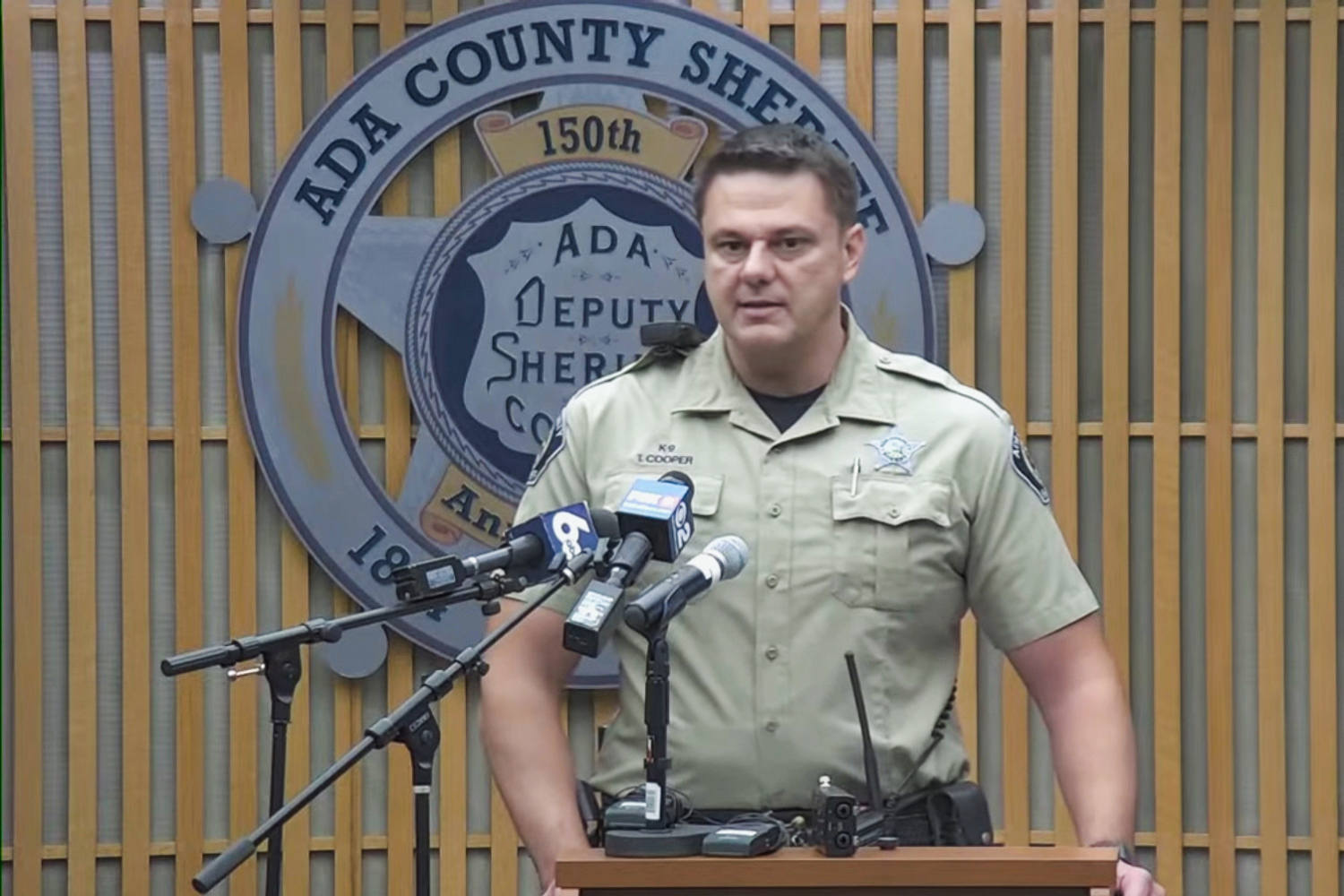
Boise, Idaho, ADA County Sheriff’s Dept. cold case detective Tim Cooper during a news conference about the Tylenol murders case on Wednesday.KTVBColleagues have recalled Betkouski as having a fascination with the “perfect crime” and with cyanide as a method to kill without detection, the sheriff’s office said. Cooper also reviewed thousands of documents, including Betkouski’s personal writings.
The sheriff’s office believed that Betkouski could have been involved in the 1982 Tylenol poisonings, in which seven people died after taking extra-strength Tylenol capsules laced with cyanide.
There has been no evidence so far connecting Betkouski to the Chicago area where the murders occurred at the time.
Betkouski had lifelong struggles with mental illness, Cooper said at a news conference Wednesday. He came from a prominent Los Angeles family and was a chemist who “struggled to connect with people.” He suffered a traumatic brain injury in 1974, which Cooper said “caused some of his problems to manifest in more concerning ways than they had before.”
He worked at a flavors and fragrances company in Florida for three years starting in 1975, but left to undergo psychiatric treatment in Los Angeles in 1978 after co-workers reported concerning behavior. He returned to the job after a couple of months but was ultimately let go because his situation had not seemed to change. Betkouski’s personal writings included musings about how to manage schizophrenia and depression as well as thoughts of violence, according to Cooper.
Betkouski’s brother kept some of his personal items. Among the items found in his desk was a map of Chicago and cyanide, which seemed to be homemade.
“This was sodium cyanide,” Cooper said. “This was not potassium cyanide, as was used in the Chicago-area deaths in 1982.”
Photos also showed that Betkouski did visit the Chicago area in 1981, a year before the Tylenol deaths. Cooper said it is unclear if Betkouski returned to Chicago the following year.
“So where this leaves us is: While our office may have identified some possible connection between Dr. Betkouski and the 1982 events, we’re not naming him as a suspect and we cannot say he was in Chicago in the final week of September 1982,” he said.
Information on the case was turned over to Chicago and Arlington Heights police departments. The Arlington Heights Police Department said it continues to work with law enforcement partners in its effort to identify whoever is responsible for the Tylenol murders.
It went on to say that it received and reviewed the information provided by the sheriff’s department but did not have additional information to release. The Arlington Heights police statement noted that it “remains an active investigation.”
The Chicago Police Department said in a statement that it has been in contact with the Ada County Sheriff’s Office regarding its investigation. It also noted that the Tylenol murders remain an open cold case.
An inquiry to the Illinois State Police was referred to the FBI field office in Chicago. The FBI noted that over the past 44 years there have been repeated allegations of links to the murders “which have remain unsubstantiated.”
“Out of respect for the ongoing, legitimate investigation, those impacted by the tragedy, and the law enforcement partners who have provided genuine support since the start, the FBI remains the lead on investigating and releasing credible information to the public once the evidence yields a true case resolution,” the FBI statement said.
In a news release, Cooper said the department hoped that getting Betkouski’s story out would generate new leads.
“I’m especially interested in learning more about his movements between Oct. 15 and Dec. 4, 1982,” he said.
Cooper worked with a forensic psychiatrist Dr. Park Dietz, who believes that Betkouski could be “a viable suspect” in the Tylenol murders. The sheriff’s office case will be featured in an “Unsolved Mysteries” documentary on Oct. 9 that will air on The Roku Channel.
Investigators have long believed the Tylenol poisonings were committed by man named James Lewis, who died in 2023 without ever being charged in the case. Lewis was convicted of writing ransom notes to Johnson & Johnson, the company that manufactures Tylenol, in an extortion attempt.
Jeremy Margolis, a former U.S. attorney and former director of the Illinois State Police, has long named Lewis as a prime suspect in the case. He described the potential Betkouski connection as “utter nonsense” to NBC Chicago.
The evidence that pointed to Lewis included the note he wrote to Johnson & Johnson, which demanded $1 million to “stop the killings” as well as drawings he made. Lewis had a pencil drawing to show how a killer could have split the capsules and used a peg board to replace the medicinal powder with cyanide, the station reported.
Doha MadaniI am a senior breaking news reporter for NBC News Digital, covering a range of news-of-the-day topics. My job is to report in a timely manner on crime, mass shootings, war coverage, domestic and international affairs, pop culture and more.