I’m a nuclear expert: A desperate Trump striking Iran now could be apocalyptic - The Independent
Want to bookmark your favourite articles and stories to read or reference later? Start your Independent Membership today.
Tucker Carlson, the US political commentator, has said that sources within the Trump administration “may be within days of launching a nuclear strike on Iran” under pressure from Israeli prime minister Benjamin Netanyahu.
“The target would be Pickaxe Mountain in central Iran, where Israeli intelligence claims the Iranian government has restarted its nuclear enrichment program,” he said earlier this week.
It is worth noting that any claim by Carlson should be taken with a pinch of salt; the right-wing commentator broke with Trump this year on a number of issues. But he has remained close friends with vice-president JD Vance, and Michael Wolff, author of the early Trump-era exposé Fire and Fury, has referred to him as a “primary supersecret source” in the past.
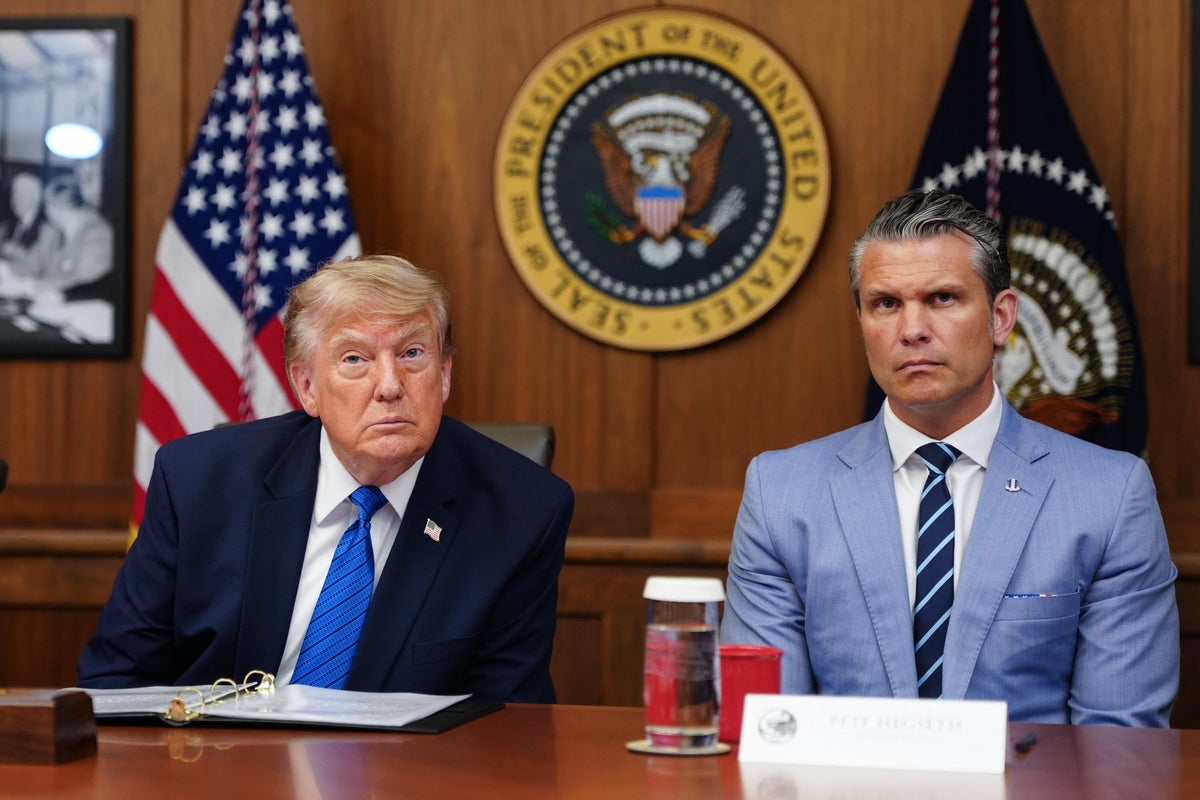
President Trump gave credence to the claim by saying: “There are one or two sites left that need to be dealt with, including Pickaxe Mountain. We can do it in 10 minutes. We have a plan for it, and we can execute it very quickly.”
What happens next in Iran is anyone’s guess. Trump explicitly ruled out using a nuclear weapon or a tactical nuclear weapon in an interview published last week, before Carlson’s comments, by right-wing American news site Newsmax. But, the president’s behaviour can be hard to predict, and with his major losses in the midterm elections this week, he may well be feeling considerable domestic pressure to finish the war as soon as possible. But the irony – and stupidity – of trying to stop Iran developing a nuclear bomb by using a nuclear bomb would not be lost on anyone.
Ten minutes is a typical flight time for a missile carrying any warhead launched from the region, including at sea. But what is far from clear is why America would even countenance the use of a nuclear weapon. The US has large conventional weapons that could be used to end any suspected nuclear weapons activities that may be taking place deep within the Pickaxe mountain, simply by blowing up the tunnels, which would make it inoperable without any of the risks of a nuclear weapon.
A nuclear weapon is a weapon like no other because the effects, such as blast and heat, are orders of magnitude bigger than any other type of explosive weapon, and it also causes devastating long-term, inhumane impact. If used, those in the nearby vicinity would be vaporised immediately, while those outside of its immediate range would be subjected to an enormous blast and subsequent fires, as well as being exposed to immediate high levels of radiation. Many would die over the next few weeks from radiation sickness, just like after Hiroshima and Nagasaki, where hundreds of thousands were killed in two single bomb attacks.
A nuclear weapon creates radioactive debris called “fallout” which, depending on the conditions of use, location and weather, goes up into a “mushroom cloud” that is carried around by the weather systems high in the atmosphere. How far it spreads depends on weather and related conditions, and it rains out on the ground below. It can also cross hemispheres.
The US launching nuclear strikes on Iran would send radioactive debris into the atmosphere and circulate it around the region, causing a huge risk to life, and nearby countries like Saudi Arabia, Pakistan and Iraq would likely be badly affected.
Such an attack would lead to widespread fury. It would cause serious instability in the Middle East and beyond and immediate condemnation of the US. However, it would not – at least at first – be likely to lead to the type of World War III scenarios imagined during the Cold War, where the Soviet Union and the US had plans to exchange large numbers of nuclear bombs and missiles within a few hours, destroying cities in Europe, Russia, the US and many other places, with millions dead. But it is important to remember that World War I and World War II were not world wars to begin with; they were smaller, regional wars in several regions that spread and involved many of the same players and incorporated other countries over the duration.
Such a terrible, unnecessary act would likely lead to a slower escalation, possibly a wider war in the Middle East spilling into other areas and encouraging more countries worldwide to think about developing nuclear weapons instead of promoting non-proliferation. It would inevitably also lead to more terrorism, putting US citizens and any allies of the US at risk. Why President Trump would want to risk that is hard to fathom.
Iran has responded to the Republicans’ historic loss in the midterm elections, with parliament speaker Mohammad Bagher Ghalibaf saying the results showed Americans were opposed to war. “Conscience or the cost of living, Americans said NO TO WAR, and we endorse this message,” he wrote on X. “If the US govt betrays their public will to serve international paymasters and blackmailers, it will learn our NO comes with a Nightmare.”
There’s also the fact that Netanyahu initially sold President Trump the idea that if he attacked Iran in June last year, the Iranian nuclear programme would end and that the regime would fall. That clearly has not happened; President Trump is aware of that and likely feels he was let down by the Israelis. But it’s hard to know what he’s being advised and where he might go. In the US, it’s particularly dangerous that only one person can order the use of nuclear weapons with no checks - and that’s the president.
Threats to use nuclear weapons undermine all attempts to prevent the proliferation of nuclear weapons. The more people believe that nuclear weapons can be used as weapons of war, just as President Putin threatened Ukraine, the more other countries think, “Well, maybe we should have them.”
But the truth is that unless you’re a leader of a country that doesn't care about anyone else but your own country, and perhaps doesn't even care very much about the citizens of that country, then you can't actually use them because the impact on you is so enormous.
Only a country that’s despotic and doesn’t care about its population would engage in nuclear warfare.
For example, if the North Korean leadership used a nuclear weapon against the US, it would spell the end of North Korea, leading to countless deaths and potentially to war with China and Russia. There was once an idea that if every country had nuclear weapons, we might have eternal peace, but human beings are not all rational and calm and those in charge are not always sane.
It seems that world leaders have forgotten how terrible these weapons are. Many in the UK will remember the Chernobyl disaster, where a graphite reactor caught fire, and how people had to wait indoors and live on provisions like tinned food and dried milk, while the radioactive rain fell as it circulated around Europe. A far worse situation would be created by a nuclear weapon attack. Chernobyl was a far smaller, far more benign event than a nuclear weapon would be.
There is of course the possibility that Tucker Carlson was given this information because the US wants to make the Iranians fear nuclear attack, and wants to force them to give up the nuclear program. But threats to Iran haven’t worked well so far. Nor did they work when Russia made similar threats to Ukraine.
But if Iran wants to help prevent a nuclear or any other attack on Pickaxe Mountain, then they could be more transparent about their nuclear capabilities. They’ve been in recent negotiations with the International Atomic Energy Agency (IAEA), discussing a new approach to what the agency could do in terms of the practicalities of moving forward. They could invite the IAEA to Pickaxe Mountain. That would reduce the severity of this situation. If they don’t, then it would be fair to ask why not.
At The Independent, our mission is to deliver unbiased, fact-based journalism. Journalism that's free from political allegiances and the influences of shareholders and commercial interests.
But we need your help. Your support enables us to uncover crucial stories that would otherwise have gone untold, hold power to account, and amplify voices often unheard.
Whether $5 or $50, every contribution counts. It fuels our reporting, invests in investigations, and maintains our independence.
It’s a reminder that our trusted, fact-based, free-thinking journalism remains available to everyone thanks to the generosity of our readers. To show your support and help us tell more of the stories that matter, please make a donation today.
Not ready to donate? Choose 'Maybe later' to start reading.