I’m an American and was pulled over by ICE. Now I don’t go out without my birth certificate
Want to bookmark your favourite articles and stories to read or reference later? Start your Independent Membership today.
When Texas mom Monique Ramirez realized that the police officers who pulled her over in San Antonio were, in fact, federal agents with Immigration and Customs Enforcement, her stomach dropped.
The 43-year-old mom, a U.S.-born citizen, was in the car with her 20-year-old son and 16-year-old daughter when she thought she was being pulled over for a traffic stop on Aug. 31.
“The officer appeared on my daughter's side [of the car], and my daughter's like, ‘Mommy?’” she recalled. “He's asking her, ‘Are you illegal? Are you a U.S. citizen?’ And so, in that moment, you can see literally in the video where I'm like, 'Oh, this is ICE.’”
Although the incident only lasted two minutes, with officers waving them on their way when they realized the family was American, Ramirez said it will stay with her for the rest of her life.
“It's changed everything,” she told The Independent. “We don't go out unless we need to. We carry our birth certificates.”
The mom, a third-generation Mexican-American, said that the agents gave no reason for pulling them over and believes that her family was targeted because of the color of their skin.
“We are from America. This is our home,” she said.
Earlier this month in Evanston, Illinois, a Black U.S. citizen was apprehended on his way to collect a prescription by federal agents in what the Department of Homeland Security said was a case of mistaken identity. Bystander video captured him being wrestled to the ground by immigration officers and he was heard screaming: “I’m a f***ing U.S. citizen!”
The man, whose name has not been released, was left bloodied from the encounter and taken to the hospital with neck and head injuries, local police said.
“The individual was given lawful commands but was not cooperative and refused to identify himself,” a Department of Homeland Security spokesperson, which oversees ICE, told The Independent. “ICE officers relied on their training and later left the scene without further incident once the individual finally identified himself.”
Since returning to office some 20 months ago, U.S. citizens have been caught up in President Donald Trump’s aggressive operation to try to deport immigrants.
The administration’s tactics have sparked widespread protests where some Americans, like Minnesotans Renee Good and Alex Pretti, were killed by federal agents. Others, like Army veteran George Retes and construction worker Leo Garcia Venegas, were detained while trying to go to work.
The government doesn’t track the number of U.S. citizens who have encountered ICE but a recent report from the civil liberties group ACLU found that 155 U.S. citizens have been detained or subjected to law enforcement misconduct, including 32 American children. The report warned that racial profiling has become “rampant” under the Trump administration.
The DHS spokesperson said that allegations of “racial profiling” are “disgusting, reckless, and categorically FALSE.”
“What makes someone a target for immigration enforcement is if they are illegally in the U.S.—NOT their skin color, race, or ethnicity,” the spokesperson said. “There are no ‘indiscriminate’ stops being made. DHS conducts enforcement operations in line with the U.S. Constitution and all applicable federal laws without fear, favor, or prejudice. The Supreme Court recently vindicated us on this question.”
Last year, the Supreme Court opened the door for federal law enforcement officers in Southern California to make immigration arrests by factoring in a person’s perceived race or ethnicity. Trump-appointed Justice Brett Kavanaugh said that “apparent ethnicity alone cannot furnish reasonable suspicion,” but it can be a “relevant factor” for immigration enforcement.
Ramirez said she was stunned when the agents asked her children whether they were in the country illegally, and claimed they told her to “shut up” when she intervened.
With her heart racing, Ramirez believed it would be better to comply with the officers and encouraged her son and daughter to answer their questions. She also showed them her REAL ID card to confirm her identity.
“In the moment when it happens, your body is so full of shock,” she said. “Your body is so full of anxiety, fear. You know, scaredness, sadness.”
Once the agents appeared satisfied that the family was U.S. citizens, they let them go.
“They never gave us a reason,” she said. “It was just to ask if we were from here.”
The experience has left a mark, particularly for Ramirez’s children. She said that her daughter was left “shaking” and asked if she could stay home from school.
“The first thing she said was, ‘Wow, I cannot believe we were just racially profiled,’ and she's saying this while she's laughing, but tears are coming down her eyes,” Ramirez said. “And I can see in that moment the hurt and the betrayal that she feels.”
Ramirez said her daughter also told her: “‘I feel like I look too Mexican to be out in the wild right now.”
In response to the incident, the DHS spokesperson claimed that ICE officers “conducted a vehicle stop on a car registered to an illegal alien.”
“Officers were respectful and did not tell the individual to ‘shut up’ during the exchange,” the spokesperson added. “She was free to go following the short stop.”
“Everything's registered under my name,” Ramirez said. “Like my insurance is in my name. My car is in my name.”
George Retes, a U.S.-born citizen and Iraq War veteran, was brutally detained for three days after being caught up in an ICE raid at the farm where he worked as a security guard in Camarillo, California, approximately 70 miles west of Los Angeles.
Retes, 26, who is also Mexican-American, says he would like to ask the agents why they targeted him.
“If I could I would ask those agents... why?” he told The Independent. “At the end of the day, I don't know what they were thinking. And I don't want to say they just came after me because I'm brown and I'm Mexican, and they thought I was here illegally. That's not for me to say.”
Retes, who deployed to Iraq from 2019 to 2020 before he was honorably discharged from the Army in 2022, is suing the government under the Federal Tort Claims Act. It allows private citizens to file claims against the federal government for injuries caused by neglect or wrongful acts of federal employees.
“Just because you're a citizen, just because you're a veteran doesn't mean it can't happen to you,” he said.
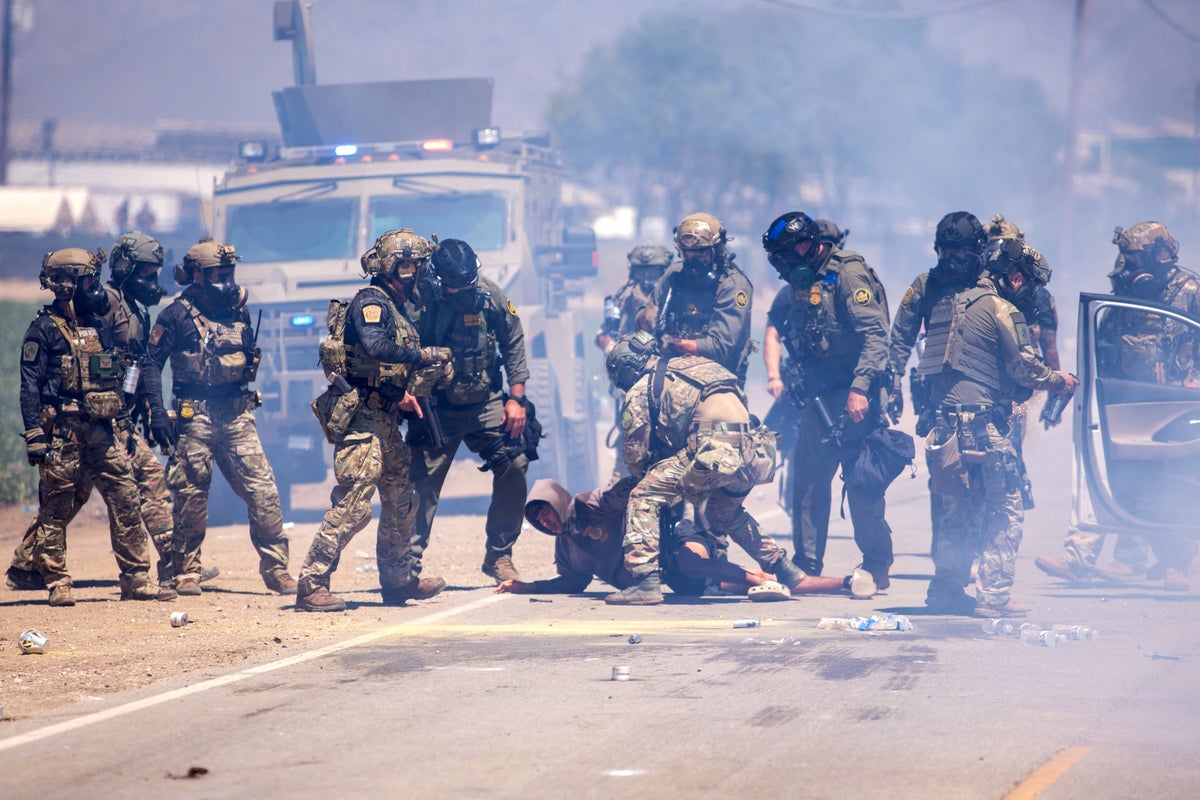
On July 10, 2025, federal agents with ICE and Customers and Border Protection had swarmed the state-legal cannabis farm where Retes worked. Protesters had gathered after hearing about the raid and the scene quickly descended into chaos, Retes recalled. He asked the agents if he could pass to get to work but they refused.
“There's cars going around each other. There's just like no way to get through,” Retes said.
They throw me on the ground. I'm basically like a rag doll. I'm not resisting. I'm not fighting. They still felt the need to have one agent kneel on my neck and another agent kneel on my back, all while trying to zip-tie my hands
The former Army soldier noted that the officers gave him conflicting orders. “They were just all yelling different things. Just all being hostile, basically,” he said.
Tear gas thrown at protesters by agents seeped into Retes’ car, and not knowing what to do, he stayed inside the vehicle while agents banged on his window. They shattered it, pepper-sprayed Retes and dragged him out.
“They throw me on the ground. I'm basically like a rag doll. I'm not resisting. I'm not fighting,” he recalled. “They still felt the need to have one agent kneel on my neck and another agent kneel on my back, all while trying to zip-tie my hands.”
Retes was taken to a navy base with no explanation as to why he was being detained. Federal agents took his fingerprints and swabbed him for DNA before transferring him to the Metropolitan Detention Center in downtown Los Angeles.
Federal agents never allowed him a chance to contact a lawyer or his family during his detention, Retes said. The veteran was placed on suicide watch after a psychological evaluation.
He spent the weekend in isolation, in a cell with a concrete bed and thin mattress, with only a thin hospital gown for warmth. “They leave the lights on 24/7, and I'm like that from Friday morning to Sunday afternoon, to literally the point I'm released,” he said.
Retes never received an explanation for his incarceration but last year DHS justified his arrest by alleging he was violent towards officers and “refused to comply with law enforcement.”
For the last year, Retes has thrown himself into advocacy, speaking to lawmakers in Congress.
But reliving what happened has taken a toll on the veteran, who says he is now figuring out what he wants to do with his life. “It's been rough trying to get back into work,” he said. “It’s kind of hard because it's like, I'm trying to move forward, like past all this, but how do I move past all this if I'm constantly going to Washington, constantly speaking out about it?”
Ultimately Retes, who is being represented by attorneys at the Institute for Justice, said he believed that speaking up was “the right thing to do.”
“There's people who are scared, who are U.S. citizens that are scared to speak up,” he said. “I'll speak up for everyone else who is scared to, who doesn't have the opportunity.”
Commenting on Retes’ case, a DHS spokesperson confirmed he was arrested and later released. “The US Attorney’s Office is reviewing his case, along with dozens of others, for potential federal charges related to the execution of the federal search warrant in Camarillo.”
Leo Garcia Venegas is another American targeted by ICE at work. Venegas, who was born in Florida to Mexican parents, works in construction in Baldwin County, Alabama, and has been detained three times, despite showing agents his REAL ID. He has partnered with the Institute for Justice to bring a federal class-action lawsuit.
“He was handcuffed, his legs shackled, and was thrown in the back of a cop car,” Jaba Tsitsuashvili, one of Venegas’ attorneys, told The Independent.
The case had a victory last week after a federal judge in Alabama ordered immigration agents to stop warrantless raids of construction sites and detaining workers without a reason to suspect that a specific individual is undocumented. DHS was also ordered to immediately release workers in the Southern District of Alabama who present evidence of being lawfully in the U.S., like a REAL ID.
Tsitsuashvili said that cases like Venegas’ in southern Alabama alone are “in the thousands.”
“People are scared, so it's important to remember that the stories that you see are a massive, massive undercount of the people that are actually being impacted by these unlawful, unconstitutional policies,” he said.
“The kind of bravery and courage that it takes to come forward like Leo has is hard,” Tsitsuashvili added. “And so it really is a matter of certain people being willing to come forward and say, ‘Stop doing this to everybody.’”
For Ramirez and her children, the damage from the brief encounter with ICE officers in her hometown will be everlasting, she said.
“You realize that to them, they're stopping you because they feel like there's something wrong with you,” she said. “And in this case, the ‘wrong with you’ is your skin tone, and that hurts because I would hope that this country, as much as it's been through, has learned a lesson or two, and we haven't.”
.jpeg?width=1200&auto=webp&trim=0%2C0%2C0%2C0)