In Saint-Pierre and Miquelon, France’s First Climate Refugees Are “Trying to Get to Safety Before It Is Too Late” - Le Figaro
Pour sauvegarder un article vous devez être connecté, vous pourrez ainsi les consulter sur tous vos appareils.
Miquelon, a village of 600 residents in the French archipelago off Canada, risks being submerged by 2100. Led by its mayor and supported by the government, the community’s plan to relocate some 1.5 kilometers from its historic site is drawing unusual attention to the territory.
This overseas territory rarely makes the news. Under normal circumstances, these French citizens off the coast of Canada tend to echo the proverb “out of sight, out of mind.” This “rock,” as its 5,800 residents call it, is more than 4,000 kilometers (2,485 miles) from mainland France and covers just 242 square kilometers (93 square miles).
Despite the distance, citizens of the Saint-Pierre and Miquelon archipelago are French and proud of it. Yet another sad source of pride has emerged in recent months: Miquelon residents are becoming France’s first climate refugees. Now in the spotlight, the village is hosting numerous journalists and President Emmanuel Macron.
Scheduled for mid-September, the presidential visit is set to leave a lasting impression. Macron will be the second French president to set foot on Miquelon’s verdant soil after François Hollande, whose December 2014 visit left the 600 residents dismayed. His announcement of a coastal risk prevention plan (PPRL) made the village — nestled on a 1-kilometer-wide strip of land, surrounded by the sea and threatened with submersion — off-limits to construction. The people of Miquelon took it as a death sentence: A building ban would deter young people from returning, and without newcomers, the economy would grind to a halt.
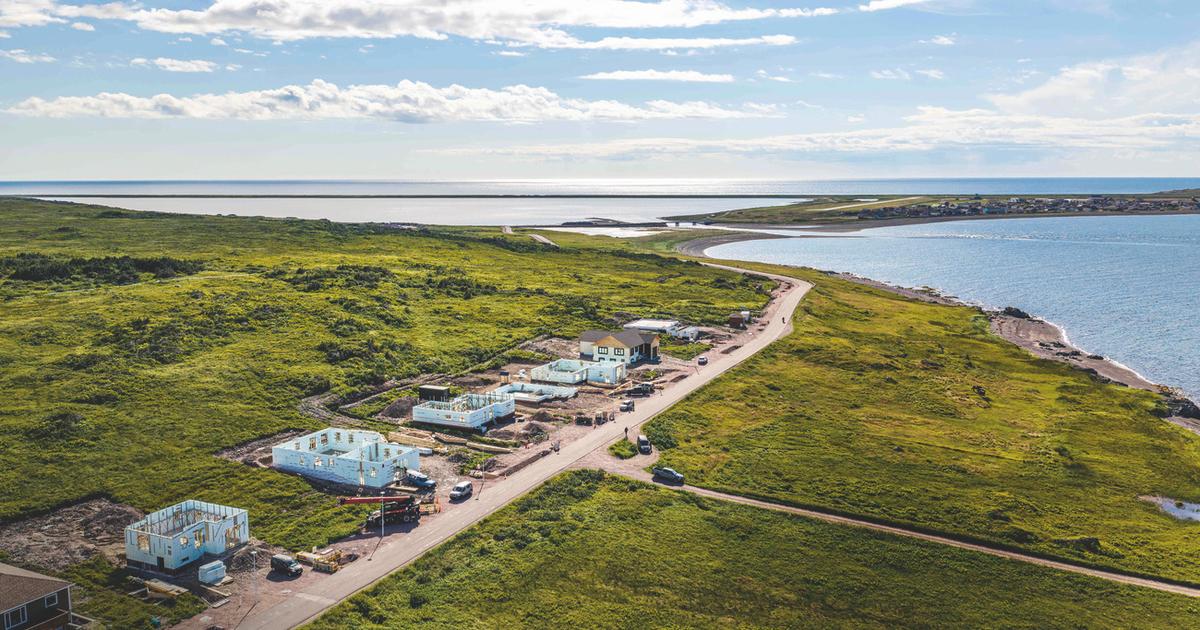
Once the initial shock had passed, the population did not sit idly by. After the PPRL’s adoption in 2018 and Hurricane Fiona in 2022 — which caused no damage to the territory but raised awareness — the village decided to relocate 1.5 kilometers (just less than 1 mile) away. Today, buildings are going up on Chemin des Roses, at an elevation of 10 meters (32.8 feet), on land ceded by the local government for a symbolic €1.
Saint-Pierre and Miquelon had not seen a construction project of this scale in a long time. For the first phase, 15 lots have been allocated, including three to first-time homebuyers. Of the nine houses currently under construction, three are nearly finished. Sites for multi-unit housing are also planned. Heavy machinery hums to prepare 14 additional lots, a new road and utility connections. Everyone is taking advantage of the summer to make progress on exterior work before winter’s icy winds begin to blow.
Among those known as the pioneers, Patricia and Claude Orsiny are happy to give a tour of their home. “We’ve been following the project from the start and applied for a lot as soon as we could,” says Patricia, who has been retired since May. Now in their 60s, the couple decided it was wise not to wait 10 years to start a new chapter of life. “We are trying to get to safety before it is too late,” she says as she cuts pieces of wood and hands them to her husband.
Nearby, Roger Bonnieul, 75, did not hesitate either. “If I had water and electricity, I would move in tomorrow,” says the former contractor, who is painting his deck alongside his son-in-law. Bonneuil is delighted that several retirees are taking part in this new adventure.
“We got the building permit in four years,” Orsiny says. “We are proud to be pioneers and to be French because the government supported us, not to mention that our mayor went out of his way for this project.”
Franck Detcheverry, 42, had not planned to become mayor, but when no one else wanted to run in 2020, the Miquelon native decided to step up. “The closer we get to 2050, the higher sea levels will rise and the harder the storms will hit us. Either we make this project a success, or Miquelon will die. The only thing we know for sure is that the project will take 50, maybe even 70 years,” he says.
Since his election — and reelection last March — this Électricité de France (EDF) employee, in addition to his duties as mayor, has devoted all his energy to this long-term plan. But he is aware nothing could have been accomplished without the government.
Prefect Marc Didio acknowledges this while praising Detcheverry’s commitment: “Of course, from a financial and logistical standpoint, the government’s involvement is essential. But the opposite is also true. If the mayor had not supported it first, if the community hadn’t embraced it, the government would not have been able to impose it.” Especially since the project is based on voluntary participation.
The principle is as follows: The government appraises the homes of those eligible for relocation and purchases them. Applicants can begin building on Chemin des Roses and must complete construction within three years. Once the residents have been relocated, their current homes will be demolished, and the land will be “restored to its natural state.” This is a sine qua non condition for receiving funding from the Barnier Fund, a fund for the prevention of major natural risks, which, among other things, allows local governments to buy back buildings at risk. “We need about 70 million to buy back the homes. In two years, we’ll have bought back 23,” Detcheverry says.
The village currently has 270 primary residences and 70 second homes. What criteria were used to select the first beneficiaries? “The main criterion is vulnerability. But we have also given priority to those who’ve been actively involved,” the mayor says. As for those who feared young people would leave the historic village en masse, leaving only the elderly behind, the project’s early stages are proving them wrong. Similarly, the term “moving” has been abandoned. Today, they speak of relocation.
“Relocation means settling in. Moving means leaving,” says Patricia Bourgeois, director of the DTAM (Directorate of Territories, Food and the Sea) for the archipelago, who is overseeing the administrative side of this new initiative.
Delphine Gazel and Gildas Morel, both in their 40s, are also hard at work. Like their new neighbors, they are building their own home, a hallmark of Saint-Pierre and Miquelon. “We had already built our first house, and, personally, I am not afraid to pick up a shovel or climb onto the roof,” says Gazel, who was born in Saint-Pierre. In July, the couple was stacking pieces of Polycrete to build the walls. “They fit together like Legos, and we pour concrete between two layers. We are also installing triple-pane windows, and unlike our old house, there won’t be any stairs,” they explain.
Frightened by Hurricane Fiona, they have noticed changes in the landscape and are convinced that in the future “certain places will be inaccessible.” However, after deciding to move, some people asked them: “Do you think you will be safe over there?” referring to Chemin des Roses. “We aren’t safe where we are now!” they replied stoically. Because, of course, the project also has its detractors. According to the mayor, “30% are opposed to it.”
In Miquelon’s quiet streets, words can sometimes be harsh when the code of silence is broken: “It’s stupid,” is heard repeatedly. Many argue that, yes, there is erosion, yes, sea levels may rise, “but that is not going to happen overnight.” The projections are for 2021. But the main complaint from opponents is the size of the lots: “They’re tiny over there!”
The new lots all measure 800 square meters (8,611 square feet), while some residents currently have 2,000 square meters (21,527 square feet) of land, where they have planted trees or a vegetable garden — quality spaces they are not willing to give up, knowing how long it takes to recreate such an environment. Others feel the location was poorly chosen: “That area is windy. They should have gone to Le Cap.”
Le Cap is a majestic peninsula north of the village overlooking the Atlantic, where a few homes have been built that are not subject to the PPRL. The issue of demolition is also sometimes a sticking point: “We are short on housing in Miquelon, yet houses that are still livable are going to be torn down. The mayor’s office could take them over and rent them out on a short-term basis,” says one woman who wishes to remain anonymous.
Behind the criticism and resentment, the most sensitive issue is inheritance. What do you leave your children when your property is no longer worth anything? Others are those considering “exile,” most often to be closer to their children in mainland France, and see the Barnier Fund as an opportunity to sell their homes at a fair price. “For now, those sellers are not given priority any more than second homes are,” the mayor says categorically.
Businesses, not yet concerned by the relocation, are already seeing an uptick in activity. How long will this last? Will this relocation — unprecedented in France — help revive Miquelon’s economy? In Saint-Pierre, the 1992 moratorium on cod fishing left people in a state of shock that has not entirely dissipated, especially since the territory has long relied on public-sector jobs. In 2026, civil servants represent between 50% and 60% of the workforce.
The sense of devastation can affect tourists. Those arriving on the 8:30 a.m. ferry from Saint-Pierre find nowhere to have a cup of coffee. For lunch, a reservation must be made well in advance. And as they walk past the newly renovated 10-unit motel, they may not understand why it is closed. Yet the people of Miquelon, some of whom are descendants of Acadians who were deported and returned several times, are known for their resilience and versatility. And they have an asset that Saint-Pierre envies: space.
With its 217 square kilometers (83.7 square miles) — compared to Saint-Pierre’s 25 (9.6) — it could accommodate factories or, at the very least, wind turbines, as wind is abundant here. During a visit to the archipelago in late June, Olivier Poivre d’Arvor, France’s ambassador in charge of poles and maritime issues, stated that with “global warming, we must prepare for a new shipping route to pass near Saint-Pierre and Miquelon in 20 or 30 years. We will need to capitalize on the benefits, whether in digital technology, data or space.”
That may comfort Detcheverry, who acknowledges that “the archipelago as a whole is not particularly attractive.” And the town will not be revitalized with just two births this year — out of about 60 in the territory — or with a retiree from Angers, drawn by the tranquility and lack of crime. But, above all, it has other concerns.
The isthmus connecting the islands of Miquelon and Langlade is in danger of breaking. Although the archipelago’s third island is populated only in the summer by residents of Saint-Pierre who have built second homes there — some of them lavish — it relies on Miquelon for supplies.
“From mid-July to mid-August, our sales double,” says Marie-Noëlle Boissel, manager of the Domane grocery store in Miquelon. The question of relocating the church, cemetery and airfield will be addressed later. The local government has not yet determined a new location for this vital infrastructure. When asked, the president declined to comment on this important matter.
Above all, as demolitions proceed, the village will become riddled with empty lots. While the pioneers — Bonnieul and the Orsinys — say they will not be affected, their former neighbors may find the experience more painful. The mayor hopes that these “vacant lots will encourage others to move.” But a fierce opponent believes, on the contrary, that “it will accelerate the depopulation.” Such comments do not disturb Detcheverry, who is eager to launch Phase 2, this time with 70 lots: “Half the village will then be safe. I hope to start it in September.”
Behind the acceleration lies the fear that, following the elections next May, the French presidency could fall into the hands of someone less sensitive to climate issues. Last March, Detcheverry even ran for re-election, fearing that a candidate opposed to the project might take office. But for 2032, his decision is made: “I will not seek re-election.” His plans include participating in Phase 2 and putting his new address, Chemin des Roses, on his business card.