
In Singapore Repertory Theatre’s Eureka Day, school parents behave badly - The Straits Times
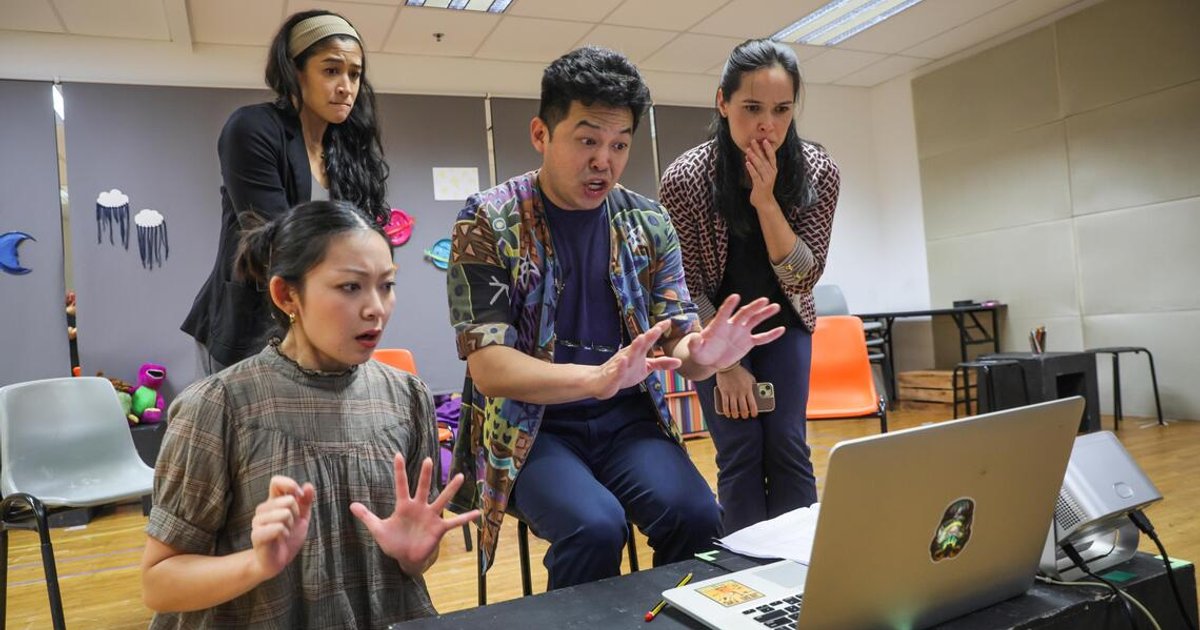
(From left) Munah Bagharib, Coco Wang Ling, Benjamin Chow and Julie Wee star in the Tony Award-winning satire about vaccines, school politics and a chaotic group chat.
SINGAPORE – Anyone who has watched a WhatsApp group chat implode spectacularly will recognise the chaotic online town hall at the centre of Eureka Day.
In the play, an outbreak of the mumps virus in an elementary school rules out in-person meetings, so the school committee engages with parents online. The live chat scrolls across the stage. As with most contentious discourse on the Internet, civility is short-lived.
The drama however is played for laughs, director Daniel Jenkins says: “We all know what happens when there’s lots of people online, and it so easily gets out of hand.”
American playwright Jonathan Spector’s 2018 satire, which won the 2025 Tony Award for Best Revival, opens at the KC Arts Centre on Nov 18.
“It’s hard to find good comedies that have a little bit more substance than just fluff, and this play is very much that,” Jenkins says on the choice of this play for the Singapore Repertory Theatre’s (SRT) year-ender.
Real events inspired Spector’s script: A 2014 Disneyland measles outbreak which led California to drastically tighten its vaccination requirements. In a post-pandemic world where anti-vaccination voices have gotten louder, the play retains its resonance.
Actor Shane Mardjuki says: “I thought it was 100% written post-Covid. It’s shocking, how the script had all those arguments and debates that we now have.”
His fellow cast members Munah Bagharib, Benjamin Chow, Coco Wang Ling and Julie Wee, play the members of the executive committee who have to come to a unanimous decision under the school’s progressive principles of inclusivity. But disagreements soon rip apart the veil of civility.
Director Daniel Jenkins describes Eureka Day as a satire with substance.
Jenkins highlights Spector’s refusal to cast a villain: “He creates characters that, although somewhat extreme in their views, are not caricatures.”
Spector’s style of dialogue includes interjections and overlapping sentences, which makes the talk feel true to life and grounds the hilarity in naturalism. Jenkins says, laughing: “It’s challenging for the actors. But also engaging to watch, because it feels like these are just real people having a real conversation.”
The script remains set in its original period, so its characters argue without the hindsight the audience might carry in. If the play feels timeless, it is because its real subject is how people simply struggle to see eye to eye when it matters most.
“This is a play about a very specific school at a very specific time,” Jenkins adds. “Yet the debates they have continue to be relevant.”
Mardjuki, who plays Eli, a full-time father on the pro-science side of the debate, adds: “It’s not too much of a logical leap for me, because I side with many of the arguments he makes.
“And as someone who’s very invested in his children, sometimes between jobs, I feel like I’m a full-time father, so I see where this guy is coming from.”
He also drew insights from an episode of American podcast series This American Life which discussed how a county health department had to word its public bulletin about a measles outbreak without causing alarm, the same dilemma the play’s committee faces.
Wee took a little longer to warm up to her character Suzanne, whose anti-vaccination views she could not voice honestly at first: “It could come out of my mouth as words, but it could not come out from my heart. So I had to do research.”
She read Seth Mnookin’s The Panic Virus, an investigative book about the origins of the anti-vaccine movement: “There were so many characters and perspectives that were exactly what I needed to understand for this role.”
She was so absorbed by anti-vaccine documentaries that her husband cautioned her not to get dragged in.
But the exercise compelled her re-examine herself: “It made me think: What do I not know? Am I doing the best for my child? Because I don’t know what I don’t know.”
The cast and director hope audiences take home the same healthy openness to debate and certainly more than just a good laugh.
Jenkins says: “We might come in thinking we know who these people are, who we’re rooting for, what we believe, but the second half of the play goes somewhere you wouldn’t expect in the first half.”
Mardjuki adds: “Because it’s a comedy, it allows you open up a bit to see the other side of the debate. It’s a good reminder to hold space.”
Where: KC Arts Centre - Home of SRT, 20 Merbau RoadWhen: Nov 18 to Dec 6, Tuesdays to Saturday, 8pm; Sundays, 2pm; Nov 29, Sunday, 2pm and 6pmAdmission: From $28, Culture Pass eligibleRating: Advisory (some mature content and coarse language)Info: str.sg/KB9c

