India, Europe Seek Strategic Autonomy As Global Alliances Face Turbulence
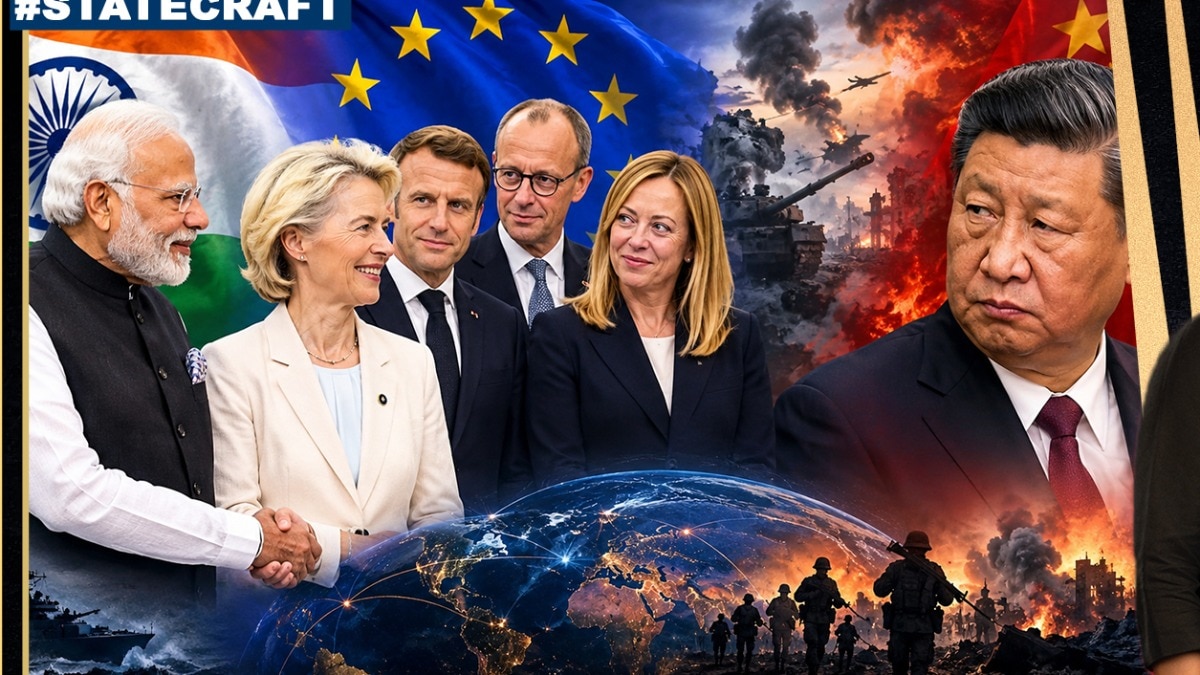
Europe is being forced to rethink its dependence on the United States, while India continues to pursue a foreign policy built around strategic autonomy. For Wolfgang Ischinger, former German ambassador to the US and chairman of the Munich Security Conference, the two approaches may be different — but they could increasingly converge.
Speaking in New Delhi, Ischinger said Europe and India face very different strategic circumstances, but share a fundamental objective: reducing dependence on any single power.
For India, strategic autonomy is rooted in its size, history and geopolitical position. For Europe, he argued, autonomy begins with the ability of the European Union’s 27 members to act collectively.
“Autonomy means something different for a huge country like India compared to a, in relative terms, very small country like Germany,” Ischinger said.
According to Ischinger, the war in Ukraine and changing US policy under President Donald Trump have fundamentally altered Europe’s understanding of strategic dependence.
He described the developments as a wake-up call for Germany and the wider European Union, which had become accustomed to relying heavily on the United States for security and, for decades, on Russia for energy.
Ischinger went further, suggesting that future historians could view both Russian President Vladimir Putin and Trump as figures who unintentionally pushed Europe towards greater self-reliance.
“There was President Putin in Russia, and there was this President Trump in the United States who helped Europe to grow up and become self-dependent,” he said.
The remark reflects a broader concern within European strategic circles: whether Europe can maintain its security and global influence if the traditional transatlantic relationship changes permanently.
Ischinger, who has spent much of his career dealing with the US and transatlantic affairs, acknowledged that Trump's approach came as a shock to his generation.
He stressed that the traditional arrangement — with the US providing the bulk of security protection while European allies depended on Washington — could no longer continue unchanged.
Europe, he argued, must now “carry our own weight” while seeking to preserve the transatlantic relationship.
Against this backdrop, Ischinger sees India as an increasingly important European partner.
He said Europe had been looking for countries it could trust amid growing volatility in the international system, and argued that India stood out because of its scale, economic potential and strategic importance.
“Trust, I learned as a young diplomat, is the currency of diplomacy,” he said.
For Ischinger, this trust could provide the foundation for a deeper India-Europe relationship.
He pointed to the growing economic relationship between the two sides and argued that cooperation should extend beyond trade into strategic affairs, conflict management, technology and artificial intelligence.
His comments also offered a notable contrast with the European approach towards China.
Ischinger rejected the idea of viewing China through a single lens.
China, he said, is an unavoidable global power with growing influence in the economy, science, artificial intelligence and military affairs.
The appropriate response, therefore, is likely to involve a combination of cooperation, competition and rivalry.
But he acknowledged an important difference in European perceptions of India and China: many Europeans, he said, feel more comfortable placing their trust in India than in China.
That distinction could become increasingly significant as Europe seeks new strategic partnerships in a more fragmented international system.
Artificial intelligence emerged as another major theme in the conversation.
Ischinger described the future of AI as potentially as consequential for global security and peace as the development of nuclear weapons.
He argued that the international community eventually developed mechanisms such as the Nuclear Non-Proliferation Treaty to address the dangers posed by nuclear technology. The challenge now is whether similar thinking can be applied to advanced AI.
The concern, he said, is not simply technological competition but the absence of effective international governance.
The rise of frontier AI models and the possibility of artificial superintelligence raise questions that governments are still struggling to answer.
For Ischinger, India and Europe cannot afford to focus exclusively on regulation while remaining dependent on others for advanced AI.
The immediate challenge is also to ensure continued access to frontier models.
Without access to the technology, he warned, countries may struggle to influence the rules governing it.
That creates a wider geopolitical question: will access to advanced AI become as strategically important as access to energy, capital and military technology?
Ischinger was also critical of the US decision to shift military attention towards Iran while the war in Ukraine remains unresolved.
He compared the situation with the US decision to invade Iraq in 2003 after Western countries had mobilised around Afghanistan following the September 11 attacks.
In his view, the lesson is that countries should be cautious about abandoning one agreed strategic mission for another.
He argued that the US military focus on Iran had consumed resources that could otherwise have supported Ukraine, including air-defence capabilities.
Ischinger described the conflict with Iran as a “war of choice” rather than a war of necessity, while acknowledging the wider consequences of the conflict for Europe and India.
Energy security is particularly significant.
The disruption of energy flows through key maritime routes has added pressure to European economies already dealing with the consequences of the Russia-Ukraine war.
The Middle East has presented another challenge for European strategic influence.
Ischinger argued that the war in Gaza exposed deep divisions within the European Union and undermined decades of efforts to build a common European foreign policy.
Instead of speaking with one voice, European governments have adopted different positions on Israel, Gaza and the wider Middle East.
For a region geographically close to Europe, he considers this loss of cohesion particularly damaging.
His assessment was stark: Europe currently has only a limited role and limited influence in shaping events in the Middle East.
He argued that Europe must rebuild a common position and engage with Israel, Arab states, the US, Turkey and other regional actors if it wants its voice to carry weight.
Despite the challenges facing Europe, Ischinger ended his assessment of India-Europe ties on an optimistic note.
He said his visit to New Delhi had exceeded his expectations and reinforced his belief that there was significant potential for closer cooperation.
The relationship, he argued, should not be limited to trade.
India and Europe could work together on conflict management, economic development, technology and AI, while building a broader strategic partnership.
For Europe, this could mean diversifying its network of trusted partners as its relationship with the US evolves.
For India, it could offer another avenue for pursuing strategic autonomy without isolation.
The larger question is whether India and Europe can translate their growing economic relationship and mutual trust into sustained strategic cooperation.
As Ischinger's comments suggest, the emerging global order may make that partnership increasingly important.- Ends