India has a massive role to play: US defence expert on new world order
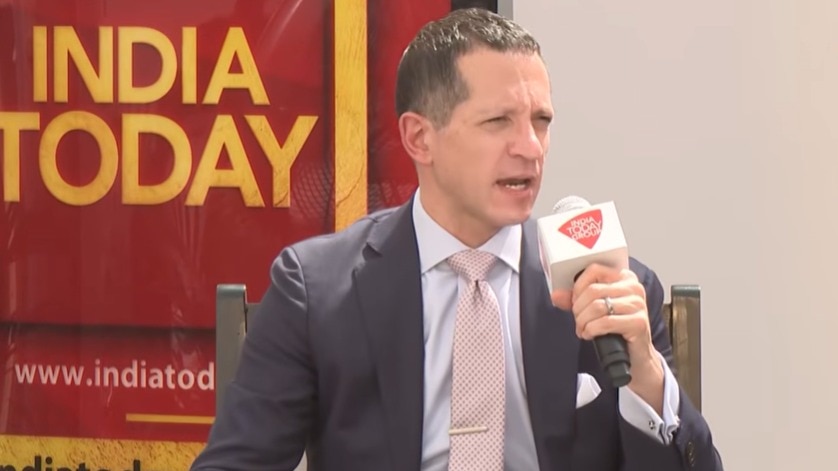
China has emerged as the “real winner” of the US-Iran war, while India is a “wild card” with a massive role to play in shaping the global future, according to Michael C Horowitz, professor at the University of Pennsylvania and former US Deputy Assistant Secretary for Defense for Emerging Technologies.
In an interview with India Today on the sidelines of Munich Security Conference 2026, Horowitz offered a sweeping assessment of how the conflicts in Iran and Ukraine are changing warfare, exposing vulnerabilities in traditional military power and reshaping the balance between the world's major powers.
At the heart of his assessment is what he calls the “era of precise mass”, where countries can combine commercial manufacturing, older precision-guidance systems, artificial intelligence and autonomous technologies to produce large numbers of relatively cheap precision weapons.
Iran, he said, has demonstrated how this can allow a weaker power to impose significant costs on a military superpower.
“We are now in the era of precise mass,” Horowitz said.
He argued that Iran has used low-cost precision capabilities to attack American bases, allies and partners across the region and withstand an initial American and Israeli strike. IRAN WAR EXPOSES LIMITS OF US WEAPONS STRATEGY
Horowitz rejected the suggestion that the US had simply lost control of the skies or seas.
“I don't know if I would say the United States doesn't dominate the skies or the seas,” he said, pointing out that Iran had not succeeded in sinking American ships and that the US still had air superiority in the region.
The problem, he said, lies in the way Washington has chosen to fight.
The US relied on “exquisite, long-range, expensive, hard-to-manufacture precision-strike weapons” to try to win the conflict while reducing the risk to American troops.
But this strategy has created a vulnerability when the supply of such weapons becomes constrained.
Horowitz said the US still had weapons available, but some of the systems that were more plentiful could require American aircraft to operate closer to the battlefield and conduct different kinds of operations.
He said the US appeared reluctant to escalate further and use those systems.
“And so we've really ended up with stalemate in the strait, because the way that the United States chose to fight the war was not enough to succeed,” he said.US FACES ‘EMBARRASSING’ PROSPECT OF DRAW
Asked whether Washington could still win the war, Horowitz said the current US strategy was focused on putting economic pressure on Iran.
He described the US effort to prevent Iran from exporting oil as an “old-school blockade”, with the expectation that economic pressure would eventually force Tehran either to collapse or its leaders to give up.
“It's been like six months and that hasn't happened,” Horowitz said.
If that strategy fails, he said, the US could face “the, like, embarrassing prospect of potentially a draw at best, a loss at worst” in the conflict.
For Horowitz, that possibility illustrates the changing nature of warfare.
A country such as Iran, he said, has been able to generate enough military force to impose costs on the US and resist military coercion despite the enormous difference in their conventional military capabilities.‘CHINA IS THE REAL WINNER’
Asked whether China was the biggest winner from the conflict, Horowitz was unequivocal.
“There is no doubt that the country in the world that has benefited most from the US war with Iran is China,” he said.
China, he argued, has a powerful military, a growing economy and advanced artificial intelligence, yet is emerging from the conflict looking like “the responsible country” seeking to promote international rules and global stability.
“That’s where we are right now. China is the real winner,” Horowitz said.
He acknowledged that this was particularly striking given China's conduct in other areas, including the South China Sea, Taiwan, global trade and rare earths.
“In this context, China looks like the responsible player right now, I suspect, a lot to the rest of the world,” he said.advertisementINDIA ‘A WILD CARD’ IN GLOBAL POLITICSHorowitz also offered a significant assessment of India's role in the emerging global order.
Asked whether India could help shape peace and the future of the international system, he said New Delhi had a “massive role to play”.
“I think India has a massive role to play in determining the global future,” he said.
He described India as “a wild card in global politics” because of its growing economy and increasingly powerful military.
“I think India has a central role to play in shaping what the next generation looks like,” Horowitz said.
His assessment comes as the US-China rivalry, the Russia-Ukraine war and the Iran conflict reshape calculations around military power and global influence.CHINA IS THE BIGGEST THREAT TO THE US
Horowitz described China as the biggest strategic challenge facing the United States.
“China is the single biggest threat to the United States that I have seen in my entire life, including the Soviet Union,” he said.
He said China posed both a military and economic challenge, particularly to a free and open Pacific.
The Iran war, meanwhile, has reduced some US weapons stocks, including Tomahawk missiles, long-range anti-ship missiles and SM-6s.
That could create challenges for American deterrence in the Pacific, he said.
His response is what he described as essentially a “crash programme” to rapidly scale up lower-cost military capabilities.
The US, he argued, needs to embrace the same kind of “precise mass” capabilities that countries such as Iran are using against it.IRAN WAR OFFERS LESSONS FOR TAIWAN
Yet Horowitz said the changing nature of warfare could also benefit countries facing much larger adversaries.
He pointed to Ukraine as an example of a relatively weaker country resisting a much more powerful military through innovation and mass deployment of drones.
He said Ukraine was on track to produce six million drones in 2026, covering short-range attacks, longer-range strikes inside Russia and extensive sensing operations.
“What they've done is incredible,” he said.
The same principle could apply to Taiwan in a potential conflict with China.
If Taiwan develops appropriate capabilities and has allies willing to support and sustain it, Horowitz said, it could have a greater ability to resist Chinese coercion than it did 20 years ago.RUSSIA-UKRAINE WAR MAY REMAIN STUCK
On the Russia-Ukraine war, Horowitz said he expected the conflict to remain broadly in a similar position over the next year unless there was an external shock.
He said Russia had failed to anticipate the level of Ukrainian resistance when it launched its invasion.
Ukraine's ability to mobilise, innovate and build a large drone force has proved extraordinary, he said.
At the same time, Horowitz said Russia was not fighting NATO directly.
“Russia is fighting Ukraine with support from NATO but that's different from direct NATO involvement,” he said.
He also said fears of nuclear escalation that were prominent in late 2022 and early 2023 had faded as the stalemate continued.
However, he acknowledged that escalation concerns could increase if Ukraine began making major advances into territory held by Russia.
He also said Russia was already engaged in “gray zone warfare” against Western countries supporting Ukraine.CHINA-TIWAN CONFLICT AND THE ‘PRECISE MASS’ LESSON
The Iran and Ukraine wars, according to Horowitz, are also providing China with lessons about the changing nature of military power.
The US depletion of some weapons stocks in the Iran war creates challenges for deterrence in the Pacific, he said.
But the broader lesson could be more significant.
If relatively weaker countries can now use cheaper precision capabilities to resist coercion from larger powers, that could alter calculations around Taiwan.
Horowitz said the US needs to apply the lessons from Iran and Ukraine to its own military planning before facing a potential confrontation with China.PROJECT MERIDIAN AND CONFLICT OF INTEREST CONCERNS
Horowitz also discussed Project Meridian and the growing involvement of technology executives in US defence policy.
He said it was not unprecedented for the Pentagon to bring in technology leaders to help understand the future of warfare.
However, he raised questions about potential conflicts of interest and the role the new board could play in defence procurement.
“If this board is just giving advice, that's one thing,” he said.
“If this board is directly factoring into procurement decisions, that would be a different kind of thing.”
Horowitz said transparency would be crucial, particularly in the context of the current administration.
“There are elements of it that don't look good regardless of what the substance is,” he said.FLYDUBAI INCIDENT AND THE FUTURE OF AVIATION SECURITY
The interview also turned to the Flydubai cockpit incident involving a co-pilot accused of trying to hijack the aircraft.
Horowitz said the incident appeared to be an act of terrorism, although whether it should be classified as “gray zone warfare” would depend on what investigators establish about the pilot's links to other groups.
“If this was somebody who was part of an organisation that was seeking to do harm to Israel, then that sure looks like a hybrid war, gray zone warfare kind of situation,” he said.
If the person acted alone, Horowitz said, it would more clearly be an act of terrorism.
The incident also raised questions about whether artificial intelligence could help identify potentially radicalised pilots.
Horowitz said AI could potentially help interrogate backgrounds and identify evidence of radicalisation, but existing screening systems should already be capable of preventing dangerous pilots from entering cockpits.
“There’s got to be a way to stop pilots from getting in the cockpit that wish to destroy the airplane they are flying,” he said.RUSSIA, IRAN WARS COULD SHAPE THE NEXT YEAR
Asked how the two major conflicts could evolve, Horowitz predicted relatively little change in the Russia-Ukraine war over the next year.
He said the situation could change if there was an external shock, but Putin's hold on Russia appeared relatively stable and Ukraine was continuing to resist Russian attacks.
For Iran, he identified the US midterm elections as a potential turning point.
He said a Democratic victory in the House or Senate could put greater pressure on President Donald Trump to wind down the conflict, although Trump could also choose to escalate in the short term in an attempt to achieve victory before January.UN STILL HAS A ROLE TO PLAY
Horowitz rejected the idea that the United Nations had passed its “sell-by date”.
He argued that the UN's effectiveness has always depended heavily on how willing the world's most powerful countries are to cooperate.
When major powers are interested in multilateral cooperation, the UN can have a greater impact.
But when the US, China and Russia are less invested in an equal multilateral process, it becomes harder for the organisation to succeed on controversial issues.
For Horowitz, the current global churn is therefore not simply about individual wars.
It reflects a broader transformation in military technology, global power and the ability of weaker countries to resist stronger ones.
And amid that transformation, he sees India as a country with the potential to play a defining role.
“India has a central role to play in shaping what the next generation looks like,” he said.- Ends