India is a side player: Rahul slams Delhi's absence from Iran talks during US visit
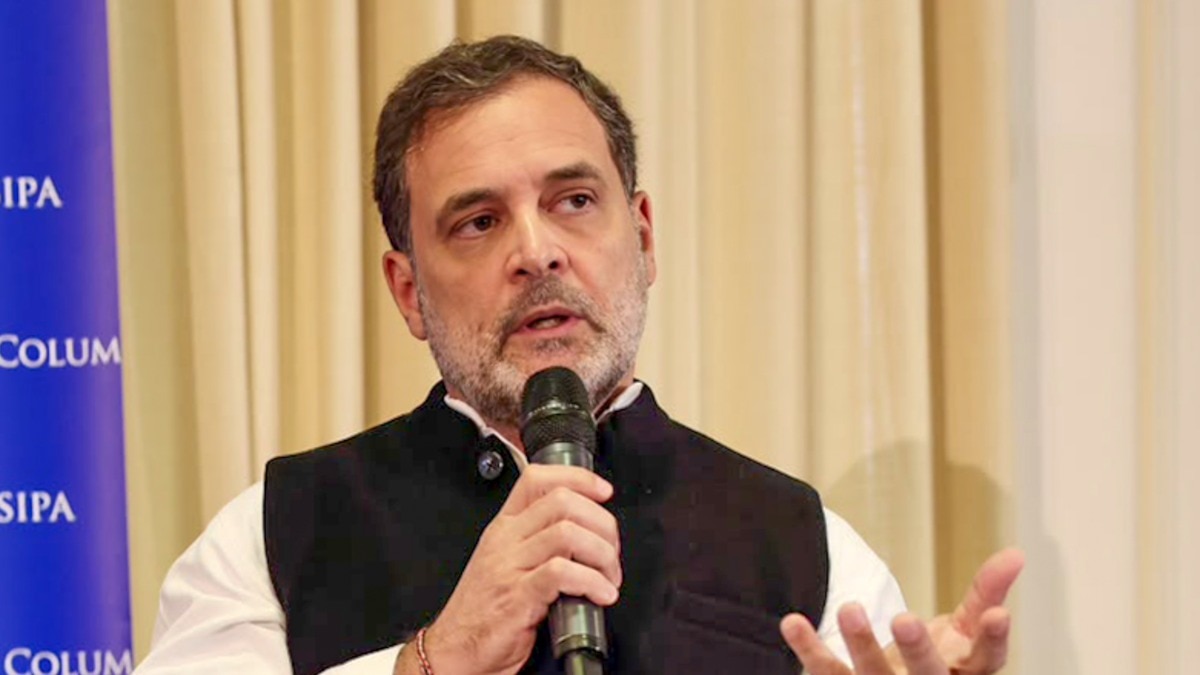
Congress leader and Leader of Opposition in the Lok Sabha Rahul Gandhi has criticised India's growing absence from global diplomatic conversations, saying the country has become a "side player" in international affairs. He expressed surprise that Pakistan was involved in negotiating between the United States and Iran while India remained on the sidelines.
In March 2025, External Affairs Minister S Jaishankar, speaking at an all-party meeting on the West Asia crisis, said India could not act as a "dalal nation" (broker nation) in global geopolitics. His remarks came as the Opposition raised concerns over Pakistan's role in mediating talks between Washington and Tehran.
Speaking during an interaction with students at the University of Chicago on Wednesday, Gandhi said India had historically possessed a sophisticated understanding of geopolitics but was no longer playing an active role in shaping global developments.
"India, by its size, naturally has a global voice and India should be actively involved in global conversations. But frankly, India has become a side player," he said.
Pointing to Pakistan's involvement in negotiations between Washington and Tehran, Gandhi said India had established relationships with the US, Iran and Russia but was failing to translate those ties into diplomatic influence.
"I'm pretty shocked that Pakistan is busy negotiating with the Iranians and the Americans, and India's just looking," he said.
Gandhi recalled India's position in the Non-Aligned Movement soon after Independence, arguing that the country once commanded considerable stature in international affairs. He said he would like New Delhi to regain that voice on the global stage.
The Congress leader also criticised the foreign policy pursued by Prime Minister Narendra Modi, particularly its emphasis on personal relationships with global leaders, including US President Donald Trump and Russian President Vladimir Putin.
Gandhi argued that personal friendships between political leaders could not determine the course of international relations, as global decisions were shaped by broader economic and geopolitical structures.
"Friendship is not the point. Who gives a damn about friendship? Do you really think that geopolitics is going to work because the guy is your friend? He's leading a structure. He's got a whole economic system under him. He's not going to make decisions based on whether he likes you or doesn't like you. So these are some of the things that disturb me," he said.
Clarifying his position, Gandhi said he had no objection to leaders maintaining personal friendships but argued that understanding geopolitical developments and India's position in the world mattered far more.
"I don't have a problem with being friends with Mr Modi or being friends with leaders. Friendship is not that important. What's important is that you understand what's going on, who you are, and where you fit," he said.
Gandhi also spoke about the changing global security architecture, arguing that the international order established after World War II was shaped by the West, while the next global structure would involve several major powers and civilisations.
"The next global architecture will not be built by one civilisation alone. It will be shaped by multiple civilisations, with America, China, India, the Middle East and Russia all having a role to play," he said.'PAKISTAN MUST STOP SUPPORTING TERRORISM FOR TALKS'
During the interaction, Gandhi also responded to a question from a Pakistani participant about the possibility of India and Pakistan moving beyond mutual accusations and working together.
He said there was scope for dialogue between the two countries but maintained that Pakistan must stop supporting and encouraging terrorism in India before any conversation could begin.
"Well, there is room, but there is a big problem, which is the support and encouragement of terrorism by Pakistan in our country," Gandhi said.
He added that India could not engage in dialogue with Pakistan while innocent people continued to be killed.
"It is impossible for us to accept our innocent people being murdered and have a conversation with Pakistan. So, the moment that stops, a conversation can potentially begin," he said.advertisementIRAN'S LAST OFFICIAL ADDRESS IN US IS UNDER PAK EMBASSYThe Iranian Interests Section in Washington, DC operates under the Pakistani Embassy, serving as Iran's sole official diplomatic presence in the US since 1992, after US-Iran diplomatic ties were severed post-1979 revolution. Pakistan provides diplomatic protection while Iran manages personnel and consular services for about 1.5 million Iranians in North America.
This unique arrangement allows Pakistan direct access to Iranian officials in Washington and positions it as a potential mediator amid US-Israel-Iran tensions, maintaining crucial diplomatic channels despite ongoing conflicts.RAHUL GANDHI'S HISTORY OF CRITICISING GOVT ON FOREIGN SOIL
This is not the first time Rahul Gandhi has criticised the Indian government while addressing international audiences. He has previously raised questions about India's democracy, unemployment and the government's policies during interactions abroad.
In October 2025, Gandhi accused the ruling BJP of eroding India's democratic fabric while addressing students at EIA University in Colombia.
In September 2024, Gandhi, while interacting with students in the US, also raised concerns about India's employment crisis and the country's dependence on imports. Responding to a question about unemployment, he traced the shift in global manufacturing, saying the US remained a production hub until the 1960s, after which manufacturing jobs moved to countries such as South Korea, Japan and China.
He said China had since established dominance in global production, pointing to the prevalence of Chinese-made products in India.
"You go to India, you look at the phones, you look at the furniture, you look at the clothes... you will see 'Made in China', that's a fact," Gandhi said.- EndsMust Watch
Politico Maniac. Loves to read, analyze, and present stories that matter.