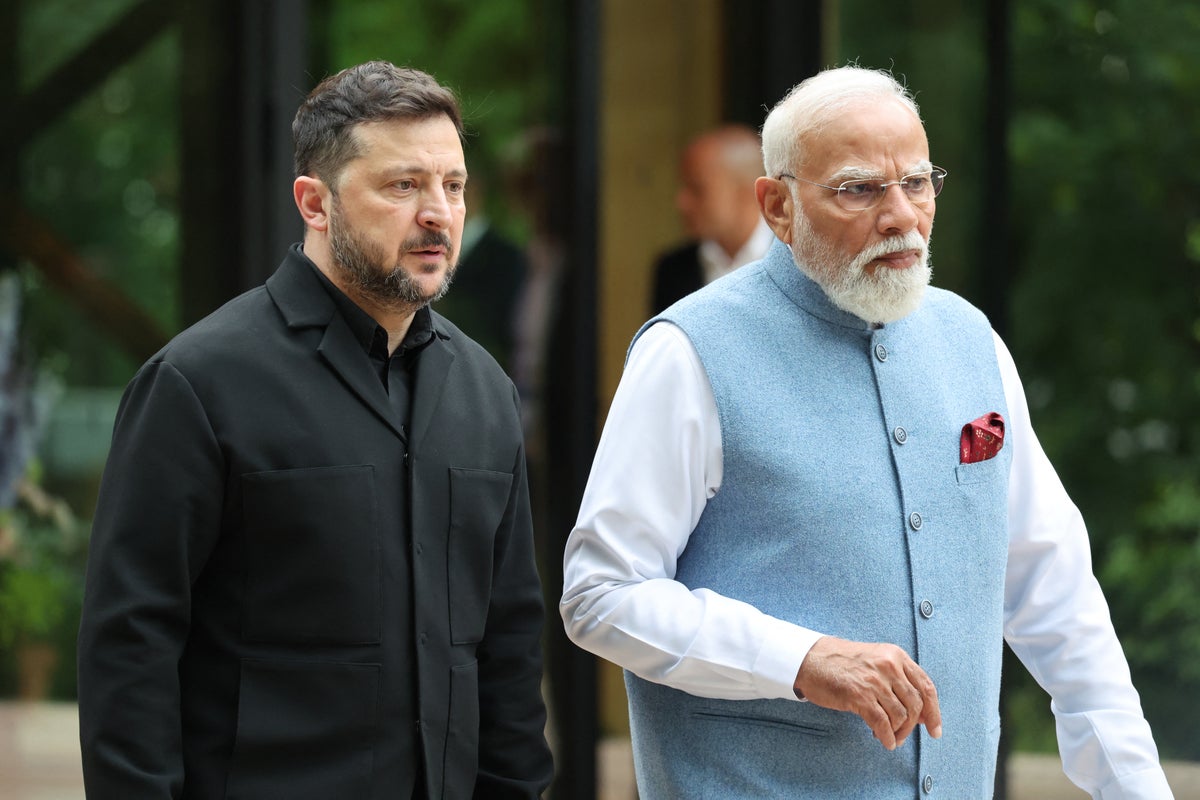
India says it wants to be more involved in ending Ukraine war as Zelensky hails peace plan
Want to bookmark your favourite articles and stories to read or reference later? Start your Independent Membership today.
India is involved “beyond advocacy” in finding an end to the Russia-Ukraine war, foreign minister S Jaishankar said, after both Vladimir Putin and Volodymyr Zelensky hailed plans proposed by Delhi.
Speaking at the Munich Security Conference in Delhi, Mr Jaishankar said India had held talks with both Moscow and Kyiv in recent months, discussing proposals ranging from protecting Black Sea shipping to halting attacks on energy infrastructure.
India has maintained a neutral stance on the war. It has called for a halt to fighting but has seemed reluctant to directly criticise Russia because of close defence and bilateral ties.
Prime minister Narendra Modi urged Mr Putin to end the war as recently as August, when they met on the sidelines of the Shanghai Cooperation Organisation summit in Kyrgyzstan.
Mr Jaishankar said India was now engaged in conversations with Russia as well as Ukraine about practical steps towards reducing hostilities.
“We got a little bit more involved beyond advocacy in the last few months,” Mr Jaishankar said on Sunday.
He said discussions had begun over the safety of shipping in the Black Sea before expanding to grain and energy exports and possible “non-attack” arrangements.
Mr Jaishankar described the war as an “unfortunate conflict” and said India’s position “has been very clear, which is that we would like to see an end to this conflict”.
His comments come after Ukrainian foreign minister Andrii Sybiha revealed on Sunday that Kyiv was considering four separate ceasefire proposals, describing India’s as the “most comprehensive”.
“We have four proposals. The most comprehensive is India’s proposal,” he told reporters in Kyiv, adding that India had for the first time signalled a willingness to play a more active role in ending the conflict.
The other initiatives have come from Turkey, Egypt, and the US. While Turkey and Egypt have proposed a Black Sea truce aimed at facilitating Ukrainian grain exports, Washington has pushed for a deal to halt attacks on energy infrastructure.
Kyiv said it was prepared to consider an energy and Black Sea truce, but insisted that the two must be combined.
“We are ready for an energy and Black Sea truce, but only in this combination,” Mr Sybiha said.
He added that such an agreement would require a complete halt to attacks on energy facilities, including port infrastructure.
After meeting Mr Jaishankar last month, Mr Zelensky said they had discussed several important issues, including the situation in the Black Sea, and thanked Delhi for its desire to end what he described as an “unjust war”.
Mr Putin, meanwhile, thanked Mr Modi for his “desire to put an end to this conflict through peaceful means and as soon as possible”. “He has an avid interest and very good ideas aimed at finding mutually acceptable solutions,” the Russian leader said in a foreign policy speech at the plenary session of the Valdai Discussion Club.
“In that sense, naturally, the prime minister takes a neutral position but with an interest in the end of the conflict.”
At their meeting in late August, Mr Modi told Mr Putin to move from “endless war” to “end of war” for the sake of humanity.
In a meeting in Moscow in 2024, the Indian prime minister had told the Russian president that “peace talks do not succeed amid bombs, guns and bullets”, and a “solution cannot be found on the battlefield”.
India has been affected by the war both directly and indirectly. At least five Indian seafarers have been killed after attacks on commercial vessels in the Black Sea since April. Delhi has responded with strong protests to both sides, and with advisories warning seafarers about the “highly volatile” situation in the region.
At the same time, it has been put under pressure by the US to stop the purchase of discounted Russian crude – it has remained the second-largest buyer of Russian energy after China – and threatened with tariffs of up to 100 per cent for failing to comply.
In spite of Western pressure, Delhi has hosted Mr Putin twice since the conflict started in 2022, for a state visit in December 2025 and for the Brics summit in September 2026.
India is not a signatory to the Rome Statute, so it is not legally obliged to arrest the Russian president despite the ICC having issued a warrant for his arrest over alleged war crimes in Ukraine.