India wants to launch 50 rockets a year to space. But, is Isro even ready?
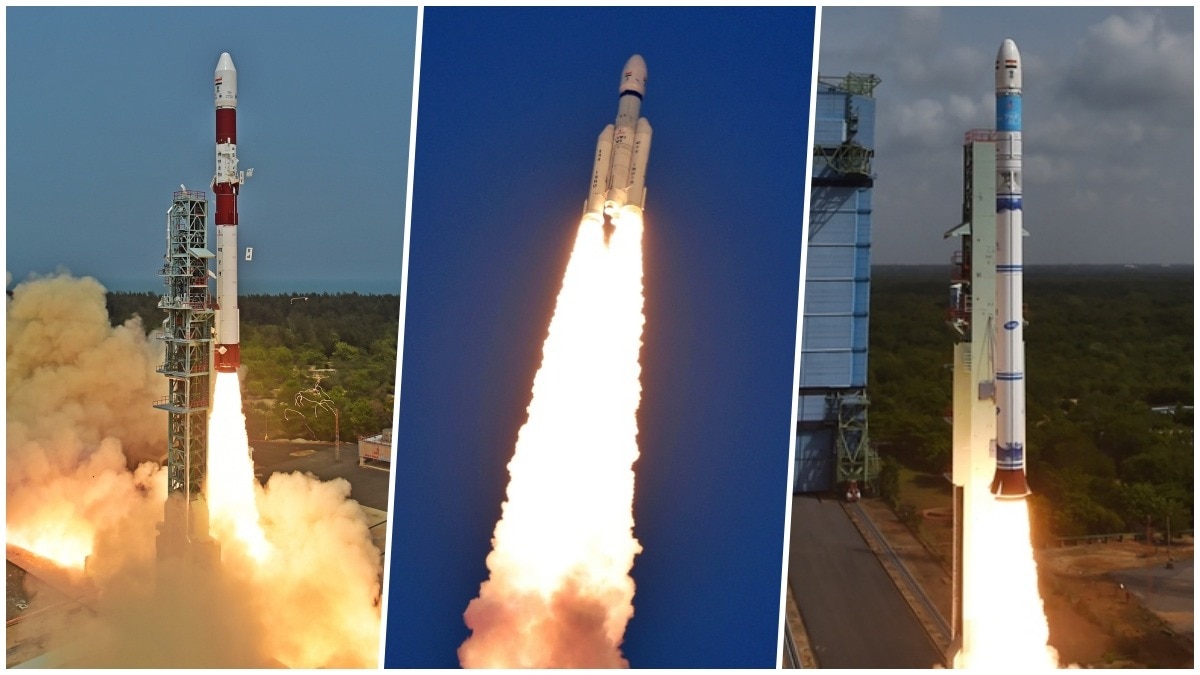
India has set itself an ambitious space target: 50 launches every year by 2030. But with just three Indian orbital launches so far in 2026, two by Isro and one by private company Skyroot, the scale of expansion required over the next four years is enormous.
The target was set out by Isro Chief Dr V Narayanan and supported by IN-SPACe Chairman Pawan Goenka, who said India would need government and private industry to build launch capacity together because the scale cannot be achieved by one organisation alone.
Isro has conducted two orbital launches in 2026 so far. The first, PSLV-C62 carrying EOS-N1, encountered an anomaly during the third stage on January 12 and the mission was not accomplished.
The second, GSLV-F17 carrying EOS-05, launched successfully on September 4. That means Isro currently stands at one successful orbital launch out of two attempts this year.
But India's launch count also includes a historic third mission: Skyroot Aerospace's Vikram-I, which successfully reached orbit on July 18 in the country's first private orbital launch from Indian soil.
Getting from three to 50 in four years will require a fundamental change in how India builds, integrates, authorises and launches rockets.FROM BUILDING ROCKETS TO BUILDING A LAUNCH SYSTEM
The biggest challenge may not simply be the number of rockets India can manufacture. A high launch cadence requires an entire ecosystem to operate simultaneously.
That means rockets being manufactured while another vehicle is undergoing integration, a third is undergoing testing and a fourth is already on the launch pad.
An industry executive familiar with launch operations told IndiaToday.in that the operational side of launches will have to become significantly more seamless.
At present, every launch involves coordination across multiple agencies dealing with air traffic, maritime traffic, safety, logistics and other clearances. For a handful of launches, such a system can function. But a cadence approaching one launch a week requires these processes to be handled in bulk.
"If you think of launch itself, there is an operational aspect to it and there is a production aspect of it," the executive said requesting not to disclose his name.
The production side will require a similar transformation.
India will need multiple launch vehicles available at different stages of readiness rather than building one rocket at a time for a specific mission.
One possible approach would be to maintain a pool of 10-15 launch vehicles at various stages of production, testing and integration, allowing missions to move through the pipeline without waiting for the previous rocket to complete its entire cycle.
The objective would be to build an ecosystem in which multiple rockets are designed, manufactured, tested and integrated simultaneously. Every launch involves coordination across multiple agencies. (Photo: Isro)
That also means expanding the supplier base.
Fuel availability, transportation, safety systems, satellite logistics, testing facilities and specialised vendors will all have to operate at a much higher frequency.
"If the vehicles are there on the pad, vendor support is required — ready availability of fuel, safety support, logistics, getting the rockets there and getting the satellites there," the executive said.LAUNCH PADS COULD BECOME THE NEXT BOTTLENECK
India currently operates two major orbital launch pads at Satish Dhawan Space Centre, Sriharikota.
The First Launch Pad primarily supports PSLV and SSLV missions, while the Second Launch Pad supports heavier vehicles including GSLV and LVM3 and is also being prepared for Gaganyaan.
The government has already approved a Third Launch Pad at Sriharikota, with an estimated cost of 3,984.86 crore. It is designed to support Next Generation Launch Vehicles as well as LVM3 variants and is intended to increase launch capacity. A high launch cadence requires an entire ecosystem to operate simultaneously. (Photo: Isro)
Separately, India is developing the SSLV Launch Complex at Kulasekarapattinam in Tamil Nadu, its second spaceport. The facility is intended primarily for SSLV launches and missions by non-government entities, with industry participation built into the infrastructure. The launchpad will also support private company launches like that of Skyroot and Agnikul.
But for a 50-launch-a-year target, merely adding one more pad may not be enough.
An industry assessment is that India could eventually need at least four launch pads, with three configured for near-continuous, all-year operations. The fourth could provide redundancy for maintenance, delays, weather or vehicle-specific requirements.
A western launch site could also provide geographical flexibility. A launch facility on India's western coast could complement the existing east and south-oriented infrastructure, although establishing such a facility would require significant investment and regulatory planning.
The basic principle is simple: a launch pad cannot be allowed to become a single point of failure for an entire national launch programme.advertisementPERMISSIONS WILL HAVE TO MATCH THE LAUNCH CADENCEAnother bottleneck could emerge in the regulatory system.
IN-SPACe is already India's independent, single-window agency for authorising and supervising space activities by non-government entities, including launch vehicles and satellites.
But 50 launches annually would require authorisation processes designed for repetition rather than individual missions.
The US offers one example. The Federal Aviation Administration's streamlined launch and re-entry licensing framework allows operators to use a single licence for multiple launches from multiple launch sites, specifically to support higher launch cadence.
A similar philosophy could become important in India, with appropriate safety and national-security safeguards.
The challenge becomes even more complicated when reusable rockets are introduced. Agnikul Cosmos, based out of Chennai, is developing a reusable launch vehicle that will have sea-based landings. Isro itself is working on a design for a future reusable rocket.
A reusable vehicle returning to Earth could involve airspace authorities, maritime agencies, the Navy, Coast Guard, environmental authorities and other government departments.
"If a vehicle lands outside India's exclusive economic zone, additional permissions and recovery procedures could be required," Srinath Ravichandran, Co-Founder & CEO at AgniKul told IndiaToday.in. Skyroot's Vikram-1 ahead of maiden flight at Sriharikota. (Photo: Skyroot)
The industry view is that these processes eventually need to work through a single nodal framework, rather than forcing launch operators to coordinate separately with multiple ministries and departments.SATELLITES MUST MOVE AS FAST AS ROCKETS
There is another less visible part of the equation: customers.
India cannot launch 50 rockets a year unless there are enough satellites to put on them.
That includes Indian government, defence and commercial spacecraft, but also international customers.
Foreign satellites can already be launched from India. Historically, international customers have used Isro's commercial arm, NewSpace India Limited (NSIL), with government-level processes involving agencies such as the Ministry of External Affairs and import procedures.
The challenge will be making this process predictable and scalable rather than treating every foreign satellite as a one-off case.
If India wants to become a launch hub for satellite constellations from countries such as Singapore, Japan, Australia or European nations, satellites must be able to enter the country, undergo processing and reach the launch site without becoming the bottleneck.ISRO CANNOT DO THIS ALONE
The most important change may therefore be institutional rather than technological.
India's space sector has moved from an Isro-dominated model to one involving hundreds of private companies.
IN-SPACe says its role is to facilitate private participation and enable sharing of government space infrastructure with non-government entities. Isro chief Dr V Narayanan and IN-SPACe Chairman Dr Pawan Goenka during the Bengaluru Space Expo. (Photo: PTI)
Skyroot's Vikram-I mission demonstrated that private Indian companies can now move beyond components and prototypes to orbital launch operations.
The next step is to make that capability repeatable and scalable.
That means Isro continuing to develop advanced technologies while private companies manufacture vehicles at scale, operate launch services and develop their own rockets.
It also means stronger coordination among the Department of Space, IN-SPACe, Isro, defence agencies, aviation authorities, maritime agencies, ports, logistics providers and other ministries.
The model has parallels elsewhere in the global space industry, where government agencies provide infrastructure, regulation and major programmes while commercial companies increasingly build and operate launch systems.
For India, therefore, the question is not simply whether Isro can launch 50 rockets a year.
It is whether India can build a system capable of launching 50 rockets a year.
At the current rate, the gap is substantial. But the 2030 target was never designed around Isro alone. It represents a shift towards a multi-vehicle, multi-company and multi-launch-pad ecosystem.
The next four years will determine whether India's space programme can make that transition from mission-by-mission launches to an industrial-scale launch cadence.- EndsPublished By: Sibu Kumar TripathiPublished On: Sep 21, 2026 10:00 IST