Indonesia’s Actions at the UN General Assembly: Walkouts and Candidacy for a Non-Permanent Security Council Seat
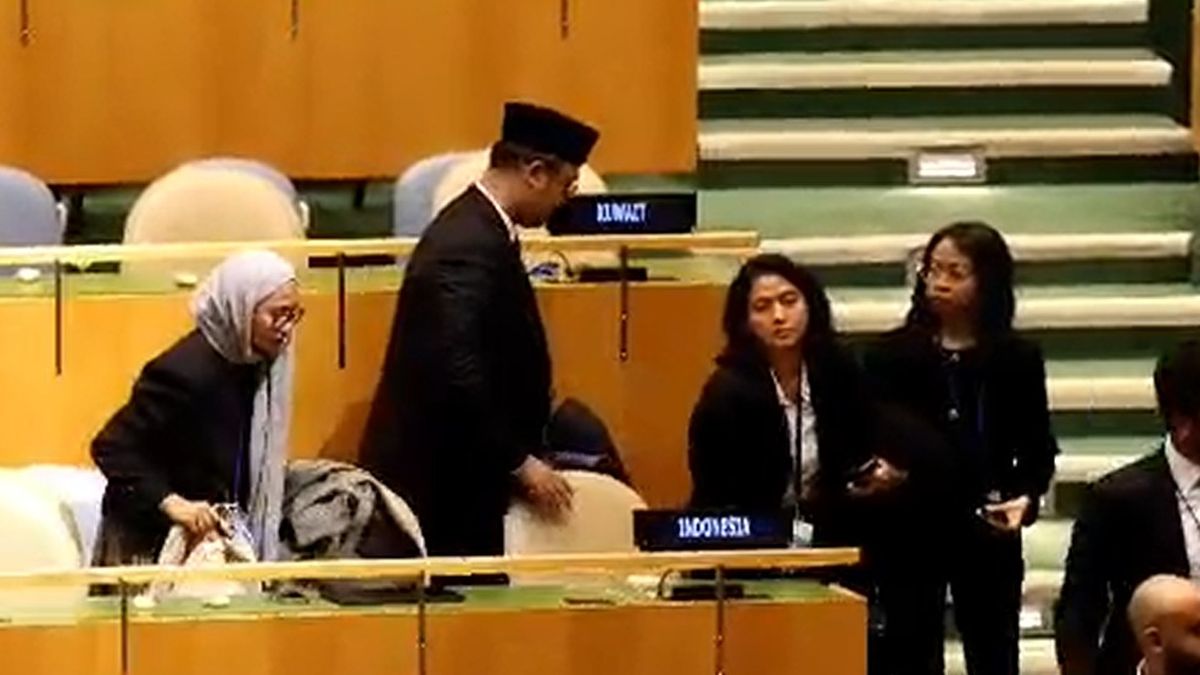
JAKARTA, KOMPAS.com - Indonesia showcased its diplomatic stance amid the dynamics of the United Nations General Assembly (UNGA) taking place in New York, USA, on Saturday (26/9/2026) local time.
On several agendas, Indonesia took a firm position on international issues, including the conflict in the Middle East.
One significant action was the Indonesian delegation's walkout during the speech by Israeli Prime Minister Benjamin Netanyahu at the UN General Assembly.
In addition to Indonesia, diplomats from various other countries also rushed out of their seats to protest the Israeli regime leader.
The atmosphere in the UN General Assembly hall became lively as delegations left their seats and exited the room.
Indonesian Foreign Ministry Spokesperson Yvonne Mawengkang stated that the delegation's walkout was a show of solidarity with Palestine and a condemnation of the humanitarian crimes committed by Israel.
"This action was taken as a demonstration of solidarity with the Palestinian people, as well as a protest and condemnation of the humanitarian crimes and violations of international law that Israel has committed against the Palestinian people in Gaza and the occupied Palestinian territories," Yvonne told Kompas.com via a text message on Friday (25/9/2026).
She mentioned that the walkout reflects Indonesia's consistent position supporting Palestinian independence.
This action can also be interpreted as Indonesia's rejection of all forms of violence and violations of international law committed by Israel.
Indonesia aimed to send a message that violations of international law cannot be normalized and must be stopped immediately.
At the international forum, Indonesia emphasized several points, including its support for Palestinian independence.
Foreign Minister (Menlu) Sugiono stated that the situation in Palestine is a real test for the consciences of nations around the world.
Sugiono initially expressed that a relevant multilateral system for the 21st century must be more representative, agile, and capable of delivering tangible results.
To achieve this, UN member states must start by strengthening collective capacities to address crises, respond effectively to global crises and humanitarian situations, and promote peace, development, and cooperation simultaneously.
He noted that merely having stronger institutions will not save multilateralism.
"International law must be upheld consistently. Sovereignty must be respected, and colonialism must be ended. Here, Palestine stands as one of the most tangible tests for these principles, as well as a test for our consciences," Sugiono stated in his speech at the 81st UN General Assembly in New York, USA, on Saturday (26/9/2026) local time.
Sugiono emphasized that the glaring violations of international law in Gaza and the West Bank remind him of the world before 1945, when a race was nearly exterminated.
At that time, there was no UN Charter.
Similarly, there was no Universal Declaration of Human Rights or four Geneva Conventions of 1949.