Indus Treaty at 66: Why Pakistan's water crisis is more than an India problem
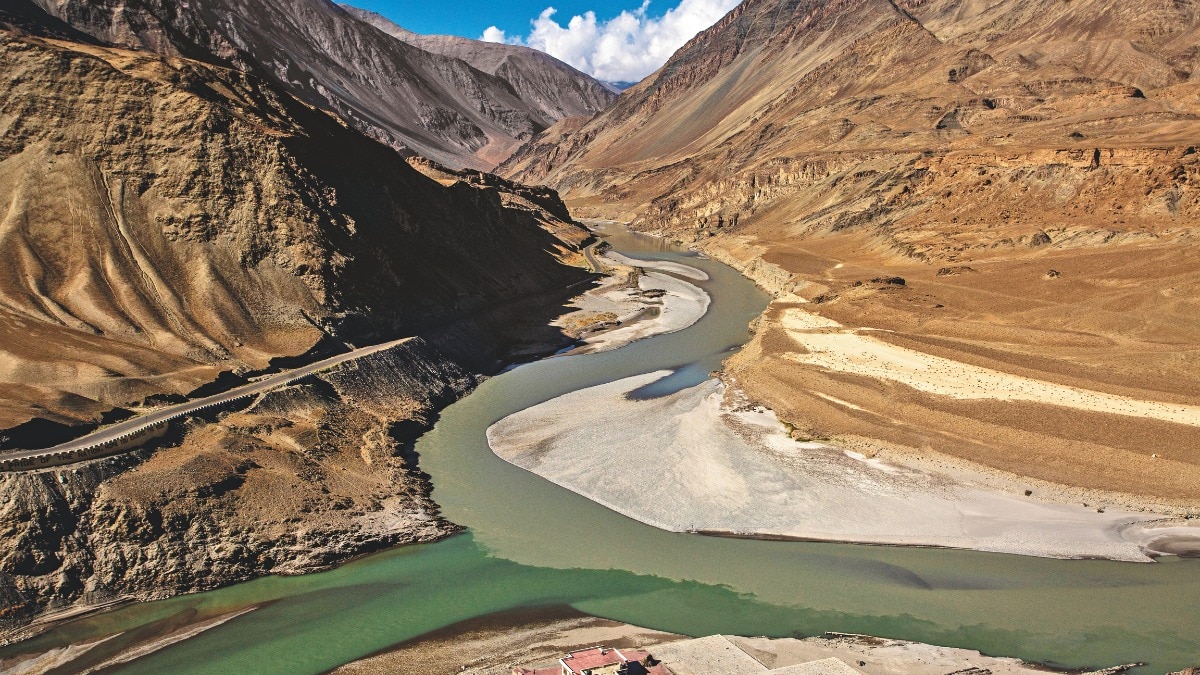
With the Indus Waters Treaty turning 66 on September 19, an agreement that has survived wars, military skirmishes and repeated diplomatic crises between India and Pakistan faces perhaps its most serious test.
Signed in Karachi on September 19, 1960, with World Bank involvement, the treaty was once regarded as a rare example of sustained cooperation between two hostile neighbours. It divided the six major rivers of the Indus Basin between the two countries and created mechanisms for data sharing, technical consultations and dispute resolution. More than six decades later, however, the agreement has become central to one of South Asia’s most consequential strategic disputes.
The treaty gave India unrestricted use of the eastern rivers—the Ravi, Beas and Sutlej—while the western rivers—the Indus, Jhelum and Chenab—were allocated primarily to Pakistan. The western rivers account for roughly four-fifths of the basin’s total flow.
The arrangement was unusual because India, as the upper riparian state, accepted extensive restrictions on its use of the western rivers while Pakistan gained priority over most of the system. At the same time, India retained treaty-defined rights to certain uses, including run-of-the-river hydropower projects.
The treaty also established the Permanent Indus Commission as a formal channel for information exchange, technical consultations and dispute resolution.
India continued to observe the treaty through the 1965 and 1971 wars and the 1999 Kargil conflict. Even during periods of full-scale military confrontation, water flows were not turned into a weapon.
That restraint, some experts argue, gave Pakistan an unusually long period to strengthen its own water infrastructure. Instead, the country remained heavily dependent on the western river system while its population expanded and storage and irrigation infrastructure struggled to keep pace. The result is a paradox: Pakistan has access to one of Asia’s great river systems but faces growing water insecurity.
One of its biggest structural weaknesses is storage capacity. Reservoirs such as Tarbela and Mangla have faced sedimentation and ageing infrastructure while major new storage projects have been delayed by financial, political and administrative problems. As the population has grown, per-capita water-storage capacity has come under increasing pressure.
“The problem is not simply the amount of water entering the Indus system but Pakistan’s ability to capture, store and distribute it,” an expert said.
During periods of heavy monsoon flows, huge volumes of water move through the basin and eventually into the Arabian Sea. But inadequate downstream storage, ageing canals, limited modernisation and weak water-distribution systems prevent Pakistan from fully converting these seasonal surpluses into dependable water security.
The problem is also internal. Water distribution has repeatedly fuelled tensions among Pakistan’s provinces, particularly between Punjab and Sindh. Islamabad’s water crisis is therefore not simply an external problem involving India; it is also an infrastructure and governance challenge that has accumulated over generations.
Pakistan’s fiscal pressures have further constrained investment. Major projects, such as Diamer-Bhasha and Mohmand, have faced prolonged delays, while debt, financing constraints and competing priorities have slowed investment in dams, reservoirs and irrigation modernisation. Allegations of corruption and diversion of resources have also added to concerns about the effectiveness of water-sector investment.
The Indus Treaty itself has increasingly become contentious over Indian hydropower projects on the western rivers. Projects, including Kishanganga, Ratle, Bursar, Sawalkot and Lower Kalnai, have faced Pakistani objections and prolonged dispute-resolution procedures.
From Pakistan’s perspective, the projects raise concerns about the timing and management of river flows. From India’s perspective, repeated objections have created uncertainty around infrastructure projects that New Delhi says fall within its treaty rights and are important for Jammu and Kashmir’s energy and economic development.
Jammu and Kashmir is estimated to possess more than 20,000 MW of hydropower potential while only a fraction of that capacity has been developed. For communities in the river valleys, delayed infrastructure is not merely a diplomatic issue; it can mean delayed electricity, employment, investment and economic development.
The decisive turning point came after the April 2025 Pahalgam terror attack, in which 26 people were killed. India subsequently announced that it was placing the Indus Waters Treaty in abeyance, linking the decision to Pakistan’s alleged support for cross-border terrorism. The move fundamentally changed the strategic meaning of the treaty. For more than six decades, India had treated water cooperation as largely insulated from the broader security relationship. After Pahalgam, New Delhi signalled that this separation could no longer be taken for granted.
Pakistan condemned the decision and described it as an act of aggression and a threat to its water security, while India argued that treaty obligations could not be divorced from the wider security relationship.
The dispute has since moved beyond engineering and diplomacy into international legal territory. India has invoked concepts including material breach and fundamentally changed circumstances under international treaty law, arguing that decades of cross-border militancy have undermined the political assumptions that allowed the treaty to function.
Pakistan, meanwhile, has portrayed India’s actions as “water terrorism” and an attack on civilian survival.
The competing positions underline the depth of the crisis. For Pakistan, the Indus is an existential resource that sustains agriculture, the economy and a large population. For India, the treaty increasingly represents an agreement whose original political assumptions no longer fully match its present economic, demographic, energy and security realities.
The circumstances have changed dramatically since 1960. India was then a newly independent and relatively poor country with limited industrial and energy requirements. Pakistan’s population was also a fraction of its current size.
Today, India is a major global economy with substantially greater energy and infrastructure needs, while Jammu and Kashmir has significant development requirements. Pakistan, meanwhile, faces rapid population growth, climate pressures, declining water availability per person and chronic infrastructure constraints. A water-sharing formula designed for the subcontinent of 1960 is therefore being tested by the realities of 2026.
The deeper lesson is that Pakistan’s vulnerability did not emerge overnight. The treaty provided considerable certainty over access to the western rivers, but that certainty was not matched by sufficient investment in storage, irrigation efficiency, water conservation and climate resilience.
A treaty can guarantee access to water; it cannot guarantee that a country will manage that water efficiently. At the same time, India faces the challenge of balancing greater utilisation of its treaty-permitted rights with the downstream consequences for Pakistan and regional stability.
The Indus Waters Treaty once demonstrated that India and Pakistan could compartmentalise their deepest disagreements and maintain cooperation even during war. Its current crisis demonstrates the limits of that approach. Water diplomacy cannot remain permanently insulated from geopolitics when the broader political relationship has collapsed.
As the treaty marks its 66th anniversary, the central question is no longer simply whether it can survive another India-Pakistan crisis. It is whether a framework negotiated in 1960 can remain workable in a radically different strategic, economic, demographic and climatic environment.
Any future settlement will have to address more than river allocations. It will require stronger domestic water management in Pakistan, greater infrastructure flexibility in India, clearer dispute-resolution mechanisms and, above all, a political environment in which cooperation once again becomes more valuable than confrontation.