
INS Kolkata vs PNS Hunain: Why Pak navy vessel is no match for Indian warship
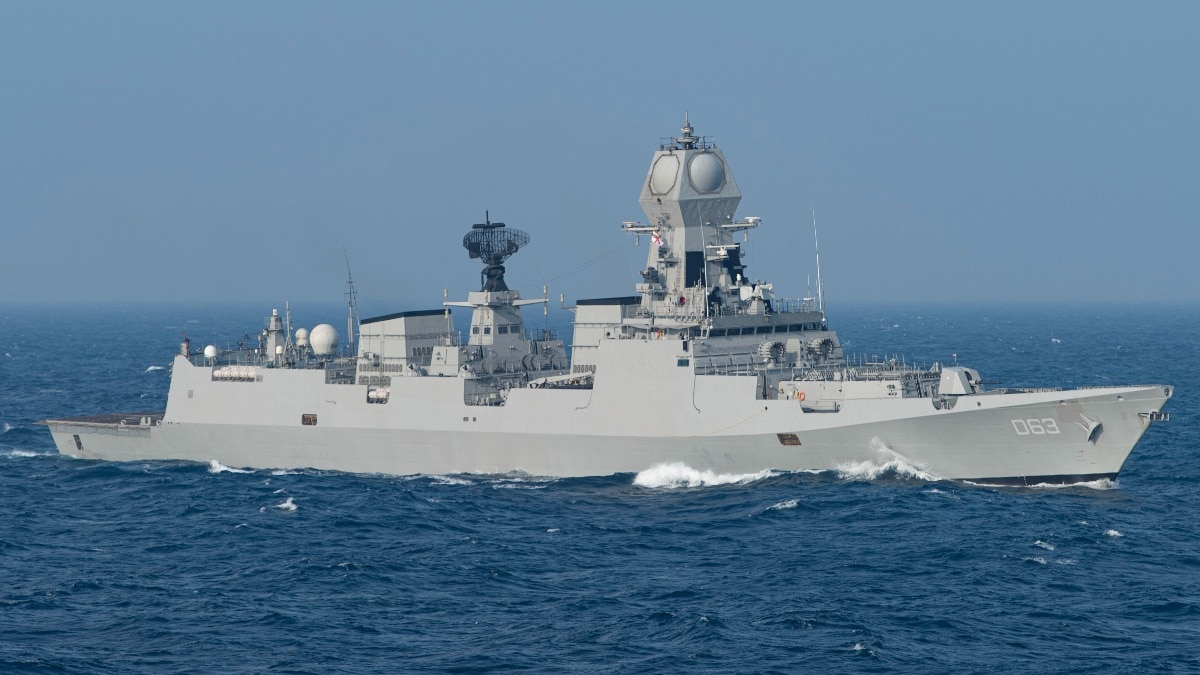
When Pakistan's PNS Hunain collided with the Indian Navy's INS Kolkata in the Arabian Sea on Tuesday, it was nothing less than a David vs Goliath moment. While the PNS Hunain is a 2,600-tonne offshore patrol vessel, INS Kolkata is one of India's most powerful and advanced warships, nearly three times its weight (7,400 tonnes). Clearly, Pakistan picked the wrong ship to mess with.
The outcome was there for all to see. While the Pakistani vessel suffered a massive dent on its front arch and had to return to the harbour for repairs, the Indian destroyer continued with its operational deployment. The MEA stated that INS Kolkata did not suffer any structural damage.
Defence analyst Sandeep Unnithan told India Today that the difference between the two warships is "enormous".
"Hunain is an offshore patrol vessel that has been slightly upgunned with more missiles. INS Kolkata is one of the largest frontline ships of the Indian Navy. That ship is a monster," Unnithan said.
The incident, however, has sparked diplomatic tensions, with both countries summoning envoys. India said the warship was on a routine surveillance mission in the North Arabian Sea when the Pakistani vessel started to shadow it. The PNS Hunain was in the region as part of the Pakistan navy's Sea Spark exercise.
Sources said the Pakistani ship was moving at high speed before a close-range manoeuvre resulted in it grazing INS Kolkata. According to reports, PNS Hunain suffered a huge dent and a possible crack. An OSINT account, War and Gore, claimed that four Pakistani personnel were injured in the incident. However, there has been no official statement from Pakistan.
The incident, however, has brought into sharp focus the striking mismatch in the capabilities of the ships involved - INS Kolkata and PNS Hunain.
Unnithan said the incident could have gone horribly wrong for Pakistan. "If INS Kolkata had turned around, to protect its crew, and rammed the Pakistani ship, it would have just toppled over and sunk. It was a very dangerous kind of manoeuvre that Pakistan attempted," he said.“Indian Navy should be empowered to protect their warships and vessels when they come close to Pakistani naval assets of this kind, given the history” says @SandeepUnnithan.#PNSHunain #IndianNavy #Pakistan #IndiaPakistan #IndiaFirst | @gauravcsawant pic.twitter.com/PIYBjNDmp1— IndiaToday (@IndiaToday) September 16, 2026PAK'S PNS HUNAIN IN FOCUS
PNS Hunain is essentially a Yarmook-class patrol vessel designed for maritime security, surveillance and limited combat capabilities. Commissioned in 2014, the PNS Hunain is about 98 metres long and has a displacement of around 2,600 tonnes.
According to Dutch shipbuilder Damen Shipyards, the corvette is basically intended for extended maritime-security missions. It comes with diesel engines and can reach speeds of up to 25 knots. The vessel can carry a medium helicopter, a UAV and rigid inflatable boats (lightweight boats).
Since such vessels are used for surveillance, they have limited naval combat capabilities. The PNS Hunain can reportedly carry anti-ship missiles, air-defence systems, and a 30 mm naval gun.
The INS Kolkata, on the other hand, packs a much bigger punch. Now, whether the captain of PNS Hunain was simply unaware of the ship's limitations when he attempted to shadow the destroyer, or deliberately wanted to play mischief, may never be known.
What is known, however, is that Pakistan was clearly barking up the wrong tree. The INS Kolkata is a much larger guided-missile destroyer, built for multi-dimensional combat to take on air, surface and underwater threats. The purported damage suffered by PNS Hunain. The image could not be independently verified by India Today INS KOLKATA PACKS A BIGGER PUNCH
Compared to PNS Hunain's 98-metre length, INS Kolkata is 164 metres long and has a maximum speed of 30 knots. In fact, the INS Kolkata, commissioned in August 2014 by Prime Minister Narendra Modi, is among the largest warships built in India.
However, the biggest difference is not simply the size, but what the ships are built to fight.
INS Kolkata carries a sophisticated suite of weapons and sensors, including the BrahMos supersonic surface-to-surface missiles. It is also equipped with long-range surface-to-air missiles, a 360-degree radar, a 76-mm gun, and AK-630 close-in weapon systems.
For anti-submarine warfare, it comes with torpedo launchers, rocket launchers, and a bow-mounted sonar system. The INS Kolkata can also operate two helicopters (usually Seaking and Chetak).
Unnithan underlined that INS Kolkata was designed to take a lot of beating, multiple hits and survive through warfare.
Its power and capability were on show during Cyclone Tauktae, which struck Mumbai in 2021. During the cyclone, wind speeds touched 120 km/hr, and waves reached up to nine metres (as high as a 5-6 storey building).
"The two ships that the Indian Navy sailed at that time were the INS Kolkata and the INS Kochi. These are the only ships of this size that can transit through the storm and rescue people," Unnithan recounted.
Simply, the INS Kolkata is a very different proposition altogether. As one user poignantly pointed out on X, "You run from a destroyer, you don't run into it!"
"What stupidity that a 2500T OPV decides to confront a 7500T Destroyer," a defence analyst, who posts from the X handle Mountain Rats, said.
This was, however, not the first time that a Pakistani naval vessel attempted a misadventure in international waters. On June 16, 2011, PNS Babur brushed past Indian frigate INS Godavari in the Gulf of Aden. Pakistan doesn't seem to be learning its lessons.- EndsPublished By: Abhishek DePublished On: Sep 17, 2026 12:01 IST


