Inside Lagos’ auto spare parts market where traders protested Chinese retailing activities - Premium Times Nigeria
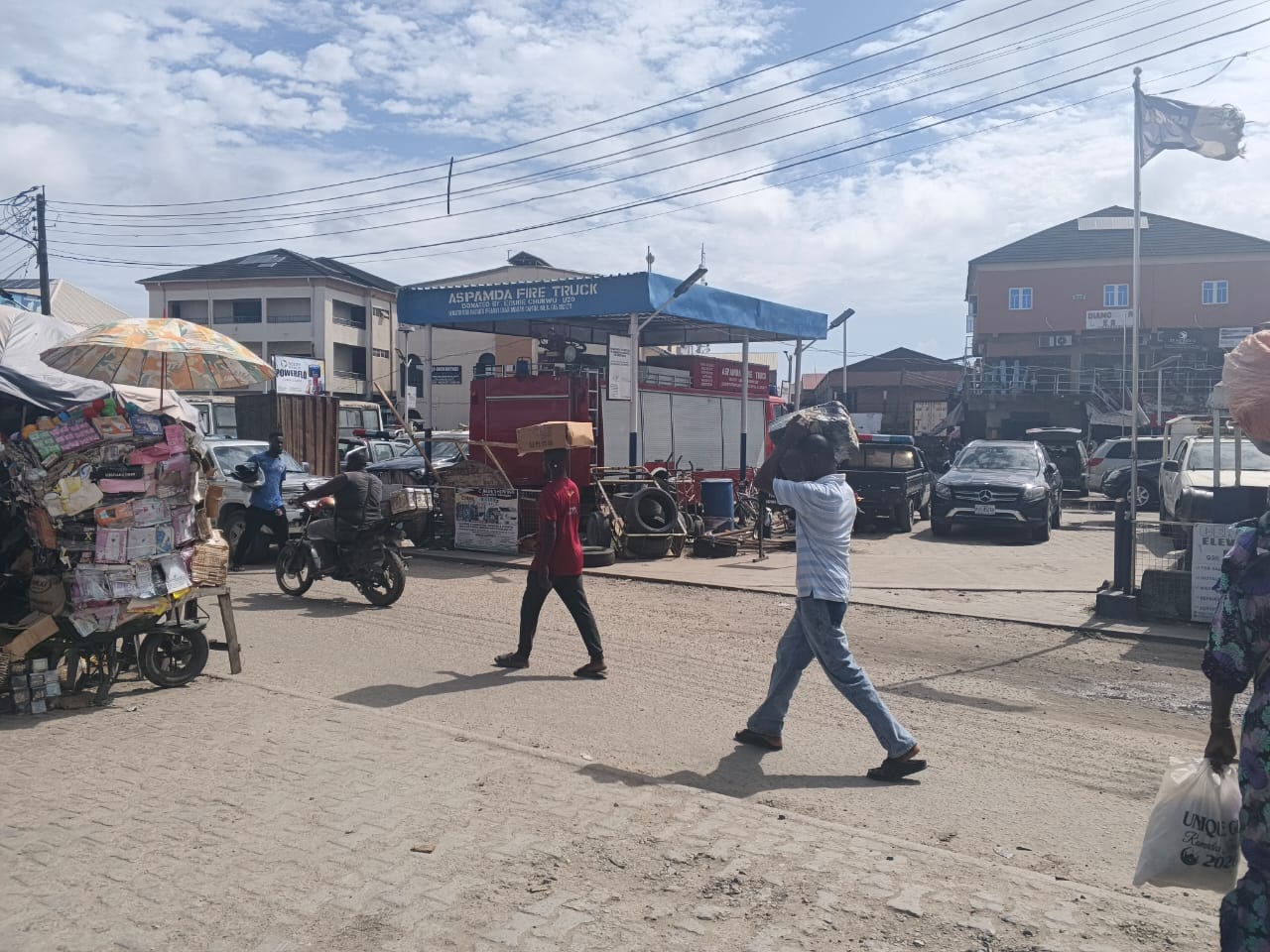
ASPMDA, Lagos International Trade Fair Complex, Lagos.
The recent protest by some automobile spare parts retailers of Auto Spare Parts and Machinery Dealers Association of Nigeria (ASPAMDA) at Lagos International Trade Fair Complex, revealed varying demands between Nigerian retailers and Chinese businesses operating in the market.
On Tuesday, some ASPAMDA traders at the Lagos International Trade Fair Complex protested against the alleged involvement of some Chinese nationals in retail trading.
The protesters had called for Chinese businesses to leave the market, accusing them of selling directly to customers and competing with local retailers.
The protesting traders held placards, some of which read, “Chinese must go” and “They should go far from our market environment and not be taking our customers,” according to a video that circulated online.
While normalcy has since returned at the market after the protest, the accounts of traders and other stakeholders show that concerns over the relationship between Chinese wholesalers and Nigerian retailers remain.
However, stakeholders at the market said the protest was mainly about the boundaries between wholesale and retail activities, rather than a demand for Chinese businesses to leave Nigeria.
During a visit to the market following the protest, business activities had returned to normal, with traders attending to customers.
Ngozi Emechebe, National President of ASPAMDA, told PREMIUM TIMES on Thursday that the association had brought the situation under control following intervention by the police and local government authorities.
“I’m happy you heard our press conference with the local government chairman. We have it under control already,” he said.
Mr Emechebe said the call for Chinese businesses to leave the market was not an option, adding that the police were investigating the circumstances surrounding the protest.
“This is the first type of protest, but that ‘Chinese must go’, it’s not possible,” he said.
When asked about the update concerning the issue, the market association president said the police had promised to investigate the root cause of the protest and establish how it started.
Mr Emechebe declined to comment extensively on the complaints raised by the protesters, saying the matter should be allowed to take its course.
“I will not dig deep into this thing because the rumours are still out. Let’s just allow the Nigerian police to investigate and get to the root of the matter. How it started,” he said.
He, however, said the association had already been working on the issue of separating the activities of Chinese wholesalers from those of Nigerian retailers.
“What they are asking for is a very small thing that we have been doing ourselves, and we are implementing it,” he said.
According to him, Chinese businesses in the market could be seen conducting transactions with Nigerian traders, even after the protest.
“If you go around the market, you can see the Chinese doing business just with Nigerians,” he said, adding that the police report would provide more clarity on the dispute.
Similarly, Paulinus Ojukwu, Chief Security Officer of ASPMDA, said the protesters did not notify market authorities before embarking on the demonstration.
Mr Ojukwu said security personnel intervened to prevent the situation from escalating, confirming that business activities resumed after security officials’ intervention.
“We called them to order and made sure nothing was destroyed during the protest, but everything is back to normal now,” he said.
John Chidebere, a motor spare parts retailer, said the protesters were concerned about the effect of direct sales by Chinese businesses on local retailers.
He said Nigerian importers typically incur costs and wait several months for goods imported from China to arrive in the country, while Chinese businesses operating in the market could sell directly to customers.
“If we import from China, we will have to wait for two to three months before it gets to Nigeria. And if you calculate both the money you used for clearance, your profit will not be more than N1,000, and you will also want to add to it to gain profit.
“But as Chinese people enter the market, they will sell it directly to our customers with the same amount we get from them, so there’s no money for house rent or upkeep,” he said.
Mr Chidebere also alleged that some Chinese traders sell products in smaller quantities directly to customers, a practice he said puts pressure on local retailers.
“They even sell in bits to the customers and they will even reduce their quality before selling for us again,” he said.
He said the protesters were seeking a resolution to their complaints rather than trying to cause damage.
“To me, the protest is based on complaints about what they are doing to us. We are not doing it by our own power, and even starters need money to do well. People even think we include additional prices on what we sell, not knowing that we sell the same amount we buy,” he said.
Another auto spare parts dealer, who identified himself as Chief Osigwe, said the concern among retailers was that Chinese importers were selling directly to the same customers they supplied.
“The importers will give you the market and they will even sell it to customers for the same amount and they will even make less money. How much do you expect them to gain and how do you expect me to feed?” he said.
He said retailers were not demanding that Chinese businesses leave Nigeria but wanted them to operate outside the retail space occupied by local traders.
“What we are saying is that they should give us a chance to sell in the market, let them go somewhere else and they also have shops. We didn’t say they should go out of Nigeria; they should just go out of here,” the auto spare parts trader said.
According to him, Chinese wholesalers could direct retail customers to Nigerian retailers instead of selling directly to them.
“What we are saying is, if people come to you to buy, just tell them you only sell for people in bulk, and direct them to us to buy,” he said.
Clement Ebere, another trader, said the dispute had affected the traditional layers of distribution in the spare parts business.
“We, the Igbos, import from them in quantity, and now they bring it down here and sell it to the motor parts users, even though business is in layers, which is not good,” Mr Ebere said.
Mr Ebere said he was not calling for Chinese businesses to leave Nigeria but wanted an arrangement that would allow local retailers to remain viable.
“With my understanding, I’m not saying the Chinese should leave, but it should be negotiated. They should be considerate so we can be able to cater for our daily needs.
“They can buy from China but not at that same unit price they sell to us. That’s not a good way to do business,” Mr Ebere said.
He said any arrangement should establish limits around where and how Chinese businesses sell their products.
“If they want to maintain their stance, it should not be within the same perimeter. Their prices should be negotiated because I can also decide that I want to go outside the country to do business, and if I do the same thing, I won’t feel right within me. It’s not right to ask them to leave, but there should be limits to it,” he said.
PREMIUM TIMES’ efforts to speak to some of the Chinese wholesalers proved abortive as they declined to speak on the matter. At a section of the market, a Chinese trader told this newspaper he doesn’t speak English, and two others declined to speak to this medium.
However, Blessing Nneka, an attendant at a Chinese spare parts wholesale complex, said the protesters did not damage the shops or physically attack her employers.
“On the day of the protest, they were saying that the Chinese must go, but they did not touch my boss and his wife. They said they just wanted them to leave,” she said.
According to her, the protesters remained outside the complex and did not damage property.
“The thing I know is that, when they came, they did not come inside and they didn’t spoil anything; they just stood there,” she said.
Ms Nneka said she was not certain about the exact reason for the protest but understood that the protesters were concerned about the distinction between wholesale and retail activities.
“We don’t even know their reason for protesting, so they said they cannot differentiate between retailers and wholesalers and they just sell to everybody,” she said.
She added that some traders appeared to believe that all Chinese wholesalers operating in the area had separate shops within the main market.
“They think it’s all Chinese wholesalers that have separate shops in the main market, but we only sell here,” she said.
Speaking with PREMIUM TIMES on Wednesday, investment research analyst Felicia Awolope said there is no law preventing foreign businesses operating in Nigeria from choosing between business-to-business (B2B) and business-to-consumer (B2C) models, arguing that the idea of Chinese traders selling directly to retailers does not, by itself, constitute a violation of Nigerian law.
Ms Awolope, who is head of investment research at Meristem Securities, covering the fast-moving consumer goods (FMCG) sector, said Nigerian traders protesting the activities of Chinese businesses at the Lagos Trade Fair Complex could instead explore collaboration with their foreign counterparts.
“The people protesting, it is not as if the Chinese people are violating any law. They have the right to choose to go B2B, B2C, anyhow they want to do their business. And the fact that they choose to interact with retailers directly does not violate any law,” she said.
According to her, Nigerian traders already have established distribution networks and could use that advantage to develop mutually beneficial relationships with Chinese businesses seeking to establish distribution networks in the country.
“Instead of protesting, I would expect what would have made more sense or what would have been more effective would be the traders in Lagos trying to collaborate. They still have a better distribution network to retailers compared to the Chinese that are just coming in,” Ms Awolope said.
She said the absence of a legal requirement for businesses to sell through middlemen means businesses can choose to deal directly with final consumers or retailers, provided they comply with applicable laws and regulations.
“There’s no law that says that you have to use middlemen for your business. There’s no law that says that. Sometimes it’s because of gaps that their own middlemen practices have opened up.
“That’s why the Chinese people would get access to retailers easily because people want better pricing, better services and all that,” she added.
While responding to an X video posted by the Senior Special Assistant to Governor Babajide Sanwo-Olu on New Media, Jubril Gawat, on Wednesday, in which the area police commander said arrests of the protesters would be made, Ms Awolope urged the authorities to prioritise mediation between the affected parties rather than responding to protests solely through arrests.
She noted that such arrests would need to be justified by conduct such as violence, vandalism or harm to people.
“But to be honest, what everybody should prioritise would be the consumers because they have the financing,” she said, adding that consumers ultimately determine which distribution channel succeeds through their purchasing decisions.
She said increased competition could also put pressure on businesses to improve their pricing and services, potentially giving consumers greater bargaining power.
“I like competitiveness. It’s going to help with pricing for the final consumers. We’ll get more value because now our bargaining power is higher,” Ms Awolope said.
On Kenya’s reported restrictions on foreign businesses engaging in retail activities, she said the legality of such restrictions would depend on the country’s domestic laws.
“If the Kenya government has local laws that prohibit foreigners from selling to final consumers, then the foreigners have violated their laws. The action can be taken,” she said.
Ms Awolope, however, said she was not aware of an equivalent Nigerian law prohibiting foreign businesses from selling directly to final consumers.
“In the case of Nigeria, I’m not sure. I’ve not extensively checked from what I know. I’m not sure if there’s any law prohibiting that,” she said.
The investment analyst said the Nigerian government could consider mediation between local traders and Chinese businesses to address the dispute while preserving competition in the market.
“Personally, I think mediation is the best thing that the government can do. Not just tell the foreigners, you can’t do this, that’s the end. And not just tell the protesters that you’ll be arrested because you protested,” she said.