Inside Tata's power struggle: The fight beyond Chandrasekaran and Noel Tata
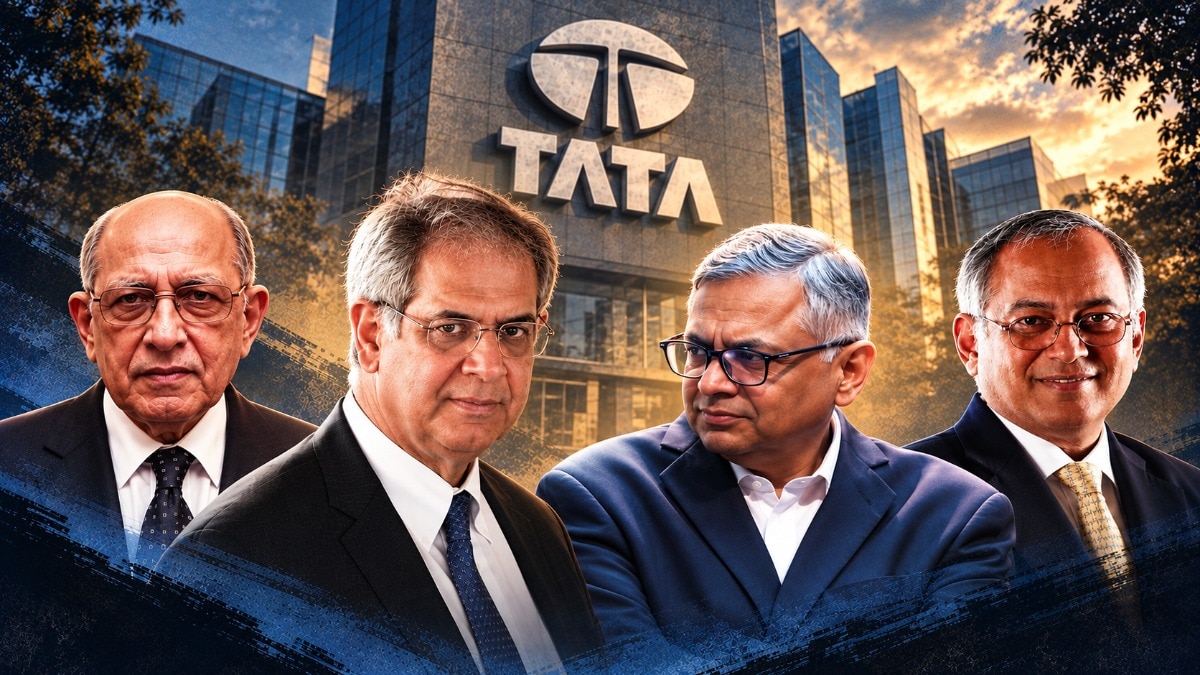
Weeks after N Chandrasekaran’s reappointment was approved by the Tata Sons board and Tata Trusts Chairman Noel Tata challenged the decision, the fight is moving beyond the company’s boardroom.
The latest fault line is inside Tata Trusts itself.
Venu Srinivasan and Vijay Singh, vice-chairmen and trustees of the Sir Dorabji Tata Trust, have questioned the process through which the Trusts backed a proposal to restructure Tata Sons and potentially avoid a listing. They said they were not consulted before the proposal was sent to the Tata Sons board.
That puts a new question at the centre of the Tata Sons feud. Who really gets to decide what Tata Trusts wants from the company it controls?
Tata Trusts owns about 66% of Tata Sons. Its position is therefore crucial to the future of the holding company, whether the issue is Chandrasekaran’s tenure, a possible listing or the proposed restructuring.
The immediate dispute is over a September 28 proposal to merge Tata Electronics Systems Solutions and Tata Consulting Engineers with Tata Sons.
Tata Trusts has presented the plan as an alternative to listing. The idea is to make Tata Sons a more operating-focused company, potentially changing its regulatory status and allowing it to avoid the listing requirement that follows from its classification as an upper-layer NBFC. The proposal would still need to be considered by the Tata Sons board and receive the necessary regulatory approvals.
Srinivasan and Singh have not simply opposed the restructuring. Their objection is first about how the proposal was approved and communicated.
In a September 30 letter to fellow trustees, as reported by The Economic Times, they said no meeting of the Sir Dorabji Tata Trust had been held to discuss the proposal before it was sent to Tata Sons. They also said they learnt about the accompanying public statement from public sources. They questioned whether the letter and statement could represent the collective position of the Trust when the trustees had not authorised them.
The two trustees also questioned whether it was appropriate for a shareholder to ask the Tata Sons board to “approve” a restructuring rather than simply put the proposal before the board for consideration.
Their argument is that the Tata Sons board must independently assess the legal, financial, commercial and regulatory consequences of such a major restructuring. They have also raised concerns that direct involvement by a public charitable trust in commercial decision-making could have implications for the Trusts’ charitable status.INSIDE TATA TRUSTS
The Tata Trusts structure makes this more complicated than a normal shareholder dispute.
The Trusts are a group of charitable institutions, each governed by its own trust deed and trustees. The Sir Dorabji Tata Trust (SDTT) is one of the key trusts through which the Tata family’s charitable institutions hold their stake in Tata Sons.
Noel Tata chairs the Tata Trusts. Venu Srinivasan and Vijay Singh are trustees and vice-chairmen of the Sir Dorabji Tata Trust. The Trust appointed Srinivasan as a trustee and vice-chairman in November 2025.
So when trustees disagree, the issue is not simply who has the louder voice. The question is what process produces the Trust’s institutional position.
That matters because Tata Sons is a separate company with its own board. Tata Trusts can exercise shareholder rights, but the Tata Sons board still has to make decisions in accordance with the company’s Articles of Association and its legal responsibilities.
If trustees do not agree on a proposal involving Tata Sons, can the chairman or a group of trustees present it as the position of the Trust? Or does the matter first require a collective decision by the trustees?
Srinivasan and Singh are arguing for the latter in the current dispute.
The same divide was already visible when Chandrasekaran’s reappointment came up. On September 17, the Tata Sons board approved another five-year term for him. Noel Tata opposed the move, while Srinivasan voted in favour.
Tata Trusts subsequently challenged the validity of the resolution, arguing that the Articles of Association required the support of its nominee directors for the appointment and that the chairman’s casting vote could not overcome that requirement.
Tata Sons has disputed that interpretation and maintained that the reappointment was valid.
The episode showed that Tata Trusts’ nominees on the Tata Sons board do not necessarily take the same position as the chairman of the Trusts on major decisions. The restructuring dispute has now exposed a similar disagreement within the Trusts themselves.
The governance fight has another strand.
Hanno One Warehousing, a company linked to Chandrasekaran’s wife Lalitha and son Pranav, has entered into projects involving TVS Motor across Tamil Nadu and Karnataka. Documents reviewed by India Today TV indicate a combined estimated project value of around Rs 436 crore.
In Tamil Nadu, TVS Motor leased around 17 acres at Uddanapalli to Hanno One. Documents filed with HDFC Bank described a roughly 3.3-lakh-square-foot facility as the “TVS Motors Warehouse Project”, with an estimated project cost of Rs 106.3 crore.
In Karnataka, Hanno One sought 35 acres near Mysuru for an industrial park described as serving TVS Motor and its Tier-1 suppliers. The proposed investment was around Rs 330 crore.
The connection matters because Venu Srinivasan is chairman emeritus of the TVS Group and also a Tata Trusts nominee on the Tata Sons board. He voted in favour of Chandrasekaran’s reappointment.
While that does not, by itself, establish a conflict of interest, it does raise a specific governance questionere the Chandrasekaran-family interests in Hanno One and its TVS-related business relationships disclosed to the relevant bodies, and did they create any obligation for Srinivasan to disclose or recuse himself from particular decisions?
Tata Sons has said the formation of Hanno One was disclosed and that the TVS transactions did not require separate disclosure to the Tata Sons board.
The existence of a commercial relationship between Hanno One and TVS Motor therefore cannot simply be treated as proof that Srinivasan’s vote was compromised. The relevant issue would be whether the relationship triggered a disclosure or recusal requirement under the applicable rules and, if so, whether those requirements were followed.
That distinction could become important if Noel Tata or Tata Trusts seeks to rely on the relationship in any legal challenge to Chandrasekaran’s reappointment.
But the immediate question is whether Tata Sons will take up Tata Trusts’ restructuring proposal and whether the RBI will accept the regulatory consequences of such a move.
And some of the harder questions are inside the Trusts. Was the September 28 restructuring proposal properly authorised? If trustees disagree, how is the Trust’s formal position determined? How much can Tata Trusts direct or influence the commercial decisions of Tata Sons?
And if the Chandrasekaran reappointment is challenged in court, will questions over the Articles of Association, the Trusts’ governance and the Hanno-TVS relationship become part of that case?
For now, those questions remain unresolved.
What began as a fight over Chandrasekaran’s reappointment has widened into a dispute over who speaks for Tata Trusts, how that authority is exercised and how far it extends into Tata Sons.
Whether the competing claims end in a court, a regulator’s office or another round of boardroom negotiations is still unclear. The unanswered questions may ultimately matter as much as the decisions already taken.- Ends
Koustav Das is the head of the business desk at IndiaToday.in, where he oversees coverage of economic policies, banking, financial markets, and personal finance. Originally from Kolkata, Koustav has been associated with the India Today Group since 2018. He began his journalism career in 2015, after completing his post-graduation from the Indian Institute of Journalism and New Media (IIJNM).
Before joining India Today, he worked with publications including Deccan Chronicle, Financial Express, and ET Now Digital, covering salary trends, taxation, and corporate governance. Over the years, he has built a reputation for breaking down complex financial concepts into clear, accessible narratives.
Driven by a curiosity to connect numbers to real-life stories, Koustav’s reporting on India’s rent, affordable housing, and salary crises has sparked wider conversations about the financial pressures confronting urban households. He specialises in stories that blend data, policy, and human experience, making finance both relevant and relatable for readers.
Fluent in English and Hindi, Koustav is passionate about making finance accessible and meaningful for everyday readers. Outside of work, he enjoys listening to rock music, watching crime and thriller movies, playing video games and the guitar, and spending time with his dog.