
Inside the Japanese university that has produced 14 Olympic wrestling golds - The Indian Express
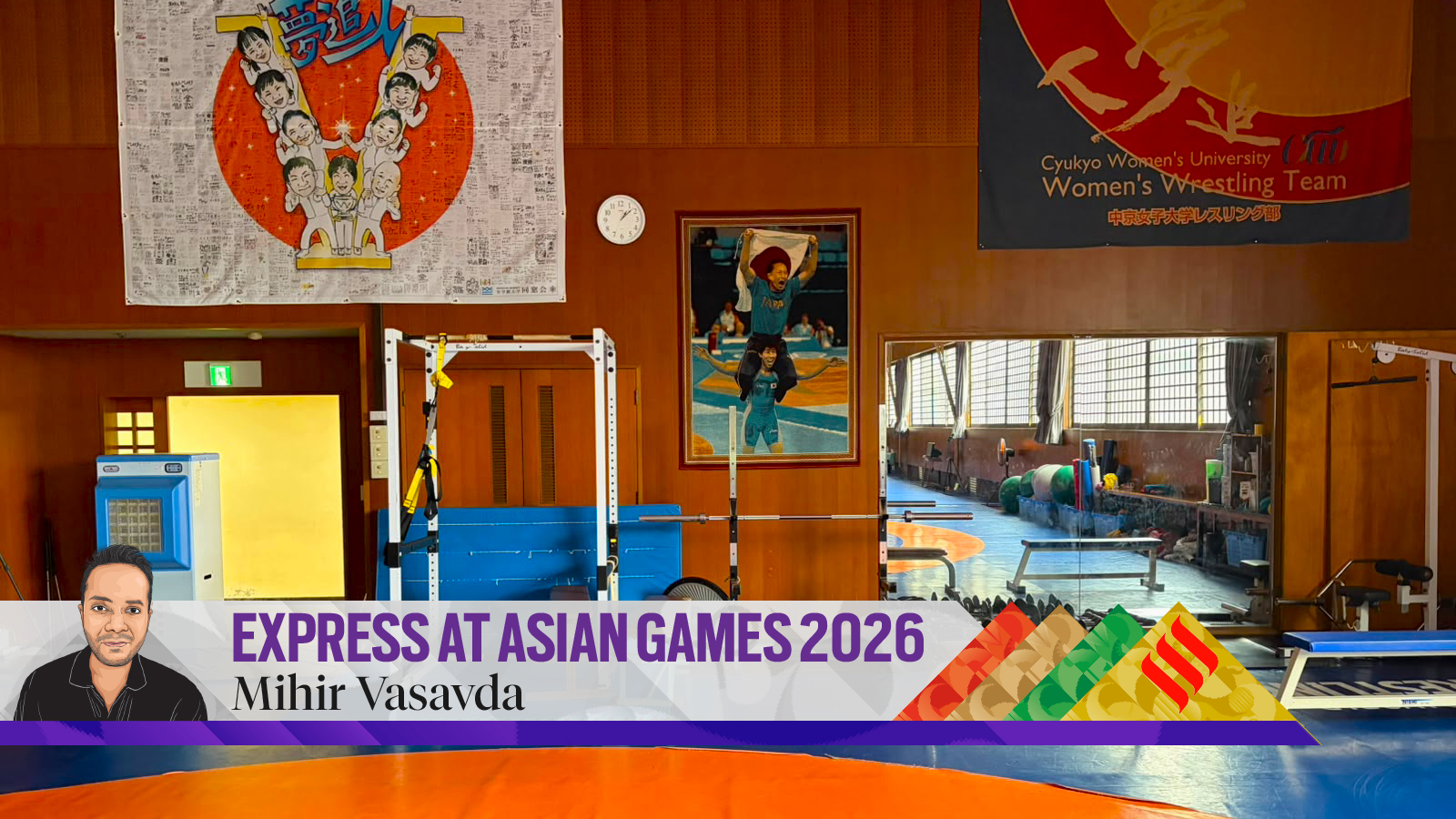
Two floors beneath a grey, unremarkable building in a quiet corner of Obu, on the outskirts of Nagoya, a long corridor leads to one of Japanese wrestling’s great rooms.
There are no grand entrances or imposing facades. Just photographs along the walls, generation after generation of Japanese wrestling champions, their faces caught in moments of triumph, focus and action. There’s Saori Yoshida, widely considered the greatest of all time. There’s Kaori Icho. And further along, more champions, more history.
At the end of the corridor, a narrow stairway descends two floors to a wrestling hall. It’s an ordinary room. What happened inside it was anything but.
Shigakkan’s women’s wrestling programme has produced 14 Olympic gold medals, India has won just 10 in Olympic history, along with generations of world and Asian champions.
To understand how that happened, one has to go back before the medals: to a university that was burned during World War II, to the long rebuilding that followed, and to a president who arrived expecting to find healthy athletes but instead found injuries and anaemia.
“I thought this should be a University of Healthy People, but I saw so many unhealthy individuals,” says Kuniko Tanioka, who became president of the university 40 years ago.
Tanioka, a Nagoya native, began her association with what was then Chukyo Women’s University 47 years ago, after graduating in biology from the University of Toronto. The place already had a strong sporting culture, particularly in athletics, but what she found troubled her. Young athletes were injured, some were anaemic and some had stopped menstruating after losing too much blood. “It was a crooked situation because the university offered courses in anatomy, physiology, elementary biochemistry, sports medicine, and nutrition,” Tanioka tells The Indian Express.
The university itself had been through a far greater rupture. Before World War II, its track and field team had sent three women to the 1936 Berlin Olympics, one finishing fourth or fifth. “But in the last year of World War II, America bombed Nagoya, and my university was heavily damaged. It took a long time to recover because all the buildings burned,” says Tanioka, also the honorary vice-president of the Japan Wrestling Federation.
The campus was eventually rebuilt on the outskirts of Nagoya, in what is now Obu. The war had cost Japan the 1940 Olympics, and Tanioka believes her university might have had Games medallists had they gone ahead. By the time Tokyo hosted the Olympics in 1964, the university was still recovering from the bombing.
Sport gradually returned to the university’s identity. “But in reality, they lacked nutrition, proper treatment, rehabilitation, and scientific knowledge,” she says. “I persuaded coaches, in vain, for long. Most of the time, they just told me, ‘we are professionals, we’ve always been doing it this way.'”
Eventually, she stopped trying and decided to build something herself. In 1988, the third year of her presidency, Tanioka established a new sport and team around three ideas: science, application and the independence of women.
At first, wrestling was hardly an obvious choice. Women’s wrestling had individual practitioners in Japan, but no established university teams and no regular home base. The national federation organised camps for a few weeks a year; the rest of the time, the wrestlers had nowhere permanent to train.
Then one day, a vice-president of the federation came to Tanioka with a suggestion. “They asked, ‘why not start women’s wrestling?’ I didn’t even know women’s wrestling existed then,” she says.
Her colleagues at the university were even less convinced. Some thought she meant professional wrestling. “I had to explain that there is amateur wrestling, too,” she laughs.
Tanioka chose it partly because she felt it suited Japanese women. Judo was already an Olympic sport for women, she says, and the two sports had some similarities. But she also saw an opportunity to build something from scratch, without inheriting the male-dominated coaching culture she disliked.
There was, initially, barely a place to build it. The university told her she could not use spaces already occupied by other sports. “So, on a clear day, we put the mat on the open ground. That’s how we started.”
To her, the philosophy mattered more. Women wrestlers training with men wasn’t conducive, she felt, because of the biological differences. “Men and women need different exercises,” Tanioka says. “Women are more linear, making it harder to build muscle, so practice should differ.”
The wrestlers were encouraged to apply what they learnt in the classroom to their training, devising their own schedules and understanding their bodies rather than simply following instructions. “The students applied their classroom knowledge to the sport, making their own schedules,” Tanioka says. “That was key to our success.”
By the time women’s wrestling got Olympic status, for the 2004 Athens Games, Shigakkan had already spent years developing that approach. With world champions emerging from the programme, the university created its Gold Medal Project, bringing together sports science, nutrition and other faculties around the same athletes.
One of the clearest examples was Saori Yoshida, one of the torch-bearers at the opening ceremony of these Asian Games. Her talent was evident from a young age, but she was too skinny, lacked stamina and struggled to build muscle. Then the coaches discovered what she was eating. “She only ate candy bars and skipped proper meals,” Tanioka says.
When the coaches confronted her, Yoshida left the university and went home. Her father, who had also been her first coach, told her to return. The nutrition department then brought in student volunteers to prepare breakfast at 6am. The wrestlers ran from 7am to 8am, ate a carefully planned meal, went to class and trained again in the gym before having dinner prepared for them in the evening.
Yoshida could not manage enough food in three meals, so she was given five. “The coaches said it was harder to make her eat than to teach her high-class skills,” Tanioka says. It worked. Yoshida began building muscle, her stamina improved, and by her second year she was a world champion, the first of 13 successive titles, three Olympic gold medals and four Asian Games titles.
Food remained part of the programme, but Tanioka did not want it to become another source of misery. In the early years, the wrestlers were made to eat large quantities of liver for its protein, minerals and iron. Yoshida hated it so much that she cried. Today, liver is rarely served. “We want the wrestlers to be happy,” Tanioka says. “Their lives are already strenuous. They are university students and must study.”
There are birthday cakes from a local shop and no blanket ban on sweets. Meals are built around protein, calcium and iron, with carbohydrates adjusted before competitions. Milk, yoghurt, cheese, chicken and eggs are staples. “They endure stressful practices, and eating should be enjoyable,” Tanioka says. “It’s also about setting up the right environment.”
The idea of how to build a wrestler begins even earlier. “We have wrestlers starting at the age of three,” says Kawase Katsuyoshi, the university coach. “They don’t grapple at that age, but the idea is to introduce them to the sport and get a feeling of the mat.”
Before they are taught technique, Tanioka adds, they are given a lesson in how to wrestle. They bow, shake hands and show the handkerchief before a bout, signifying that the wrestler is ready to clean up blood or fluids to keep the mat hygienic. “And you never touch the hair. They are strict about kids going against the rules. That reduces injuries,” Tanioka says.
Tanioka noticed the difference while watching younger women from other countries at a United World Wrestling workshop. “They were really fighting rather than playing wrestling,” she says. “In Japan, you don’t see that kind of scene. Every kid obeys the rules, avoiding rough games. They can grow as athletes without many injuries or fear, which is important.”
The emphasis on keeping athletes healthy is visible even in the building. Right beside the wrestling hall is the clinic of Dr Hideyuki Goto, a sports medicine specialist, putting treatment and rehabilitation within arm’s reach of the mat.
And yet, for all the science, planning and decades of work that have gone into Shigakkan’s success, Tanioka admits there is still something about Japanese women’s wrestling that she cannot quite explain. “Once, at a UWW reception, an American woman asked me why Japanese women’s wrestling is so strong,” she says.
It was a question Tanioka had wondered about herself. So she offered an answer. “I said, ‘Madam, you know the word ninja.’ She said, ‘Of course, my boy loves ninjas.’ In Japan, ninjas are not only men; we also have women ninjas. Perhaps Saori Yoshida and all those women are descendants of these ninjas.”
Over the course of a 18-year-long career, Mihir Vasavda has covered 2010 FIFA World Cup; the London 2012, Tokyo 2020 and Paris 2024 Olympic Games; Asian Games in 2014 and 2022; Commonwealth Games in 2010 and 2018; Hockey World Cups in 2018 and 2023 and the 2023 ODI Cricket World Cup. ... Read More
