Inside the JSC's Flawed Pursuit of Judge President Mbenenge - IOL
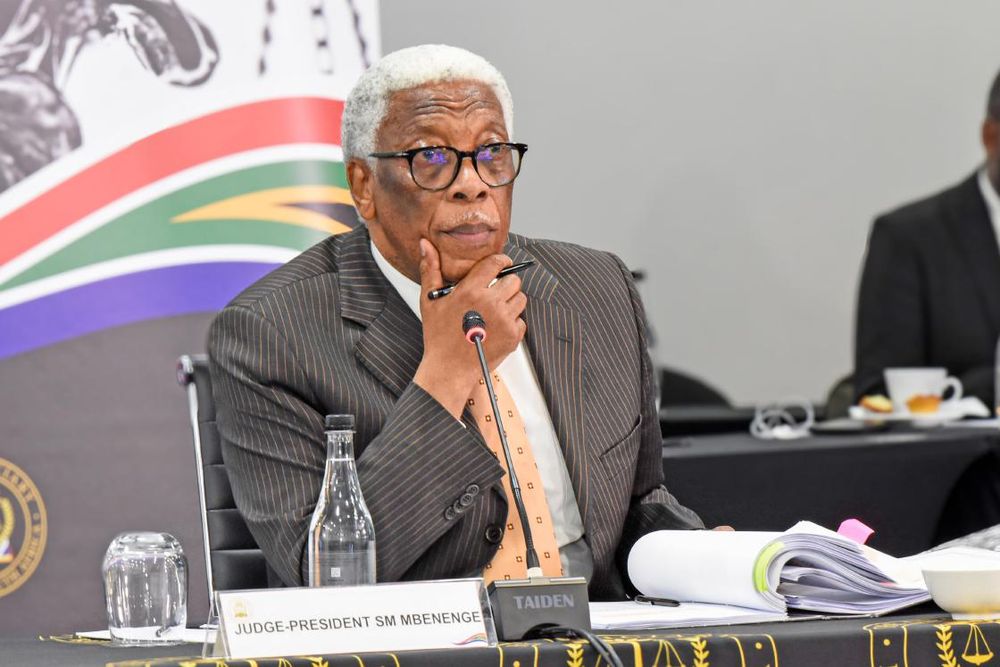
In a supplementary affidavit, Eastern Cape Judge President Selby Mbenenge alleges that the JSC reached its gross-misconduct finding before constructing reasons to defend it. The claims form part of a pending High Court review and have yet to be tested.
The supplementary affidavit filed by Eastern Cape Judge President Selby Mbenenge does far more than dispute an adverse decision. Drawing on the Judicial Service Commission’s own transcript and internal correspondence, it presents evidence suggesting that the disciplinary process worked backwards from a preferred result.
The outcome appears to have come first. The reasoning followed.
That is the disturbing picture emerging from Mbenenge’s account of the JSC’s deliberations of March 5, 2026, when it rejected the conclusion of the Judicial Conduct Tribunal and declared him guilty of gross misconduct – the constitutional threshold that opens the road to impeachment.
These allegations form part of a pending High Court review. They have not yet been determined by a court, and the JSC and other respondents remain entitled to answer them. The filing timetable gives the respondents until October 30, 2026 to submit their answering affidavits. What can already be examined, however, is the process described in the JSC’s own recorded deliberations and correspondence.
The Tribunal had spent 30 days hearing witnesses, examining evidence and assessing credibility. It found no sexual harassment, no proven abuse of power and no gross misconduct. It found that the exchanges between Mbenenge and court secretary Andiswa Mengo were mutually flirtatious, that he reasonably believed them to be welcome, and that when one proposition was rejected, he accepted the rejection and did not pursue it.
The Tribunal nevertheless criticised his conduct. It found that sexualised communication during working hours contravened Article 5.1 of the Code of Judicial Conduct and amounted to misconduct that fell short of gross misconduct.
That distinction is constitutionally decisive. Ordinary misconduct permits corrective action, including a reprimand. Gross misconduct places a judge’s career, office and reputation in jeopardy.
The JSC crossed that threshold without expressly overturning the Tribunal’s central factual findings.
According to Mbenenge’s supplementary affidavit, the JSC reached its decision through a secret ballot on three propositions formulated during the meeting by commissioners advocating a gross-misconduct finding. No collective reasons had been settled when the votes were cast. The task of producing reasons was left to the JSC’s litigation committee after the decision had already been taken.
The reasons were then circulated and adopted through email correspondence.
This raises more than a minor administrative concern. Reasons are meant to explain why a decision follows from the established facts and applicable law. When they are written after the vote by a smaller group, there is a danger that they cease to explain the decision and begin to defend it.
Mbenenge argues that the record demonstrates precisely this problem.
His affidavit states that parts of the eventual JSC report do not correspond with what commissioners discussed. Some propositions appearing in the report were apparently never articulated during the deliberations. Important qualifications raised in the meeting disappeared. Contentions advanced by individual commissioners later appeared as the reasoning of the institution.
Most troublingly, formulations in the JSC’s report allegedly resemble submissions made on behalf of Mengo. Those submissions reached the JSC three days prior to its meeting but, according to the affidavit, were never given to Mbenenge. He therefore had no opportunity to answer them, despite having reserved his right to reply.
His own written representations, by contrast, appear to have received little more than a passing reference during the recorded discussion.
If the record sustains this account, it cuts into the elementary principle that a person facing an adverse decision must know the case against him and receive a fair opportunity to respond. A hearing loses its legitimacy when one party’s submissions enter the deliberative chamber unseen by the other and later appear in the decision-maker’s reasons.
The transcript, as presented in the affidavit, also reveals what Mbenenge describes as material misrepresentations of the Tribunal’s work. Commissioners reportedly asserted that the Tribunal had ignored the imbalance of power between a Judge President and a junior court employee. Yet the Tribunal had expressly considered the hierarchy, heard expert testimony about power relations and concluded that the evidence did not establish an abuse of office.
The expert’s argument did not persuade the Tribunal. That is quite different from the Tribunal failing to consider it.
Power differences exist across countless workplaces and institutions. They demand scrutiny, but hierarchy alone cannot prove coercion. The legal question concerns whether power was used to procure, punish, intimidate or extract sexual compliance. On the Tribunal’s findings, neither it nor the JSC identified such conduct on the accepted facts.
The JSC’s reasoning therefore appears to have converted the existence of institutional rank into evidence of its abuse.
This risks substituting ideological presumption for tested evidence. Once hierarchy itself becomes proof of guilt, evidence loses its function. The accused person faces a proposition that cannot be disproved: his position supplies the offence, irrespective of how the exchange occurred or what the evidence establishes.
Commissioners also reportedly stated that the Tribunal had not been asked to determine whether sexual harassment occurred. Yet Mbenenge argues that the complaint, terms of reference and Tribunal report demonstrate that sexual harassment lay at the centre of the inquiry.
This allegedly incorrect premise then influenced the formulation of the ballot.
The JSC relied heavily on what its decision would “send to society” and how the public might perceive the judiciary. Public confidence undoubtedly counts. Yet confidence in a judicial institution cannot be secured through a process that bends evidence towards a socially approved conclusion.
Public confidence grows from consistency, procedural integrity and fidelity to law. It is weakened when an institution treats anticipated public sentiment as a substitute for legal reasoning.
One of the most revealing portions of the transcript concerns the commissioners’ attention to future litigation. Advocate Tembeka Ngcukaitobi SC is recorded as describing the preferred route as making the decision “impregnable” and “impossible to challenge”. The Minister of Justice reportedly moved from accepting the Tribunal’s findings towards supporting gross misconduct on the basis that this would reduce the risk of challenge.
The meaning and context of these remarks will undoubtedly form part of the respondents’ answer. On their face, however, they raise an obvious concern. A disciplinary body does not sit to litigation-proof a preferred outcome. It sits to determine the correct outcome from the evidence and the law. When protection of the institutional decision overtakes impartial evaluation, the prospect of review begins to shape the original verdict.
The process then risks abandoning the question, “What happened, and what does the law require?” for another: “How do we secure this outcome against judicial interference?”
Mbenenge further argues that the JSC never properly engaged with the constitutional threshold for gross misconduct. That standard is reserved for conduct so destructive of judicial integrity and public confidence that the judge becomes incapable of continuing in office.
The recorded deliberations moved between general statements about inappropriate conduct, workplace hierarchy, social messaging and the reputation of the courts. Yet misconduct and gross misconduct are not interchangeable. If every instance of unacceptable judicial behaviour becomes impeachable, Parliament’s distinction between corrective discipline and removal collapses.
The JSC’s position appears still more difficult to reconcile with the factual findings it left intact. It did not expressly reverse the Tribunal’s findings that the communications were consensual and flirtatious, that the disputed allegations were unproven, that Mengo had omitted some of her own messages, that her credibility had been damaged on material aspects, and that Mbenenge accepted the one identified rebuff.
Instead, it retained those findings while replacing the Tribunal’s legal conclusion.
This produces an institutional contradiction. The JSC “declined to accept” that there had been no sexual harassment, while stopping short of making a positive finding that sexual harassment had occurred. It then found gross misconduct on what it called the “admitted facts”.
The negative formulation allowed the Commission to occupy two incompatible positions: retaining the Tribunal’s factual findings while rejecting the conclusion flowing from them.
Mbenenge now asks the High Court to set aside the JSC’s decision and substitute it with a finding that he is not guilty of gross misconduct. Although he maintains that the Tribunal lacked authority to convict him of ordinary misconduct without properly notifying him of that case, he offers a pragmatic alternative. For the sake of finality, he is prepared to accept the Tribunal’s lesser finding and a reprimand.
That is not the stance of a judge refusing all accountability. It is an insistence that accountability remain proportionate, evidence-based and lawful.
The respondents may dispute Mbenenge’s interpretation of the transcript, explain the process by which the reasons were adopted or argue that the JSC was legally entitled to depart from the Tribunal. Their answers must be examined with the same care. The High Court, rather than the media, will decide whether the process was irrational, procedurally unfair or unlawful.
Yet the public is entitled to interrogate the documentary record now placed before that Court.
The JSC occupies an immensely powerful position between a judge and removal from office. That power demands a process more exacting than political instinct, reputational anxiety or ideological conformity. It cannot safely operate through secret ballots followed by retrospective reasoning. It cannot receive one party’s submissions without allowing the other to answer them. It cannot misdescribe a Tribunal’s report, disregard tested credibility findings and replace evidence with generalised social narratives.
The Mbenenge case now reaches beyond one Judge President. It raises urgent questions about who guards the integrity of the institution entrusted with guarding judicial integrity.
If the High Court finds that the supplementary affidavit accurately reflects the JSC record, the Commission will have done more than reach a debatable conclusion. It will have compromised the method through which a constitutionally devastating conclusion was produced.
When an institution entrusted with judicial accountability constructs its reasons only after reaching its verdict, public confidence is not protected.
* Gillian Schutte is a social critic, writer, and filmmaker whose work confronts power through a counter-hegemonic, class-based lens. She exposes neoliberalism, the whiteness construct, and the role of media in upholding dominant systems.
**The views expressed do not necessarily reflect those of IOL.