Interactive graphic: Road to a House majority
FOR SUBSCRIBERSDOJ is deploying a record number of monitors on Election Day FOR SUBSCRIBERSHow to watch election night: Key races, poll closing times, bellwether campaigns and moreFOR SUBSCRIBERSThe Data Dive: Steve Kornacki’s guide to early election night bellwethersFOR SUBSCRIBERS‘Terrible betrayal’: House Democrats consider whether to banish Michigan Rep. Haley Stevens FOR SUBSCRIBERSChatGPT and other AI tools rely on a small Brooklyn nonprofit for voting informationFOR SUBSCRIBERSTrump wants states to set aside ballots. So far, federal judges aren’t having it.FOR SUBSCRIBERSHow NBC News has prepared to cover election nightFOR SUBSCRIBERSWelcome to the gas price electionFOR SUBSCRIBERSJosh Shapiro takes on Pennsylvania Democrats’ biggest challenge: Beating Brian FitzpatrickFOR SUBSCRIBERSIs Brazil the exception to Latin America’s right-wing wave? Why the region is shiftingFOR SUBSCRIBERSNetwork of independent AI evaluators aims to boost public insight into AI giantsFOR SUBSCRIBERSThe fight for young men comes to MichiganFOR SUBSCRIBERSEnergy drinks linked to higher risk of cardiac arrest in 18-to-34-year-olds, study findsFOR SUBSCRIBERS‘A genuine toss-up’: Senate battle comes down to red states and Republican votersFOR SUBSCRIBERSTrump holds final rally of a 28-stop midterm blitz Slide 1 of 1Democrats enter the final sprint to Election Day as the clear favorites, polls show, though Republicans have money and geography on their side.
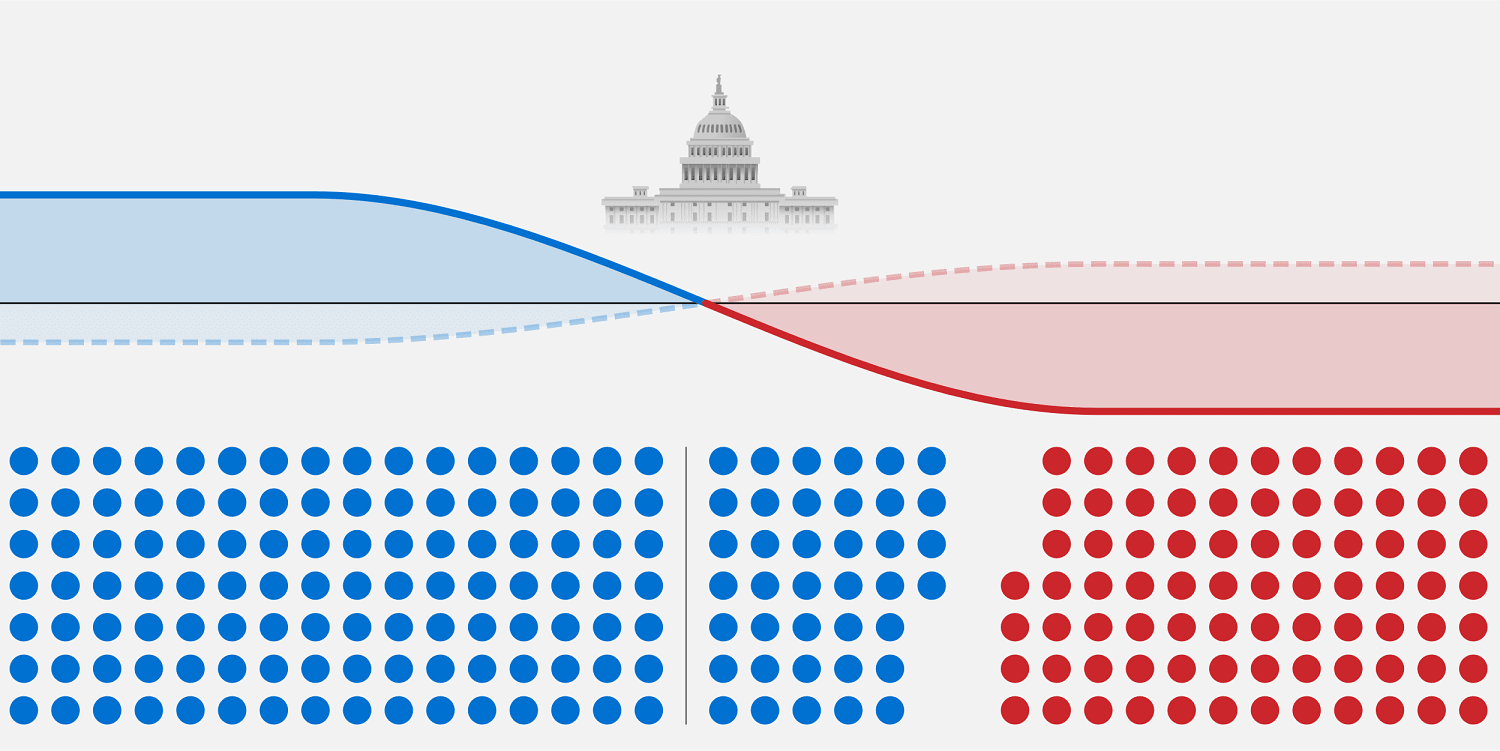
Currently, the Democrats hold 214 seats in the House, compared with 219 held by the Republicans, with two vacant seats. Democrats need to net just three seats to gain the majority; the question then becomes, how big is that majority?
The chances that Republicans maintain a majority control appear slim, but that outcome is still possible. The House battleground runs primarily through states and districts that President Donald Trump won in 2024, and Republicans attempted to shore up their structural advantage last year through redistricting. Those two factors could prevent Democrats from fully capitalizing on the increasingly favorable political environment even if they flip the chamber.
Explore the interactive below to see how Democrats could build a big majority, or Republicans could hang on.
The exact number of seats won by the Democrats and Republicans will be mostly determined by the size of the national partisan shift toward or against the Democrats. If the vote margin in all 435 House districts shifts 4.6 percentage points toward the Democrats from 2024, the party could win 218 seats — a one-seat majority.
FOR SUBSCRIBERSDOJ is deploying a record number of monitors on Election Day FOR SUBSCRIBERSHow to watch election night: Key races, poll closing times, bellwether campaigns and moreFOR SUBSCRIBERSThe Data Dive: Steve Kornacki’s guide to early election night bellwethersFOR SUBSCRIBERS‘Terrible betrayal’: House Democrats consider whether to banish Michigan Rep. Haley Stevens FOR SUBSCRIBERSChatGPT and other AI tools rely on a small Brooklyn nonprofit for voting informationFOR SUBSCRIBERSTrump wants states to set aside ballots. So far, federal judges aren’t having it.FOR SUBSCRIBERSHow NBC News has prepared to cover election nightFOR SUBSCRIBERSWelcome to the gas price electionFOR SUBSCRIBERSJosh Shapiro takes on Pennsylvania Democrats’ biggest challenge: Beating Brian FitzpatrickFOR SUBSCRIBERSIs Brazil the exception to Latin America’s right-wing wave? Why the region is shiftingFOR SUBSCRIBERSNetwork of independent AI evaluators aims to boost public insight into AI giantsFOR SUBSCRIBERSThe fight for young men comes to MichiganFOR SUBSCRIBERSEnergy drinks linked to higher risk of cardiac arrest in 18-to-34-year-olds, study findsFOR SUBSCRIBERS‘A genuine toss-up’: Senate battle comes down to red states and Republican votersFOR SUBSCRIBERSTrump holds final rally of a 28-stop midterm blitz Slide 1 of 1A shift smaller than 4.6 points would translate into the Republicans maintaining control of the House. For the Democrats to command a majority at least as large as the one they won in the 2018 midterms — 235 seats — the national shift toward the Democrats would have to be just over 10 percentage points. Of course, national trends don’t mean every district shifts exactly the same amount. Some districts will have a larger shift than the national average and others will have a smaller one. Still, the national trends will largely drive where the race is going on election night.
Stephen PettigrewStephen Pettigrew is a senior elections analyst on the NBC News Decision Desk.
John LapinskiJohn Lapinski is director of elections at NBC News.