International Day of Peace: A turbulent world needs more peace
By continuing to browse our site you agree to our use of cookies, revised Privacy Policy and Terms of Use. You can change your cookie settings through your browser.
Fighters of the paramilitary Rapid Support Forces arrive in a vehicle in the west of Omdurman, Sudan, August 19, 2026. /VCG
As conflicts continue to rage across the Middle East, Ukraine and Sudan, the world is facing a growing deficit of peace and security.
"Our world is the most violent it has been since World War II," Jorge Moreira da Silva, executive director of the United Nations Office for Project Services, said in a statement earlier this year, warning that the number of people forced to flee their homes was increasing by the hour.
The risks are not confined to existing battlefields. The 2026 Global Risks Report, based on a survey of 1,300 stakeholders worldwide, found that large-scale war recorded the biggest upward shift in perceived imminence among the risks assessed. Some 36% of respondents expected a large-scale war within one year, while 76% saw it as a risk within seven years.
Against this backdrop, the International Day of Peace, observed on September 21, takes on renewed significance. The question is no longer simply how to end individual conflicts, but how to build mechanisms capable of preventing confrontation from becoming the default way of addressing differences.
Vessels remain at anchor in the Strait of Hormuz in Bandar Abbas, Iran, September 12, 2026. /VCG
For China, a permanent member of the UN Security Council, this has been reflected in its call for a broader approach to international security.
In 2022, as the Ukraine crisis escalated, China proposed the Global Security Initiative (GSI), which calls for a common, comprehensive, cooperative and sustainable approach to security, respect for the sovereignty and territorial integrity of all countries, adherence to the purposes and principles of the UN Charter, and the peaceful resolution of disputes through dialogue and consultation.
By the end of 2025, the initiative had gained support from more than 130 countries and international and regional organizations and had been included in more than 140 bilateral and multilateral documents, according to China's Foreign Ministry.
At the recently concluded 18th BRICS Summit, China called for BRICS countries to become a pioneer in upholding peace and stability.
The call is part of a broader Chinese approach that places emphasis on dialogue, mediation and political solutions in addressing international and regional conflicts.
In 2023, China hosted talks between Saudi Arabia and Iran in Beijing that resulted in an agreement to restore diplomatic relations.
In September 2024, China and Brazil, together with other Global South countries, helped launch the "Friends for Peace" group on the Ukraine crisis. Bringing together representatives from 17 Global South countries at its first ministerial meeting, the platform was established to support dialogue, ceasefire efforts and a political settlement.
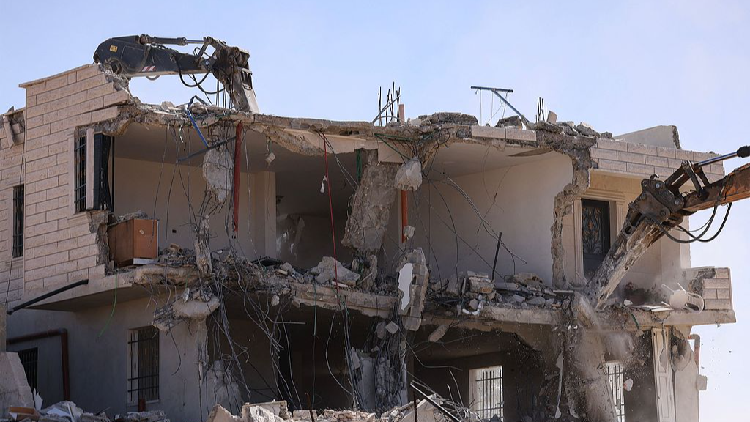
Excavators demolish a Palestinian house that Israeli authorities say was built without construction permits in Khalet al-Homus, near the town of Yatta in the Israeli-occupied West Bank, on September 16, 2026. /VCG
In the Middle East, China has continued to call for political and diplomatic solutions to the Palestinian question and tensions between Iran and the United States.
China has also consistently supported the UN peacekeeping system. It first sent military observers to a UN mission in 1990 and has since participated in dozens of UN peacekeeping missions. The UN describes China as the largest troop-contributing country among the five permanent members of the Security Council.
Such efforts have drawn attention from observers at home and abroad. Russian political scientist Vasily Kashin said the GSI differs fundamentally from initiatives associated with traditional bloc politics.
China has no intention of using it to build any form of alliance, nor is it aimed at expanding military presence, Kashin said. He added that China had played a significant mediating role in several international conflicts and was seeking to continue such efforts.
Gao Fei, president of China Foreign Affairs University, said China's efforts to work with countries and regional partners to find solutions to disputes reflect its long-standing diplomatic principles.
Speaking about China's mediation efforts amid tensions between Cambodia and Thailand, Gao said such efforts reflected China's emphasis on peace and development.
"China is a peace-loving country and emphasizes development," Gao said. "While the use of force may appear to offer a solution in some circumstances, in the long run it can create greater problems for the region."
The emphasis on political and diplomatic solutions is particularly important in the face of the growing number and complexity of conflicts around the world.
UN Secretary-General Antonio Guterres, in the preface to the 2026 Global Risks Report, said the evidence presented in the report should inform choices and urged countries to act while cooperation could still shape a safer course.