Iran-US live: Trump weighs ‘big decision’ on war after UN says school attack may have been war crime
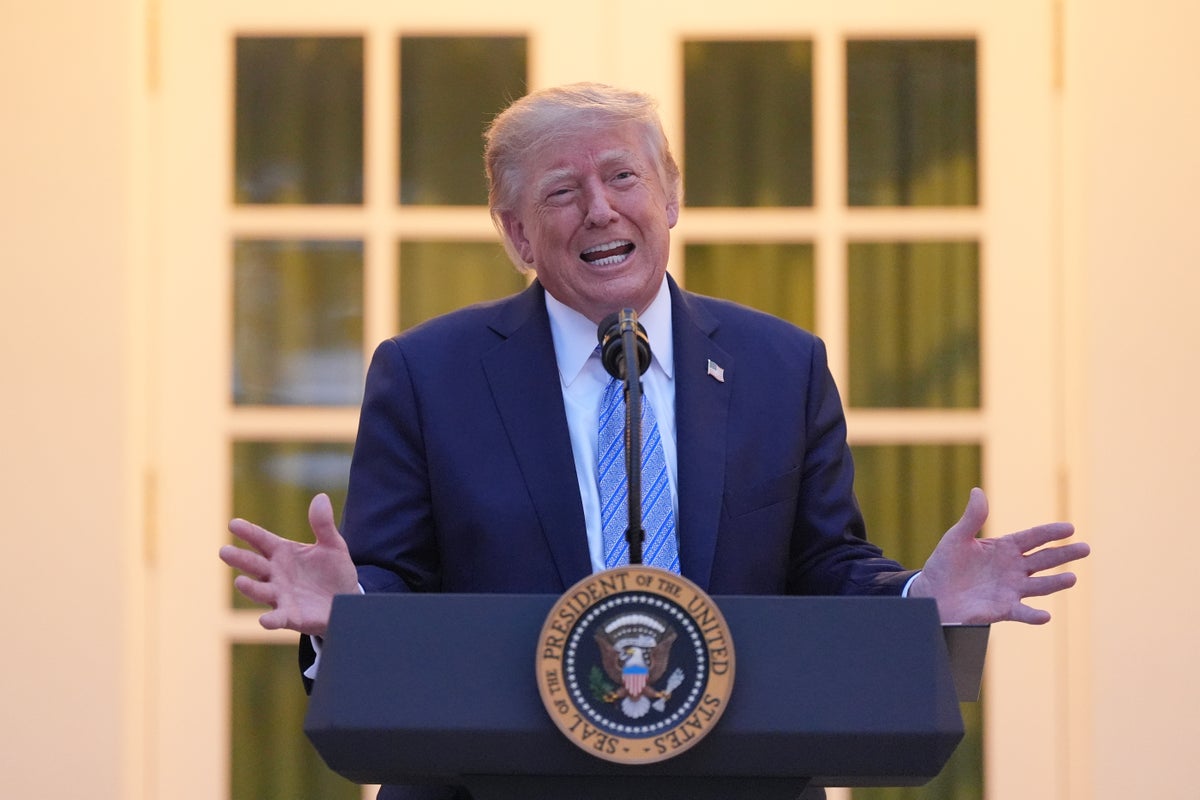
Donald Trump has said he faces a “big decision” on how to proceed with the Iran war, in his first remarks since a UN report said two US strikes in February may have amounted to war crimes.
The president has yet to respond directly to the UN report, but in an interview with Axios he said: “I have a big decision coming up. Do I want to go in and annihilate them [the Iranian regime] or do I not? It's a big decision. Anything could happen with me.”
Earlier, the UN fact-finding mission to Iran said the US struck a school in Iran “while being aware of a substantial risk of striking a civilian object”.
One of the strikes targeted a primary school in Minab, where more than 150 people were reportedly killed, including about 120 children, and another hit a sports centre in Lamerd that killed or injured 22 civilians.
The report, which also found that Iranian authorities committed crimes against humanity during their deadly crackdown on anti-government protests, will be submitted to the UN Human Rights Council in Geneva.
Russia and China have ended a United Nations Security Council mandate for the independent monitoring of international sanctions on Iran, reviving their argument that all UN measures on Tehran had been removed under a nuclear deal with world powers.
All UN sanctions on Iran were reimposed a year ago after France, Britain and Germany accused Tehran of violating the 2015 nuclear pact meant to prevent it from developing a nuclear weapon. Iran denies seeking nuclear weapons.
This included the return of an independent panel of experts to monitor and report to the 15-member Security Council on violations and recommend further action. However, the council has been operating without a panel of experts on Iran for the past year because it has been unable to agree on their appointment, a move that must be done by consensus.
Russia and China then vetoed on Thursday a resolution that would have extended the mandate for the independent monitoring of sanctions. Eleven council members voted in favour, while Pakistan and Somalia abstained.
"Without an independent panel of experts, this council loses its principal source of impartial, evidence-based reporting on sanctions violations, creating a monitoring gap that only benefits the Iranian regime and those who profit from evading those measures," deputy US ambassador Jennifer Locetta told the council after the vote.
US president Donald Trump said he is approaching a decision on whether to restart large-scale military attacks on Iran in a bid to bring the war to a close.
"I have a big decision coming up. Do I want to go in and annihilate them or do I not? It's a big decision. Anything could happen with me," Mr Trump told Axios.
The comments come ahead of a planned meeting on Tuesday with leaders from six Gulf countries, Saudi Arabia, the UAE, Qatar, Bahrain, Kuwait and Oman, on the sidelines of the UN General Assembly in New York.
Mr Trump said he wanted to hear directly from regional allies about the war's next steps before deciding whether to resume major combat operations, for which he would need their backing.
"I want to find out where they are and how they are doing. We have been very protective of them," he said.
China has privately asked Tehran to help rein in Yemen's Houthis after an appeal to Beijing by Saudi Arabia, Reuters has reported quoting three Iranian sources familiar with the matter.
Riyadh turned to China for help after the Houthis made rapid advances along the Red Sea coast and around the Bab el-Mandeb Strait, moves that have left Saudi oil exports and shipping more exposed, the sources said.
China has publicly called for restraint, dialogue and the restoration of safe navigation, but its private message went further than the public statements, they said.
Beijing wants Iran to use its influence with the Houthis to help prevent the conflict spreading further across energy routes on which China, the world's second-largest economy, depends.
The sources, who were briefed on the discussions and spoke on condition of anonymity, did not provide details of how the message was delivered or whether it was conveyed during a visit to China on Wednesday by Iranian Foreign Minister Abbas Araqchi, the news agency reported.
The US state department says it has approved the sale of Lockheed Martin's F-35 Lightning II fighter jets to Saudi Arabia, as the kingdom is drawn deeper into war in the Middle East.
A sale would mark a significant policy shift from the US, potentially altering the balance of military power in the Middle East and testing Washington's definition of maintaining its ally Israel's "qualitative military edge."
Saudi Arabia made a direct appeal for the jets in early 2025 to US president Donald Trump and has long been interested in Lockheed Martin's fighter.
The estimated $24.3bn sale, which still needs congressional approval, would include 48 of the military aircraft and 49 Pratt & Whitney engines along with communications equipment, spare parts and other support items, the state department said.
Washington weighs weapons sales to the Middle East in a way that ensures Israel gets more advanced US weapons than regional Arab states.
The Saudi embassy in Washington welcomed the proposed sale, describing it as a further step in defence cooperation between the two countries.
"The proposed F-35 sale reflects the strength and enduring nature of the Saudi-US strategic partnership and the continued advancement of our defence cooperation," the embassy said on X.
South Korean foreign minister Cho Hyun said on Thursday that no decision had been made on any military deployment to the Strait of Hormuz.
Cho was speaking to reporters before departing for Washington, where he is due to hold talks with US secretary of state Marco Rubio.
Earlier this month, it was reported that South Korea was considering deploying military assets to the Strait of Hormuz as it faced growing pressure from the US to do more in the Middle East.
Later, Seoul said that the military deployment was an option but clarified that nothing had been decided yet.
Despite an ongoing blockade of Iranian maritime trade and attacks by Iran’s military on commercial ships, the US military has said its forces have kept the Strait of Hormuz open to commercial shipping.
The US also claimed that they are helping facilitate the movement of hundreds of millions of barrels of oil through the strategic waterway.
On Wednesday, US Navy Captain Tim Hawkins, a spokesperson for US Central Command, said traffic through the strait “continues to flow”, rejecting suggestions that Iran controls the waterway.
“Since early May, we have assisted commercial vessels moving more than 900 million barrels of crude oil through the Strait of Hormuz to the global energy market,” Hawkins told Al Jazeera.
The US and Iran have continued to make competing claims over who has greater control of the critical Strait of Hormuz in the Gulf.
A building housing half a dozen families gave out in Gaza City overnight into Wednesday, killing sixteen people as they slept and leaving rescuers digging through rubble for dozens more who'd been sheltering inside the structure.
The sudden collapse of the building, which was known to be unstable due to damage from Israeli strikes earlier in the war, underscored how perilous and desperate living conditions have grown for the majority of the enclave’s population as a ceasefire deal between Israel and Hamas stalls.
The sixteen dead include at least twelve women and children, according to Zaher al-Wahidi, a spokesperson for the Gaza Health Ministry. The toll was expected to rise as more bodies were recovered from the wreckage.
Authorities were investigating the incident, UKMTO added.
The US has announced sanctions on an Iranian cryptocurrency exchange controlled by the sanctioned financier Babak Zanjani on Thursday, according to the Reuters news agency.
Washington accused it of processing payments received for safe passage through the Strait of Hormuz.
Treasury said BitBank had routed hundreds of millions of dollars to the Islamic Revolutionary Guard Corps and described the exchange as a key component in Iran’s digital assets-based sanctions-evasion infrastructure. The exchange was used to transfer funds paid to Iran's newly established Hormuz Safe Marine Services Authority, Treasury said in a statement.
Zanjani has long been a key figure in Iran’s sanctions-evasion networks. He was sentenced to death by Iranian authorities in 2016 for embezzlement. His sentence was commuted in 2024. The following year he re-emerged as a backer of Iranian government economic projects.
The designation is part of Treasury's “Operation Economic Outcast” intended to isolate Iran economically and disrupt Iran's global financial, commercial and logistical networks, according to the statement. The strategy has targeted Iran’s illicit oil trade, financial intermediaries, exchange houses and shipping, aviation and front companies.