
Iran-US war latest: Trump says conflict ‘hopefully’ nearing end and claims to be in direct talks with Tehran
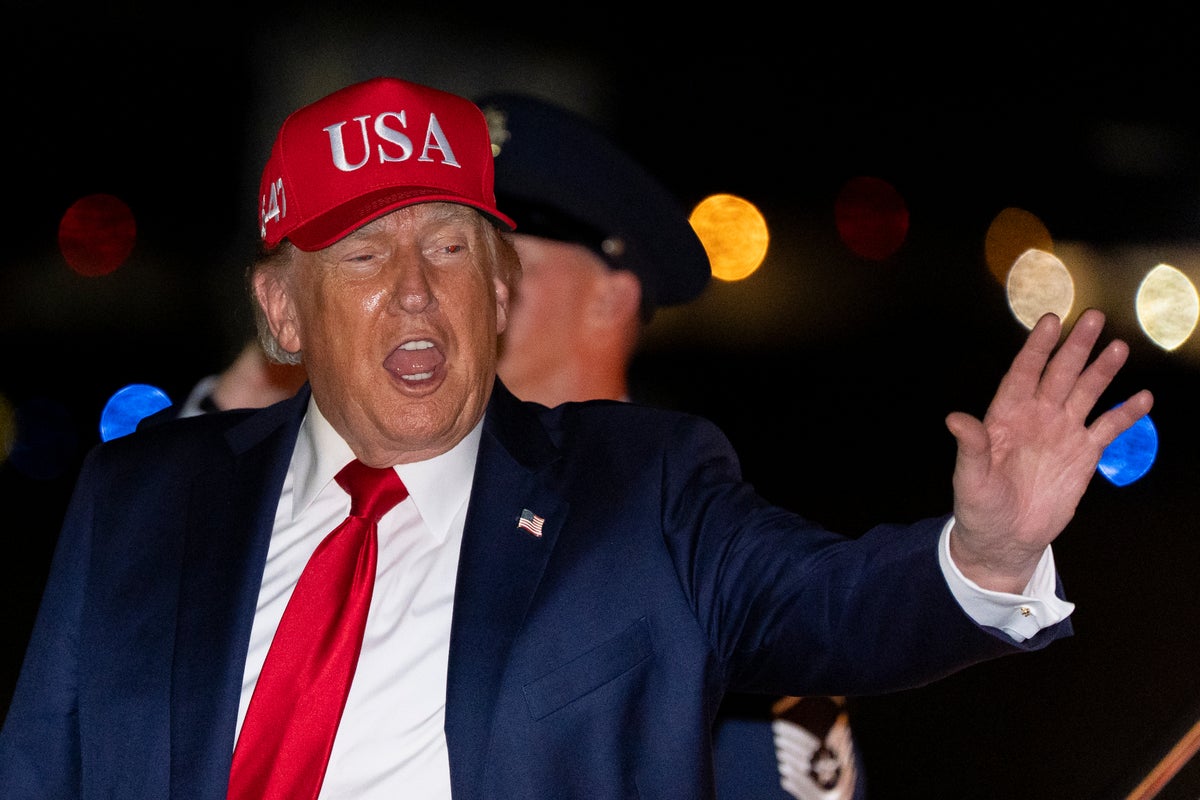
Donald Trump told reporters that the US is “hopefully toward the end” of its war with Iran, adding that he has spoken with Tehran “directly”.
He also repeated his claim that Tehran was seeking a deal, despite Iranian officials declaring only hours earlier that peace talks will not resume until all of their conditions are met.
Brig. Gen. Abolfazl Shekarchi, chief spokesperson for the Iranian armed forces, told Iranian media: “The people disrupted the enemy’s calculations with 200 nights of resistance, and the armed forces will defend Iran until the last drop of blood.”
Oil prices crept up to $108 per barrel, lifted by disruption around the Strait of Hormuz and the burgeoning crisis between US ally Saudi Arabia and the Iran-aligned Houthi rebels near the Red Sea.
Iran’s foreign minister was instructed by his Chinese counterpart meanwhile to reopen the Strait and return to the interim peace deal signed with the US in June as disruption to energy supplies continues to be felt around the world.
The US House of Representatives has passed a bill named after the late Senator Lindsey Graham, voting 262-159 to impose sweeping sanctions and tariffs aimed at increasing economic pressure on Iran and Russia, Reuters reported.
The Lindsey O Graham Sanctioning Russia and Iran Act of 2026, introduced by Graham himself, was approved by the Senate last month in an 86-11 vote.
While the legislation primarily targets Russia, it also extends the Iran Sanctions Act of 1996, signed by then-president Bill Clinton.
The 1996 law was due to expire in 2026 but has now been extended for another five years.
Dozens of Democratic representatives joined most Republicans in backing the bill, sending it to president Donald Trump to be signed into law.
Oil prices fell in early trading on Thursday, extending losses from the previous session after reports that Saudi Arabia was offering additional crude cargoes through Oman eased concerns over potential supply disruptions in the Middle East.
Brent crude futures fell $1.24, or 1.2 per cent, to $104.59 a barrel by 00:49 GMT, while US West Texas Intermediate (WTI) futures declined $1.14, or 1.1 per cent, to $101.29.Both contracts dropped by about $3 on Wednesday.
South Korean foreign minister Cho Hyun said on Thursday that no decision had been made on any military deployment to the Strait of Hormuz.
Cho was speaking to reporters before departing for Washington, where he is due to hold talks with US secretary of state Marco Rubio.
Earlier this month, it was reported that South Korea was considering deploying military assets to the Strait of Hormuz as it faced growing pressure from the US to do more in the Middle East.
Later, Seoul said that the military deployment was an option but clarified that nothing had been decided yet.
Despite an ongoing blockade of Iranian maritime trade and attacks by Iran’s military on commercial ships, the US military has said its forces have kept the Strait of Hormuz open to commercial shipping.
The US also claimed that they are helping facilitate the movement of hundreds of millions of barrels of oil through the strategic waterway.
On Wednesday, US Navy Captain Tim Hawkins, a spokesperson for US Central Command, said traffic through the strait “continues to flow”, rejecting suggestions that Iran controls the waterway.
“Since early May, we have assisted commercial vessels moving more than 900 million barrels of crude oil through the Strait of Hormuz to the global energy market,” Hawkins told Al Jazeera.
The US and Iran have continued to make competing claims over who has greater control of the critical Strait of Hormuz in the Gulf.
UN secretary-general Antonio Guterres has called for de-escalation and a return to diplomacy as tensions mount across the Middle East, including mounting hostilities between Saudi Arabia and Yemen's Iran-backed Houthi rebels.
“At this critical moment in the Middle East, de-escalation must be a priority,” Guterres said.
“Any actions that harm civilians must stop. Humanitarian operations must proceed safely and without obstruction. Navigational rights and freedoms must be fully restored & respected.
“The only path forward is de-escalation, diplomacy and dialogue,” he said.
President Donald Trump told reporters that the US is “hopefully toward the end” of its war with Iran, adding that he has spoken with Iran “directly”.
He also repeated his claim that Tehran was seeking a deal.
He told the crowd in North Carolina that gas and oil prices will “come down very quickly” after the war ends in Iran.
A building housing half a dozen families gave out in Gaza City overnight into Wednesday, killing sixteen people as they slept and leaving rescuers digging through rubble for dozens more who'd been sheltering inside the structure.
The sudden collapse of the building, which was known to be unstable due to damage from Israeli strikes earlier in the war, underscored how perilous and desperate living conditions have grown for the majority of the enclave’s population as a ceasefire deal between Israel and Hamas stalls.
The sixteen dead include at least twelve women and children, according to Zaher al-Wahidi, a spokesperson for the Gaza Health Ministry. The toll was expected to rise as more bodies were recovered from the wreckage.
Saudi Arabia says its air defences destroyed an incoming Houthi drone south of Mecca before it entered prohibited airspace over the holy city.
The drone, intercepted on Tuesday, marked the second Houthi attempt to target Mecca after a ballistic missile launch in 2017, a spokesperson for the Saudi-led coalition said, warning that the security of holy sites was a “red line”.
Saudi Arabia issued security alerts for Mecca - along with Taif and Jeddah - but Houthi political bureau member Mohammed al-Farah denied the group had targeted the holy city, calling the allegation “an outright lie”.
