Iran War Has the U.S. Military on the Brink of a “Breakdown” - The Intercept
The U.S. military is straining under the pressures of the Iran war, according to two U.S. officials familiar with operations in the Middle East. One cautioned that this stress could lead to a “breakdown” in the military’s ability to effectively continue a war that President Donald Trump said would end in early April.
As the conflict has engulfed the region, the military has grappled with a growing list of challenges: Iranian attacks on U.S. bases and warships in the Middle East, depleted stockpiles of defensive munitions, increasing casualties, maintenance issues on ships, lengthy troop deployments, complicated logistics, flagging morale and a host of other issues that have taken a heavy toll on troops, damaged military readiness, and a strained Pentagon budget — contradicting moths of rosy pronouncements by the Trump administration.
Both officials said that Iran is facing extreme economic pressure, according to intelligence reports. The first official characterized recent Iranian attacks on warships with ballistic missiles as a “go for broke” strategy to increase economic pressures on America ahead of the U.S. midterms. That official said it was unclear which country would “blink first.”
Trump suggested on Sunday that the U.S. could “stay and keep the oil” in Iran, like the neo-colonial resource grab the administration is carrying out in Venezuela. The second official said that a U.S. occupation of Iran would be “almost impossible” and that the idea was “nonsensical obviously.”
Iran’s ability to overwhelm U.S. air defenses in the Middle East using attack drones and advanced ballistic missiles, as previously reported by The Intercept, has left the U.S. military in a precarious state. The Trump administration failed to appreciate Iran’s military prowess, said the first official. The other pointed to a “complete lack of planning” for the war. Since July 7 alone, there have been hundreds of U.S. casualties caused by Iranian attacks, according to official Pentagon statistics.
The officials said the military’s ability to function at peak capacity was crippled in the opening hours of the conflict when an Iranian missile and drone attack on February 28 destroyed Navy facilities in Manama, Bahrain, the region’s most critical logistics hub. The Pentagon claimed for months that the strikes did not significantly impact military operations, but last week acting Navy Secretary Hung Cao admitted “they blew the hell out of Bahrain.” More than six months after the attack, Naval Support Activity Bahrain remains a shambles. “We’re not getting back in there anytime soon,” said Chief of Naval Operations Adm. Daryl Caudle, the Navy’s highest-ranking officer, during a recent town hall.
A Wall Street Journal investigation previously found that rebuilding the U.S. Navy’s Fifth Fleet headquarters, barracks, and communication towers at NSA Bahrain may cost more than $400 million, which the second official said could be an underestimate if it’s ever attempted. Naval Forces Central Command referred questions about the cost estimate to Central Command, which did not respond.
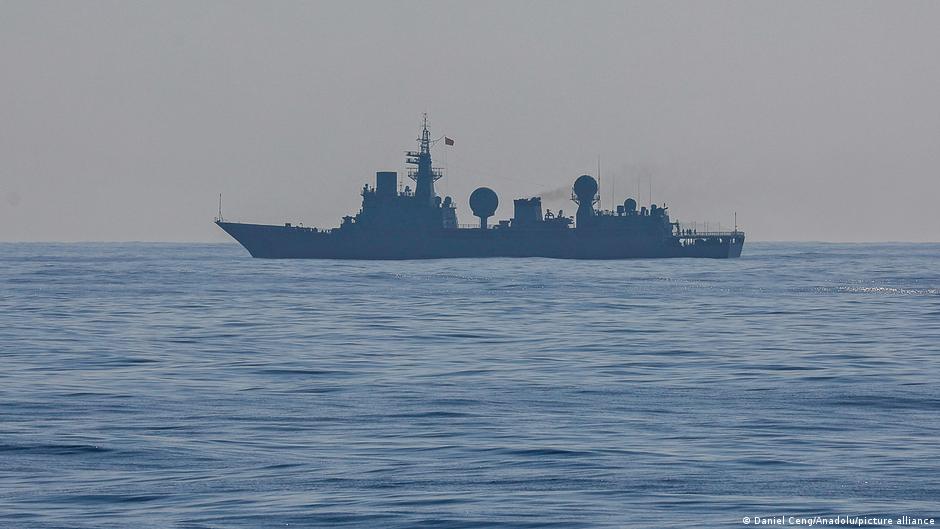
Trump has touted the destruction of Iran’s navy as one of his signature accomplishments of the war, but the officials pointed to the severe strain placed on U.S. naval forces in the region. With the home of the Fifth Fleet knocked out and other ports in the region within range of Iranian missiles and drones, the Navy found itself facing the daunting challenge of maintaining a flotilla of more than 24 ships — including two massive aircraft carriers and numerous guided-missile destroyers and cruisers, attack submarines, or supply ships deployed at any one time.
While aircraft carriers are nuclear-powered, the planes and helicopters on them, as well as the other ships, require millions of gallons of fuel each week. And the sailors aboard the ships require hundreds of thousands of meals. This means Navy ships need to haul supplies more than 2,000 miles from a longtime U.S. base on the Indian Ocean island of Diego Garcia. A War Department inspector general report released on Monday noted that the shift in “naval bases and support ports posed significant challenges,” pointing specifically to the “issue with shifting logistics support and infrastructure to Diego Garcia” and the challenges of “extended sea transit requiring 14- to 18-day logistics cycles.”
“It’s difficult and ultimately unsustainable,” said the second official, who told The Intercept that White House assumptions that Iran would “crack” before the Navy have yet to be borne out.
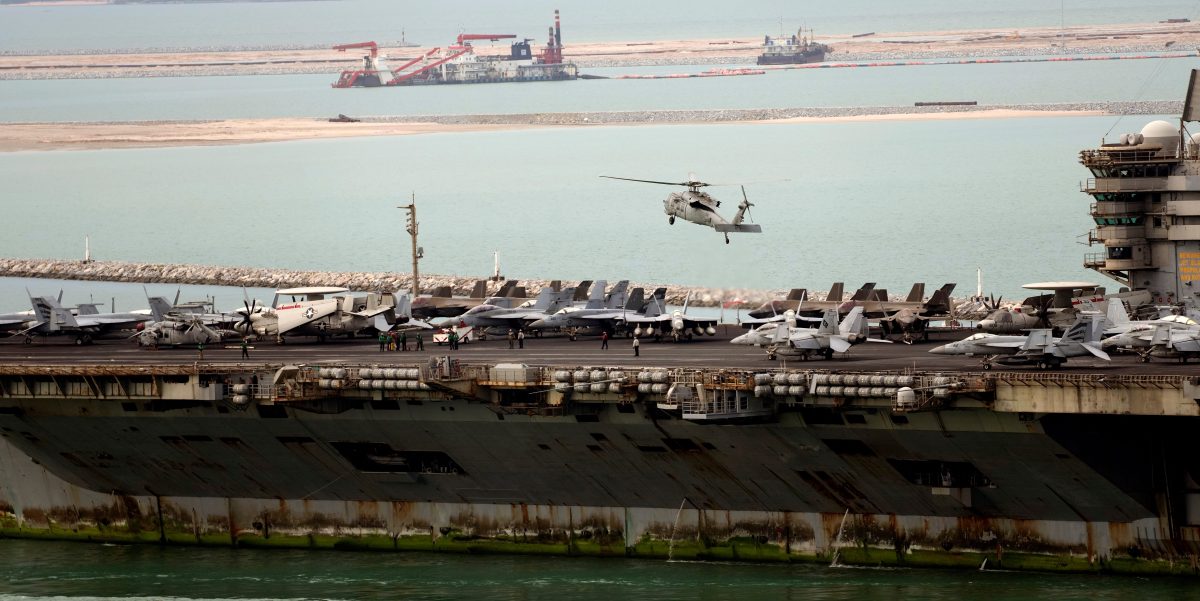
The Navy has just 11 aircraft carrier strike groups, and amid the ongoing strain of extended deployments, its oldest carrier, the USS Nimitz, has seen its service life extended. So far, four of the 11 carrier strike groups have already been deployed to the Middle East during the war. Some of the remaining carriers are undergoing substantial repairs and will not be ready to deploy again for years.
The USS Gerald R. Ford Carrier Strike Group completed a record-breaking, 11-month deployment that also included the invasion of Venezuela. (Under normal conditions, a carrier would visit port about once a month to allow its crew to rest.) The ship was, according to a Presidential Unit Citation, under “persistent threat from enemy missiles and one-way attack drones” during its deployment to the Middle East.
Early in the Iran war, the Ford suffered extensive damage from a laundry fire and a malfunctioning fire-suppression system that forced crew members to manually fight the blaze for around 30 hours. The fire halted sorties for two days, and around 600 sailors lost access to their bunks due to the damage. The Navy claimed few casualties from the blaze, but reports soon emerged that the more than 200 sailors were treated for smoke inhalation or lacerations.
The Ford has also been plagued by plumbing issues for years. During just a four-day span in 2025, there were 205 breakdowns. Before the Ford left the Caribbean, it was facing constant issues with the nearly 650 toilets aboard. And then in the Middle East, the carrier again suffered from clogged, excrement-filled toilets, according to video obtained by CNN.
Another carrier, the USS Abraham Lincoln, spent most of its nine months at sea with no port calls, leading to reports of rampant morale problems, supply shortages, and suicide attempts, with at least one crew member going overboard. At an August 11 town hall in San Diego, families expressed deep concerns about their loved ones to Cao, the acting Navy secretary. But Trump dismissed worries about the sailors, saying the Lincoln’s deployment was “not nearly long enough.” Last month, the Lincoln was relieved by the USS George Washington, allowing the heavily rusted Lincoln to pull into Thailand for a port call.
Those ships have left the region but sailors remain under persistent threat. The Islamic Revolutionary Guard Corps targeted a U.S. aircraft carrier and guided-missile destroyer with ballistic missiles this month, according to Central Command. CENTCOM did not reply to a request for additional information about the strikes.
We’re independent of corporate interests — and powered by members. Join us.
Original reporting. Fearless journalism. Delivered to you. Will you take the next step to support our independent journalism by becoming a member of The Intercept?
By signing up, I agree to receive emails from The Intercept and to the Privacy Policy and Terms of Use.
Despite months of claims by Trump and self-styled War Secretary Pete Hegseth that Iran’s military was annihilated, Iran has attacked more than 15 bases across the Middle East, according to information from U.S. officials and Iranian reports.
Stocks of advanced air-defense missiles, like Patriot and THAAD interceptors, are so depleted that U.S. forces are not shooting down all Iranian missiles and drones aimed at U.S. and allied targets across the Middle East, according to U.S. officials who spoke to The Intercept as well as numerous press reports.
Trump and Hegseth have pushed back on these claims. Trump posted on Monday that the U.S. is “producing more Exquisite and Elite Weapons than at any time in our History,” but the aforementioned inspector general report immediately contradicted the president, revealing that the conflict has resulted in “strategic inventory shortfalls and revealed industrial base bottlenecks for munitions resupply.”
“I have all the munitions necessary to both defend our forces as well as conduct a broad range of contingencies,” Adm. Brad Cooper, the CENTCOM chief, told Congress in May. But even the Pentagon admits that 410 U.S. troops have been killed or wounded since July 7 alone. Three U.S. soldiers were killed during Iranian ballistic missile and drone attacks on Jordan’s Muwaffaq Salti Air Base on July 17 and 18, for example. And an Iranian drone attack on Erbil Air Base, Iraq, on July 18 killed one soldier and left another injured during what CENTCOM called a “controlled detonation” of the downed aircraft.
The U.S. and its allies burned through more than 11,000 munitions, including large amounts of defensive missiles, in the first 16 days of the war alone, according to a March analysis by the Royal United Services Institute. About 65 percent of Patriot interceptors were expended between February and July, leaving fewer than 830 remaining from a pre-war total of 2,330, according to an analysis by the Center for Strategic and International Studies. The number of THAADs dropped from more than 450 to less than 270.
On Sunday, Cooper, the CENTCOM commander, continued to downplay the risks of depleted stockpiles and told CBS’s “60 Minutes” that he wasn’t worried for the safety of U.S. troops. “I’m not concerned at all,” he replied when asked about defending against Iranian attacks. CENTCOM did not reply when asked if Cooper would resign if U.S. troops were killed or wounded in future attacks.
In addition to the destruction of NSA Bahrain, the Combined Air Operations Center at Al Udeid Air Base, Qatar, was severely damaged by Iranian missiles early in the war, rendering it inoperable. Both were recently attacked again, raising questions about whether either will ever be rebuilt. Iran also struck Muwaffaq Salti Air Base in Jordan last week, damaging multiple U.S. military aircraft, according to the second U.S. official. In response, U.S. forces fired a “significant” number of Patriot interceptors to protect U.S. forces, the second official said.
U.S. officials confirmed that Iran has also attacked Tower 22, a U.S. military outpost on the northern Jordanian border with Syria. Satellite images as well as photos and videos circulating online indicate the base suffered extensive damage. (In 2024, a drone attack on Tower 22 by an Iran-backed militia killed three U.S. troops.)
Iran says it has also attacked U.S. military facilities at Jordan’s Prince Hassan Air Base and King Faisal Air Base; and Kuwait’s Al-Adiri base, Ahmed Al-Jaber Air Base, Camp Doha, Ali Al Salem Air Base, and Camp Arifjan. Last week, the IRGC announced its forces had “simultaneously attack[ed] the American bases in Jordan, Bahrain, and Erbil,” including “a combined missile-drone attack on the headquarters and residence of the American commander of the Ali al-Salem base.”
CENTCOM failed to respond to a request for comment about attacks on its outposts or provide its own official count of the number struck. But the Pentagon inspector general report revealed Iranian strikes “damaged and destroyed hundreds of buildings and structures at U.S. bases in Kuwait, Bahrain, Qatar, UAE, Saudi Arabia, Iraq, Oman, and Jordan during the conflict.” It also disclosed that “dozens of U.S. aircraft were destroyed or damaged,” including four F-15 fighter aircraft, 12 KC-135 refueling aircraft, and as many as 30 MQ-9 Reaper drones.
What we’re seeing right now from Donald Trump is a full-on authoritarian takeover of the U.S. government.
Court orders are being ignored. MAGA loyalists have been put in charge of the military and federal law enforcement agencies. The Department of Government Efficiency has stripped Congress of its power of the purse. News outlets that challenge Trump have been banished or put under investigation.
Yet far too many are still covering Trump’s assault on democracy like politics as usual, with flattering headlines describing Trump as “unconventional,” “testing the boundaries,” and “aggressively flexing power.”
The Intercept has long covered authoritarian governments, billionaire oligarchs, and backsliding democracies around the world. We understand the challenge we face in Trump and the vital importance of press freedom in defending democracy.
IT’S BEEN A DEVASTATING year for journalism — the worst in modern U.S. history.
We have a president with utter contempt for truth aggressively using the government’s full powers to dismantle the free press. Corporate news outlets have cowered, becoming accessories in Trump’s project to create a post-truth America. Right-wing billionaires have pounced, buying up media organizations and rebuilding the information environment to their liking.
In this most perilous moment for democracy, The Intercept is fighting back. But to do so effectively, we need to grow.
That’s where you come in. Will you help us expand our reporting capacity in time to hit the ground running in 2026?
I’M BEN MUESSIG, The Intercept’s editor-in-chief. It’s been a devastating year for journalism — the worst in modern U.S. history.
We have a president with utter contempt for truth aggressively using the government’s full powers to dismantle the free press. Corporate news outlets have cowered, becoming accessories in Trump’s project to create a post-truth America. Right-wing billionaires have pounced, buying up media organizations and rebuilding the information environment to their liking.
In this most perilous moment for democracy, The Intercept is fighting back. But to do so effectively, we need to grow.
That’s where you come in. Will you help us expand our reporting capacity in time to hit the ground running in 2026?