Iran’s Tough Talk at the UN Gives Away Its Secret - Newsweek
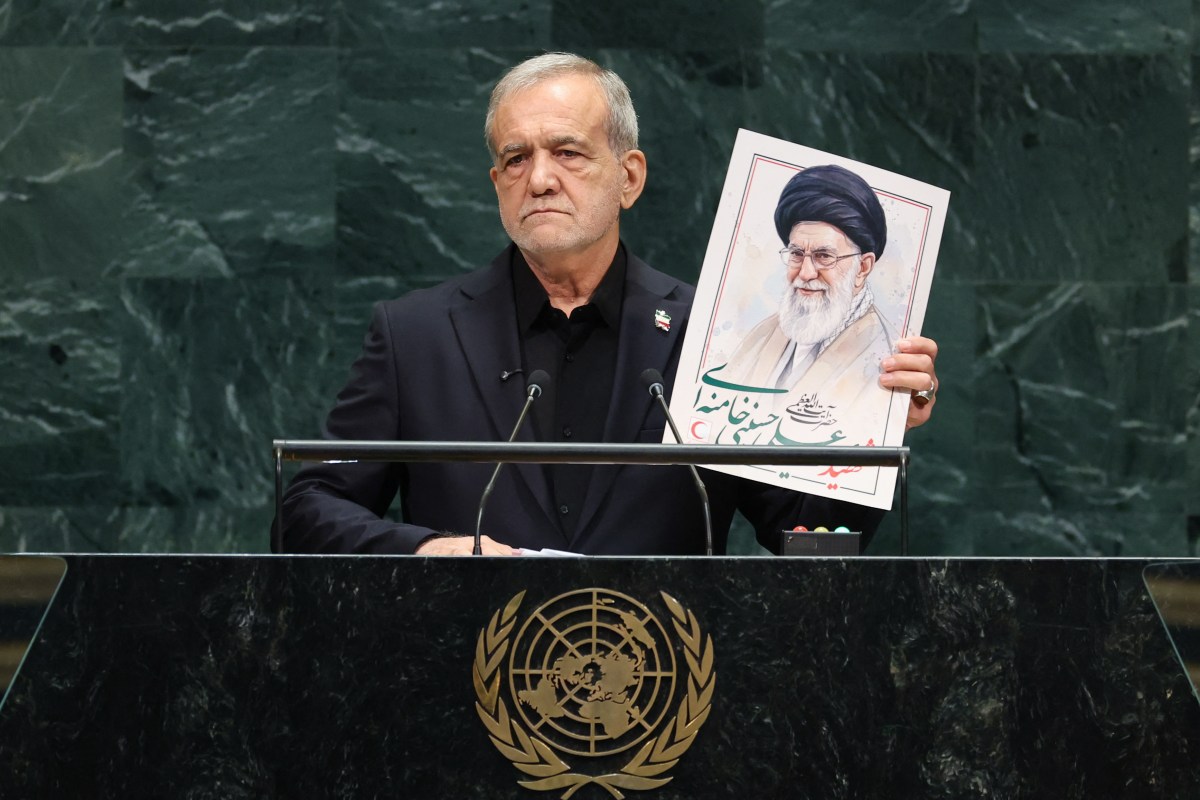
Iranian President Masoud Pezeshkian told the United Nations General Assembly on Wednesday that Iran would not surrender in its war with the United States, while still backing diplomacy to end the conflict. The posture sounded defiant but pointed to a more difficult constraint: Tehran may need negotiations as much as it needs to prove it was never forced into them.
“We will never bow our head or bend at the knee,” Pezeshkian said, highlighting his refusal to yield after accusing Washington of pressure, sanctions and bullying.
Pezeshkian also said Iran was “ready for dialogue and diplomacy and negotiations without accepting the language of force.”
The pairing of the two lines illustrates the conundrum: Iran’s public message is resistance, but its strategic need may be a negotiated off-ramp that does not look like submission. So where does it go from here?
Pezeshkian was speaking a day after President Donald Trump used his own U.N. address to defend the war with Iran, accuse Tehran of stalling and warn that he may “annihilate” the Islamic Republic if no deal is reached.
U.S. and Iranian officials also held talks around the U.N. gathering, with Trump describing the meeting as “very good” and Secretary of State Marco Rubio saying Trump was open to meeting Pezeshkian while he was in New York.
For Tehran, that creates a familiar bind: Negotiating under pressure can bring relief, but negotiating while U.S. threats are still public can look like capitulation.
Pezeshkian’s answer was to make the talks politically usable before they become diplomatically useful. By presenting Iran as battered but unbowed, he was not closing the door to diplomacy but trying to define the terms under which diplomacy could be sold.
The logic harks back to the Iranian state’s modus operandi: Endurance is a source of legitimacy. In wartime especially, compromise has to be framed as proof of resistance, not an admission that pressure worked.
The speech clearly displayed Iran’s contradiction.
Pezeshkian said Iran had “only defended” itself and accused the U.S. and Israel of attacking. His claim that Iran had not hit civilian populations was undercut by civilian deaths among mariners and migrant workers in the region.
On the Strait of Hormuz, Pezeshkian warned that hostile fleets and the expansion of war would not bring peace. He said it was unacceptable for others to benefit from the waterway while Iran was denied access to shipping through it.
That was more than rhetoric. A senior Iranian official said Tehran could reopen the Strait of Hormuz within seven days if the U.S. eased military pressure and lifted its blockade on Iranian ports.
So the practical offer and the public defiance are moving in the same direction. Iran is signaling it may bargain over the war’s most economically damaging pressure point, while insisting that any bargain must appear to validate Iranian leverage rather than American coercion.
Pezeshkian’s domestic problem is visible in the company he keeps rhetorically.
Parliament Speaker Mohammad Baqer Qalibaf, who previously led the country’s negotiating team, said Iran would never surrender and warned that Trump could not impose his power on the Iranian people or armed forces.
Iran’s joint military command also called Trump’s threat “domestic propaganda,” said repeated U.S. threats showed “strategic desperation” and warned of more severe attacks on the U.S. and Israel.
Pezeshkian, often described as a more moderate figure inside Iran’s political system, arrived in New York under wartime scrutiny and after months of conflict that have raised the cost of any visible concession, a fact that makes his speech at the U.N. less a statement of confidence and more an exercise in political sequencing. First comes the claim of endurance, then comes the space for diplomacy.
The U.S. and Iran both need to look strong, so turning indirect and lower-level contacts into a proper process that can benefit both of them will be the real test.
For Trump, the political incentive is to show that pressure brought Tehran back to the table, especially after he accused Iran of waiting to see how he performs in the midterm elections before making a deal.
For Iran, the incentive runs the other way: Any deal must look like Washington recognized Iranian staying power, particularly if it involves the Strait of Hormuz and sanctions.
If Iran keeps tying Hormuz to U.S. military pressure and port access, the war may be entering a bargaining phase. If Iranian officials escalate the language faster than mediators can define terms, Pezeshkian’s defiance may become harder to convert into diplomacy.
For what it’s worth, for now, the speech gave away Iran’s secret: Tehran is not just trying to resist; it is trying to negotiate an exit while preserving the politics of resistance.