Iraq's risky standoff: The state vs. Iran-allied militias
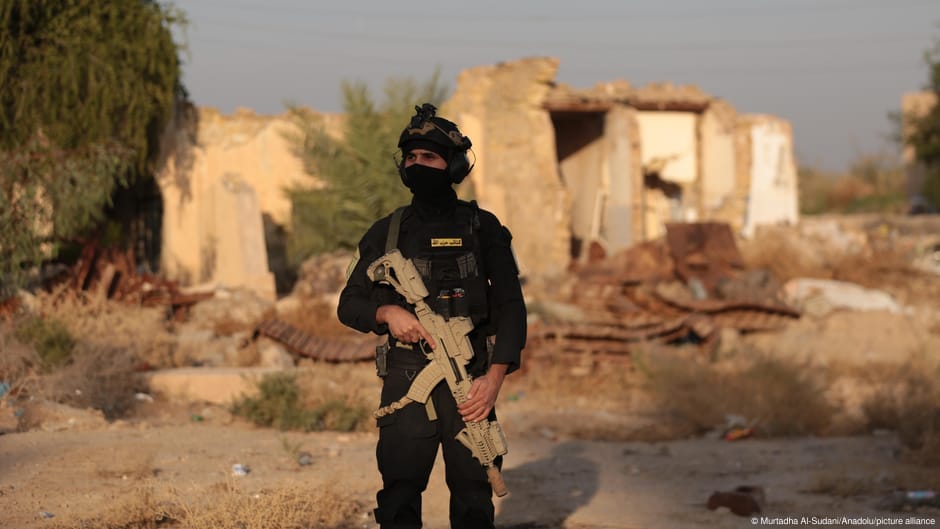
The Iraqi state has been trying to disarm local militia groups and some have agreed to give up their arms; Kataib Hezbollah is not one of themImage: Murtadha Al-Sudani/Anadolu/picture allianceAdvertisementFor years, there have all kinds of rumors about Jurf al-Sakhar, an area around 50 kilometers (31 miles) south of the Iraqi capital Baghdad. It is controlled by an Iraqi militia called Kataib Hezbollah, that's closely allied with Iran, and no Iraqi government troops or news media outlets have been allowed inside for around 12 years.
Rumors about what's happening in the area include allegations about secret prisons, mass graves, drone and weapons manufacturing and storage, as well as criminal activity such as oil smuggling. Jurf al-Sakhar is also allegedly a base for foreign, Hezbollah-supporting nationals from Iran, Yemen, Bahrain and Lebanon.
Recently two people — an Israeli researcherand a US journalist — who were kidnapped by an Iraqi militia are thought to have been held captive in this area.
Jurf al-Sakhar previously had an estimated 89,000 residents but after the extremist group known as the "Islamic State," or IS, rose to power in Iraq in 2014, much of the population was displaced in fighting. The area was eventually taken over by Kataib Hezbollah, a militia that had fought IS alongside other armed groups.
As a collective, the armed groups are referred to as the Popular Mobilization Forces, or PMF. Not all of them have pledged allegiance to Iran but Kataib Hezbollah, a Shiite Muslim majority group, has.
In the past 12 years, tens of thousands of the displaced people from here, mostly Sunni Muslims, have not been allowed to return and the area has been described as militarized.
Its name was even changed by Kataib Hezbollah fighters, from Jurf al-Sakhar ("rocky bank") to Jurf al-Nasr ("bank of victory").
But recent events may shake Kataib Hezbollah's hold on this area.
An early November report for the Iraqi government says that since 2021, the group has smuggled hundreds of millions of dollars' worth of state-owned oil, siphoned from pipelines around Jurf al-Sakhar.
Iraq's new government, headed by Prime Minister Ali al-Zaidi, made several arrests based on the report and demanded that Kataib Hezbollah leave Jurf al-Sakhar by Friday, Nov. 20.
Kataib Hezbollah rejected al-Zaidi's ultimatum, with a spokesperson saying the group would not withdraw "not even over our dead bodies."
Al-Zaidi then ordered state security forces to surround the area, while Hezbollah reportedly brought in reinforcements.
Observers have described the standoff as one of the most consequential and riskiest confrontations between an Iraqi government and Iranian-backed militiasin Iraq in more than two decades.
"It is a political signal that things will change, that he [al-Zaidi] wants to disarm militias, integrate them into state and claim back the state's authority," Ulf Laessing, head of the Syria and Iraq project for Germany's Konrad Adenauer Foundation, or KAS, told DW. "But it's a minefield and he needs to navigate carefully."
The standoff is also the result of long-running political tensions in Iraq, where the state is torn between its US allies on the one hand and Iranian allies on the other. Both hold sway in Iraq and are considered important relationships.
During Donald Trump's presidency of the US, and thanks to the US and Israel's war with Iran, there's been more pressure on Iraq to disarm Iran's allies inside the country. Al-Zaidi has set a deadline of next June to bring all weapons under the state's control.
The situation in Jurf al-Sakhar became even more tense this week. Al-Zaidi announced a new security plan for the area that involves other members of the PMF, state security forces and the police. Kataib Hezbollah rejected the plan.
"Al-Zaidi appears serious about ending Kataib Hezbollah's autonomous control of Jurf al-Sakhar," Hayder al-Shakeri, a research fellow at the British think tank Chatham House told DW. "Deploying federal forces and now establishing a new security command there shows this has moved beyond rhetoric."
But how dangerous is Kataib Hezbollah really? After all, al-Zaidi was actually nominated for the prime minister's job by a political bloc known as the Coalition Framework, or CF — these are the politicians who represent the PMF in parliament. Kataib Hezbollah's political party, Harakat Huqooq, is part of the CF.
And other researchers have been critical on social media, noting that the PMF troops that will be given partial control over Jurf al-Sakhar (should Kataib Hezbollah withdraw) are associated with that group anyway.
But Iraqi news media have also reported that there are divisions inside the CF, and apparently even within Kataib Hezbollah, about how to deal with the current standoff. Reportedly, some senior officials think that parts of Jurf al-Sakhar could be handed to federal forces in a gradual withdrawal, the London-based outlet Amwaj Media reported earlier this week, while some senior members of Kataib Hezbollah would seemingly prefer to hand the territory over to certain PMF brigades rather than to state security forces.
Late Thursday afternoon, the news agency Reuters reported that, according to three anonymous officials, all parties had come to an agreement that would allow government forces to enter Jurf al-Sakhar on Friday.
A compromise is good because it avoids violence, KAS' Laessing said. "It might not be what al-Zaidi initially hoped for but it's still a political signal."
If it did come to actual fighting, the Iraqi military has more resources than Kataib Hezbollah, al-Shakeri explained. "[It] could probably take Jurf al-Sakhar if the political leadership and security institutions remained united," he said. "But there would be no easy victory. Kataib Hezbollah does not need to defeat the Iraqi army conventionally. It can impose costs through asymmetric attacks, political pressure and its networks inside the state."
How the reported compromise plays out in the coming days, will also impact other Iraqi militias and they will be watching closely. Because "the core issue is whether a faction can continue controlling territory and economic activity beyond effective government oversight," al-Shakeri explained.
"The most likely compromise may be to remove Kataib Hezbollah's monopoly rather than remove the PMF from Jurf al-Sakhar altogether," he continued. "That would still matter if it opened the area to regular state forces, if it protects the oil infrastructure and places security under a clearer government command structure."
It could also lead to displaced residents being allowed back to their homes.
"But if one PMF faction simply replaces another while retaining its own networks and autonomy, then Zaidi has redistributed armed influence rather than fundamentally resolved the problem," al-Shakeri concluded.