
Is Trump banning Canadian beer? - Toronto Star
CEO Andrew Oland says Moosehead has weeks of U.S. stock left — and no plan to brew south of the border.
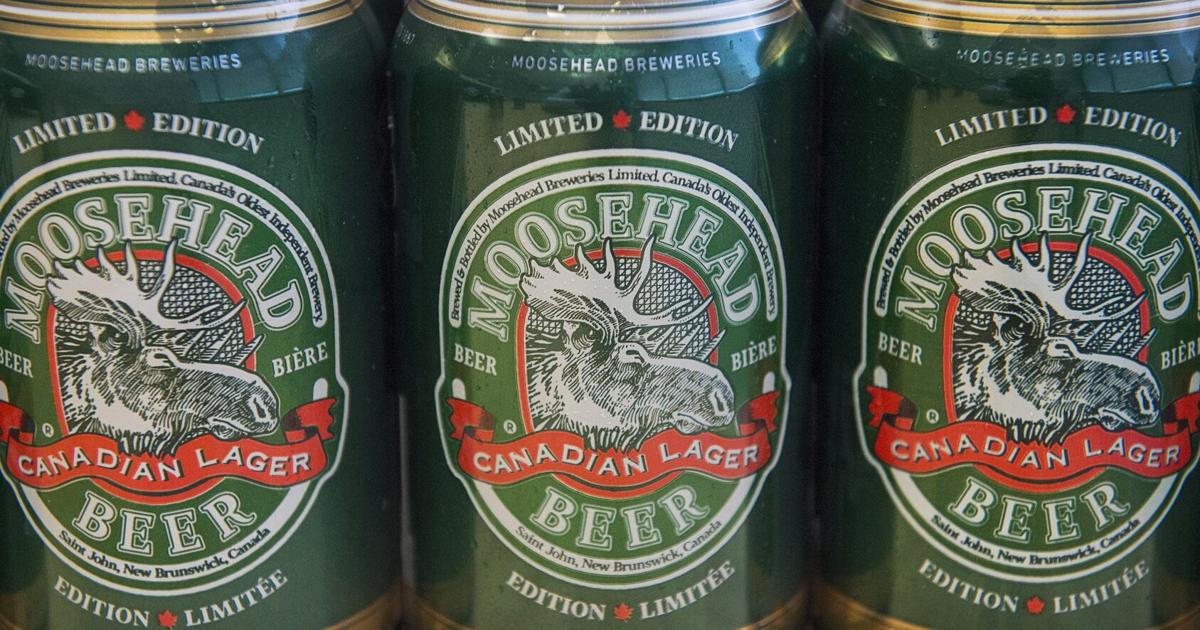
Cans of Moosehead beer are seen in Halifax in this file photo.
For the past two weeks, Andrew Oland has had one thing on his mind: Cranking out beer for the U.S. market.
“We’ve been trying to rush as much across as we can,” said Oland, CEO of Moosehead, Canada’s largest independent brewery, based in Saint John, N.B. “We’ve rearranged all our schedules.”
The reason? A U.S. import ban on Canadian beer imposed by U.S. President Donald Trump takes effect Sept. 29. The outright ban follows 50 per cent tariffs on roughly $28-billion worth of Canadian goods — including beer — that went into effect Aug. 22.
For small craft breweries, exporting to the U.S. really isn’t a significant part of their business. The biggest Canadian brands, like Molson Canadian or Labatt Blue Light, are brewed in the U.S. for the American market.
Moosehead, however, makes virtually all of its beer in Saint John, N.B., and Oland estimates that roughly 15 per cent of its overall volume heads south of the border.
Any beer that makes it in before Sept. 29 is still subject to the 50 per cent tariff, meaning Moosehead takes a loss on every can or bottle sold into the U.S. That’s bad enough, but still worth it to stay on shelves in the world’s largest economy, Oland said.
“We’re just trying to preserve our access to the market. If we’d stopped shipping, we’d lose out altogether,” said Oland, the sixth generation of his family to run Moosehead since its founding in 1867.
Eating the 50 per cent tariff, Oland said, was something Moosehead was prepared to do for a while, because the cost of rebuilding a brand’s presence in such a competitive market from scratch would be prohibitive. It’s not just about catching the eye of consumers, but securing shelf space with retailers.
“You’ve got to regain that shelf space, which takes time and money,” Oland said. “It would be a long time before we walk away from a market. It would be many months.”
Now, though, that rebuilding process looks like it might be necessary anyway.
Based on typical sales volumes, Oland figures the supply of Moosehead in the U.S. might last for another month or so.
“We’ve probably got beer in the U.S. until late October or early November,” Oland said. “If we don’t have clarity by that point, I just can’t predict what will happen.”
Moosehead is in a middle ground between small craft breweries and the largest Canadian brands, said beer and spirits author Stephen Beaumont.
“Of the small breweries, very, very few are exporting anything at all, much less a significant quantity,” Beaumont said. “The big guys have long since pivoted to U.S. brands.”
Molson Canadian is produced in the U.S. for the American market. Labatt Blue Light is produced in Rochester, and the rights to the brand in the U.S. are no longer owned by Labatt.
“The ones that are caught in the middle are basically Moosehead and Unibroue,” Beaumont said.
Before the ban, published reports said that Unibroue’s parent company, Sapporo, was shifting some of its production for the American market from Guelph, Ont., to the U.S. The company since said the only product it was considering shifting was its Sapporo non-alcoholic brew, and that no final decision had been made.
The Quebec-based Unibroue brand, however, continues to be brewed in Chambly, Que., making export to its second-biggest market a non-starter for the time being, Beaumont said.
While bigger brewing companies like Sapporo can shift some production into the U.S. to get around the import ban, Oland says it’s not an option he’s keen to pursue for Moosehead.
“We make all the beer for the U.S. here in Saint John. We’re very proud to be Canadian,” he said, adding that the beer’s origin is a key part of Moosehead’s brand. “Part of the appeal is that we’re made in Canada.”
Not that he’s taking a shot at Sapporo’s decision, mind you.
“I have great respect for my competitors. They’re all dealing with their own challenges,” he added.
Even if he wanted to, brewing Moosehead in the U.S. isn’t something that could happen overnight, Oland said.
“That’s probably at least a four- to five-month process,” he estimated. “We’d have to find someone, certify their quality, do a contract, then get packaging made up for the market.”
Still, he’s optimistic that the import ban will be lifted, and that when it is, Americans will pick right up where they left off.
“The folks who drink Canadian beer have an affinity for Canada. I’m not too worried about our U.S. consumers,” Oland said. “We’re a strong, multi-generational business. We’ve come through the Halifax explosion and World War II. We’ll come through this.”
Josh Rubin is a Toronto-based business reporter. Follow him on Twitter: @starbeer.


