Isro chief unveils Yuri Gagarin statue, thanks Russia for supporting space programme
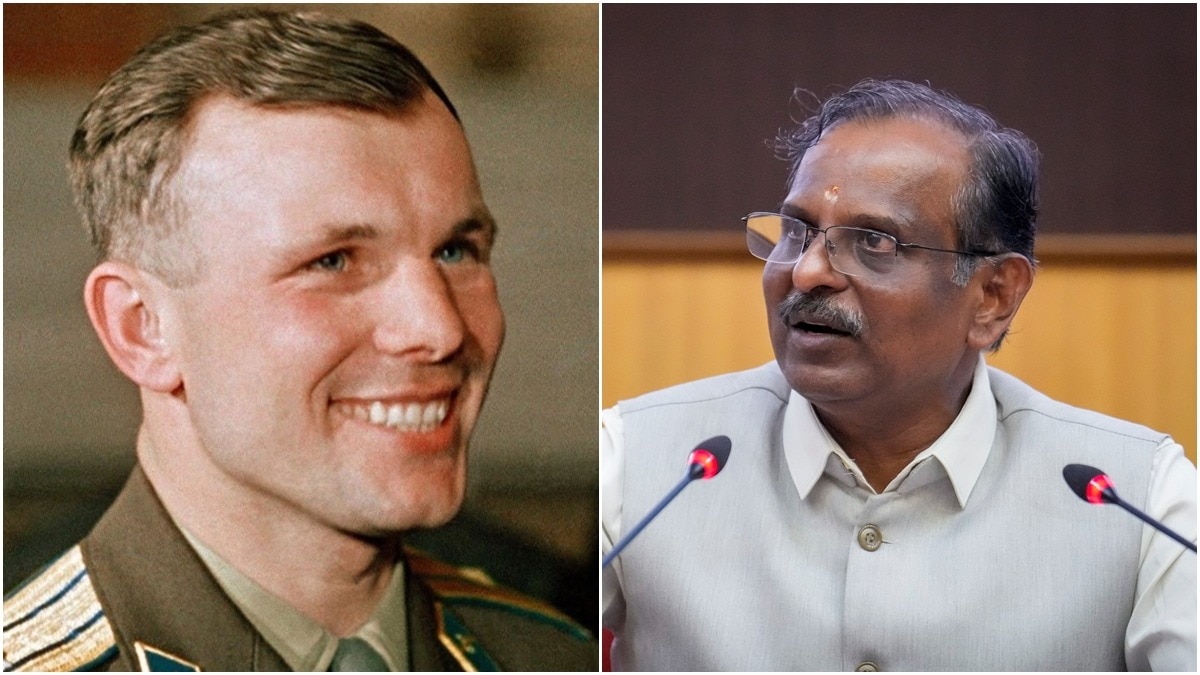
Isro Chairman V Narayanan on Thursday unveiled a statue of Yuri Gagarin, the first human to travel into space, in Chennai and thanked Russia for its longstanding support to India's space programme.
Recalling how several countries had refused to share crucial space technologies with India, Narayanan said Russia had stood by the country during key moments in its journey towards becoming a major space power.
The event was held in the presence of Valery Khodzhaev, Consul General of the Russian Federation in Chennai, and was organised in association with the Russian Centre of Science and Culture.VIDEO | Tamil Nadu: ISRO Chairman Dr V Narayanan and Russian Consul General in Chennai Valery Khodzhaev inaugurated a statue of Soviet cosmonaut Yuri Gagarin at the Periyar Science and Technology Centre in Chennai. ISRO Chairman Dr V Narayanan said, "It is a great honour and pleasure to inaugurate the statue of one of the legendary leaders of the global space community, Yuri Gagarin, who ventured into space on April 12, 1961, and returned safely. I consider it a true privilege to stand among this distinguished audience today to unveil this statue alongside the Director of the Periyar Science and Technology Centre, Dr Shanmugasundaram, and the Consul General of Russia Valery Khodzhaev. What has been achieved here is truly unique. I am confident that this initiative will motivate our youth and foster a scientific temper, encouraging them to pursue activities in science and technology, particularly in space exploration." He added, "Back in 1961, India did not have its own space program; in fact, most of us were not even born yet. That was the era when he traveled to space and returned safely. Before that, on October 4, 1957, Russia launched Sputnik, the first man-made satellite. Following that, Yuri Gagarin's mission marked the next major milestone in human spaceflight, the very first time a human being was successfully sent into space and brought back safely on the very first attempt. The credit and our deepest respect belong to the extraordinary Russian scientists of that era..." (Full video available on PTI Videos - https://t.co/bIyFWTfmBd)— Press Trust of India (@PTI_News) November 5, 2026RUSSIA'S ROLE IN INDIA'S SPACE JOURNEYRecalling the launch of India's first indigenous satellite, Aryabhata, Narayanan said it was sent into space with the help of a Russian launch vehicle.
He also highlighted Russia's role in sending India's first astronaut, Rakesh Sharma, into space.
Sharma travelled aboard the Soviet Soyuz T-11 spacecraft in 1984, becoming the first Indian to go to space.
Narayanan said India had also faced restrictions when it sought cryogenic engine technology from other countries.
Several nations refused to provide the technology, citing the Missile Technology Control Regime (MTCR), even though it had no direct military application.
"However, Russia was ready to provide us that cryogenic technology. I was also part of the team that went to Russia to acquire the technology. But, due to certain geopolitical circumstances, it could not materialise," he said.INDIA DEVELOPED ITS OWN CRYOGENIC TECHNOLOGY
Although the proposed technology transfer did not go ahead, India eventually developed its own cryogenic engine technology, Narayanan said, highlighting the progress made by the country's space programme.
He also cited India's major achievements, including the Chandrayaan-3 landing near the Moon's south polar region, the Mars Orbiter Mission and the launch of 104 satellites in a single PSLV mission.
Narayanan said India had now reached a stage where it was helping other countries build their capabilities in the space sector, marking a significant shift from its early years of dependence on international support.- Ends