
It caused a sensation 20 years ago. Now 'Heaven,' an all-nude, silent ballet is back on a Toronto stage - Toronto Star
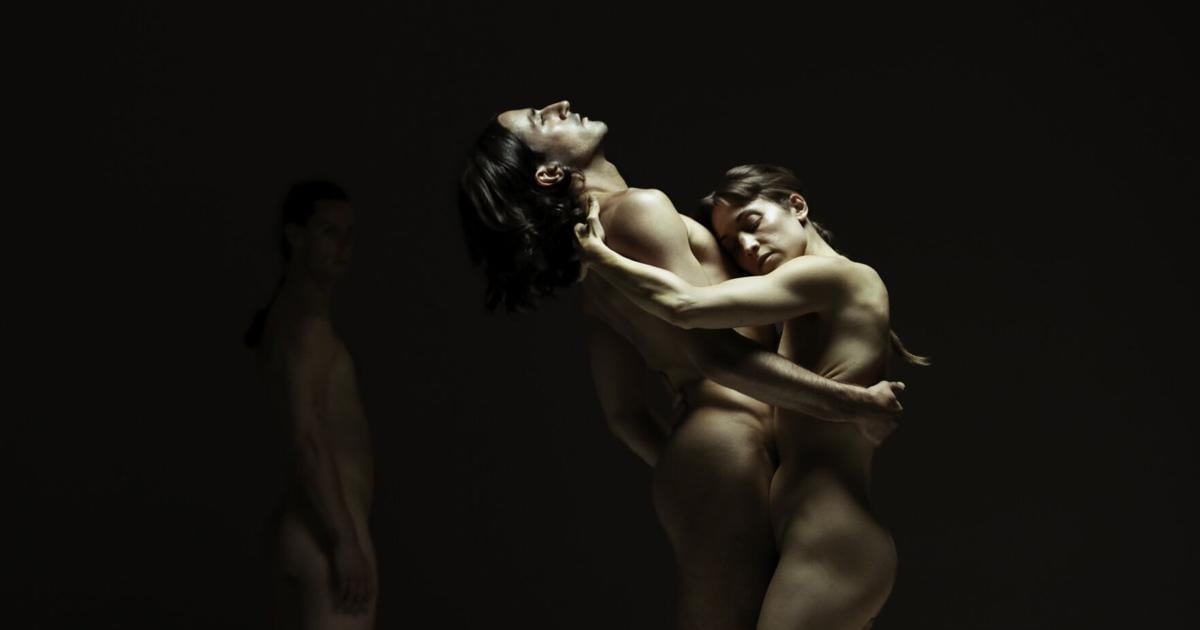
Sasha Ivanochko remounts 'Heaven,' her pioneering contemporary dance piece for its 20th anniversary.
Scott McCabe, Sully Malaeb Proulx and Jessie Garon in “Heaven,” which runs Sept. 29 to Oct. 3.
Sasha Ivanochko is returning to “Heaven,” the 2006 dance triad that emphatically cemented her reputation as one of Canada’s boldest choreographers, as much for the work’s emotionally charged themes as for the fact that it was performed naked and in silence.
“I’ve never wanted to provoke or make a statement,” Ivanochko said during an interview with the Star. “I’m concerned with clarity and coherence. Audiences should encounter something that’s clear, that they can engage with.”
Even so, nudity on stage tends to arouse audience interest. As Ivanochko recalled her father saying in 2006: “Well, that should help sell some tickets.”
Now, 20 years after its Toronto premiere, “Heaven” is returning to the city for a six-show run at the Theatre Centre, Sept. 29 to Oct. 3, with a new cast and lighting design but still danced naked and in silence on a bare stage. In accord with modern practice, Anisa Tejpar joined the team as intimacy co-ordinator.
The contemporary dance world is notoriously bad at nurturing its creative offspring. Even the most successful works often have a short lifespan. In part it reflects the art form’s relentlessly forward-looking, innovative ethos. It’s also because most of today’s choreographers must work independently on a project-to-project basis without the continuing financial and institutional resources needed to preserve and present their work. The ballet world makes a habit of honouring its heritage; contemporary dance woefully less so.
“Heaven” bucked this trend. Over six years, the work has toured across Canada and as far away as the Dominican Republic. Beyond that, it might then have vanished had it not been for the intervention of Jessie Garon.
The Toronto-based dance artist had learned and danced segments of “Heaven” as a student under Ivanochko’s tutelage.
“Jessie had fond memories of ‘Heaven’ and wanted to have a bigger experience of its demands,” recalled Ivanchko. They agreed to co-produce it with Garon performing Ivanochko’s original role.
“Heaven” began life as an intensely collaborative process. Ivanochko, then in her midthirties and dancing prime, was eager to work with two men she much admired, Louis Laberge-Côté and Matthew Waldie, then both members of Toronto Dance Theatre where Ivanochko had earlier been a leading light. As the choreographer recalled in 2006, the gendering choice was indirectly seeded by Ivanochko’s recollection of the twisted two men/one woman love triangle of William Styron’s 1979 novel “Sophie’s Choice.” Ivanochko borrowed the title from director Tom Tykwer’s 2002 movie, “Heaven.”
The decision to dispense with costuming was a collective one. Ivanochko has always viewed dance as an elemental physical expression of the inner being. That belief has shaped an adjacent career: Ivanochko is two years into a five-year part-time study program to qualify as a psychotherapist.
The nudity in “Heaven” was not part of the original conception: it was agreed upon during the work’s evolution, motivated by the desire to strip away anything inessential to the emotional theme; to lay bare not just dancers’ bodies but also their human strengths and vulnerabilities.
In the case of “Heaven,” Ivanochko sought to evoke the human urge for connection and emotional intimacy amidst the tumult of earthy existence. The original cast discussed what the notion of heaven meant to them, concluding that it is a human construct, summoned as a counter to life’s existential bleakness.
“We came to a consensus that heaven is union with others,” said Ivanochko, acknowledging that the work does have spiritual allusions.
“I don’t consider myself religious, but there are references to an upper spiritual world in the work,” she explained. “There is a lot of reaching towards other people.”
The hour-long “Heaven” has neither overt narrative nor characters, but the interactions of the dancers, sometimes tender, other times animalistic or almost brutal, are bound to shape a quasi-narrative in the imaginations of audience members.
And “Heaven” is not silent. It is driven by a powerful, physical rhythmic pulse and by the sounds of bodies breathing and gasping, slapping into each other, sweatily intertwining and slamming against the floor.
Breaking news, interactive polls, video, and voice notes. Star stories you’ll want to share, delivered where you’re already chatting. Follow the Star on WhatsApp.
Ivanochko danced in all the work’s previous iterations. During those touring years she made slight changes and now aims to recreate what she thinks of as a final, definitive version.
Ivanochko and Garon gave great care to the selection of the new cast, Scott McCabe and Sully Malaeb Proulx. The nature of the work requires an unusually deep level of trust and emotional understanding among its performers.
As in 2006, Ivanochko and Garon hope that in its remounted 20th anniversary version “Heaven” may also have an afterlife. This November, in the hope of interesting potential presenters, they will be taking an excerpt to the CINARS Biennale in Montreal, an important international gathering of performing artists, companies, agents and programmers.
Said Ivanochko: “We very much want to tour it.”
“Heaven” runs Sept. 29 to Oct. 3 at the Theatre Centre, 1115 Queen St. W.
Error! Sorry, there was an error processing your request.
There was a problem with the recaptcha. Please try again.
You may unsubscribe at any time. By signing up, you agree to our terms of use and privacy policy. This site is protected by reCAPTCHA and the Google privacy policy and terms of service apply.
Michael Crabb is a freelance writer who covers dance and opera for the Star.
/https://i.s3.glbimg.com/v1/AUTH_da025474c0c44edd99332dddb09cabe8/internal_photos/bs/2026/y/g/fABevfSw6Y6rgWGdoenQ/a0a5113.jpeg)
