James Dyson Award: How a question inspired this BTech student to invent voice-enabled Braille printer - The Indian Express
A question from a visually impaired student changed the direction of Himaja Lingampalli’s innovation. While visiting a school for visually impaired children near her college, Lingampalli, a fourth-year BTech student at Sri Vishnu Engineering College for Women, watched students use traditional Braille slates and pins to write. The process required them to apply considerable pressure to punch dots onto paper. Once the writing was complete, they had to turn the sheet over to read the Braille from the reverse side.
The experience made Himaja wonder if technology could make the process less physically demanding and easier for visually impaired students.
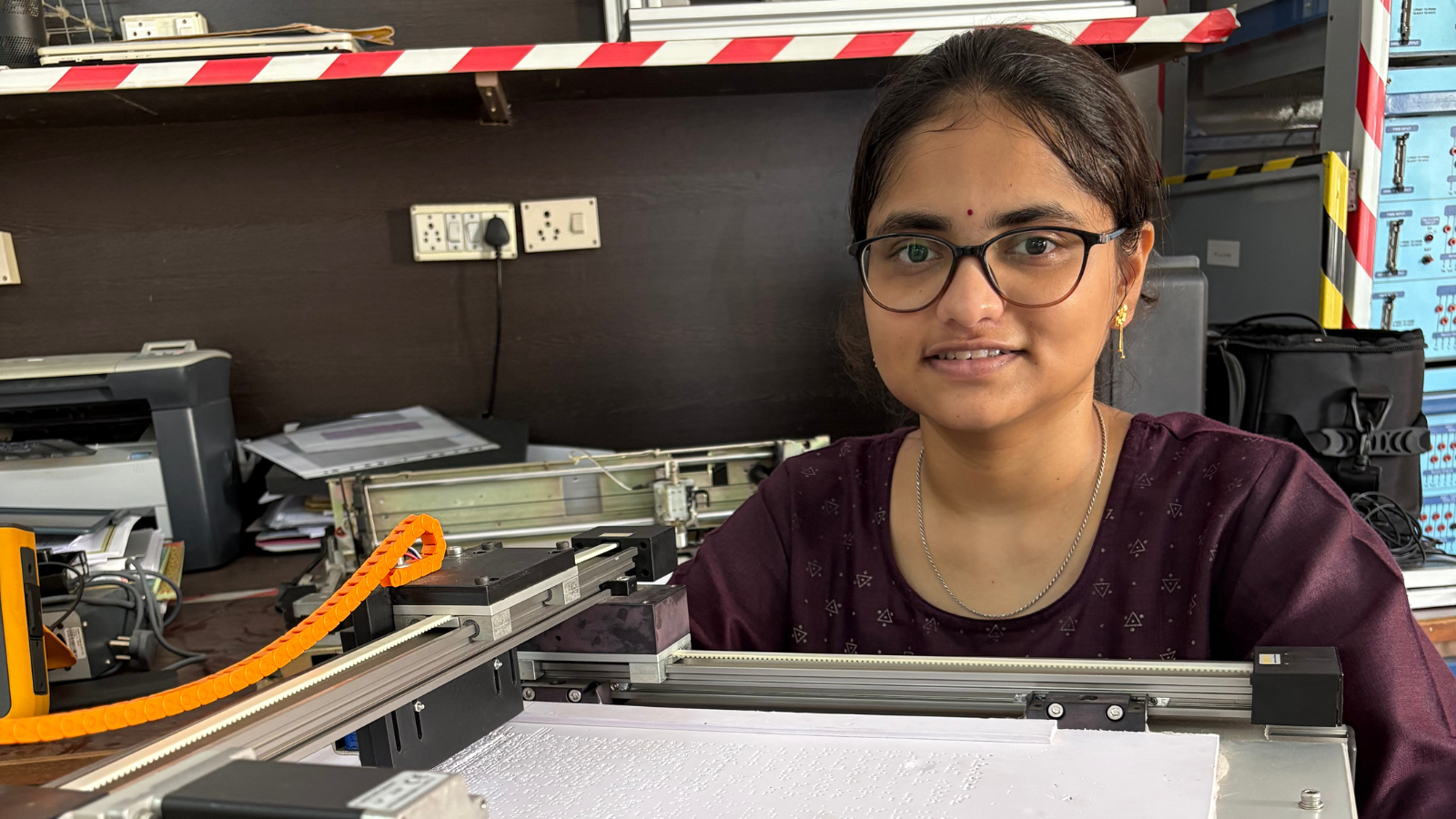
Her idea eventually took shape as ‘Rudhra’, a voice-enabled Braille printing system designed to make Braille writing more accessible. The innovation has won the James Dyson Award in India for 2026, along with a cash prize of Rs 6 lakh. Himaja will represent India in the international round of the award.
The initial challenge was not just the physical effort involved in punching the dots. Students also had to learn and remember the corresponding six-dot patterns that make up Braille characters. For Himaja, the visit raised a simple question: could her technical knowledge help reduce some of these difficulties?
Himaja’s prototype looked very different from the current version of Rudhra. It required students to use push buttons to select the six dots that make up each Braille character. She took the prototype back to the school to test it and gather feedback from the students. But one student’s question made her rethink the entire approach.
“Akka, why can’t we just speak instead of pressing these buttons?” the student asked.
That question became the turning point for Himaja. She began exploring how voice input could be incorporated into the system using Alexa, eventually transforming the button-based prototype into a voice-enabled Braille printing device.
The system is now capable of converting spoken words into Braille and printing the corresponding characters. Himaja said the machine produces Braille patterns that users can feel and read in their actual form, eliminating the need to reverse the paper and learn the corresponding pattern before reading it.
Her project is inspired by Lord Shiva, and therefore, she named it ‘Rudhra’. “Lord Shiva is known as Trinetra — the three-eyed one. His third eye is traditionally a symbol of wisdom, higher knowledge, and an ability to see beyond ordinary perception. My project carries a similar idea: although a visually impaired person may not have conventional sight, Rudhra is designed to open an alternate doorway to knowledge by converting information into Braille that can be read through touch.”
The development of ‘Rudhra’ took her around one-and-a-half to two years to complete. She worked on this project with the assistance of her college faculty and said the process included extensive research, trials and errors.
Feedback from users played an important role in developing the final prototype, said Himaja.
The project allowed her to apply concepts from her engineering curriculum directly into the practical field. “Topics such as engineering drawing, power electronics, embedded systems and sensors helped her develop the machine,” she added.
The project also required her to learn about microprocessors earlier than they were formally introduced in her curriculum.
When asked about what was one thing that she could not learn in an engineering class, Himaja said that one of her biggest takeaways from the project was that practical feedback could provide valuable inputs to a project that textbooks could not.
Is the machine affordable for a common person?
The current version of ‘Rudhra’ reportedly cost around Rs 1.5 lakh to build. Himaja said this was mainly because she used heavy metal and other standard components to make the prototype stable and efficient.
On the market price, she estimates that redesigning the machine with different elements, specifically for student use, could bring the cost down to around Rs 50,000 – Rs 60,000.
In the current design of ‘Rudhra’, the printer head moves along the X-axis and Y-axis while the paper remains stationary. Himaja has future plans to make the device smaller and lighter, compatible with travel. She is also exploring a design in which the printer head remains static, and the paper itself moves. Such a design could eventually reduce the machine’s size and weight significantly.
For now, she said her top priority is to figure out how the technology can be made useful to students and organisations rather than launching it as a commercial product at this stage.
Beyond engineering, Himaja has pursued several other interests during her school education. She trained herself in the Kuchipudi classical dance, and has also received several accolades for her performances. She later took up guitar and has performed both in the college’s cultural programme and outside it.
She has also balanced academics with her responsibilities as a class representative and active participation in sports and other activities.
As a piece of advice to her fellow engineers, Himaja said that it is important to just follow the way that your heart suggests. The passion and constant effort to do something incredible will eventually make the journey and destination incredible.