
JD Vance Chances Against Ossoff, Buttigieg and AOC: Latest 2028 Polls - Newsweek
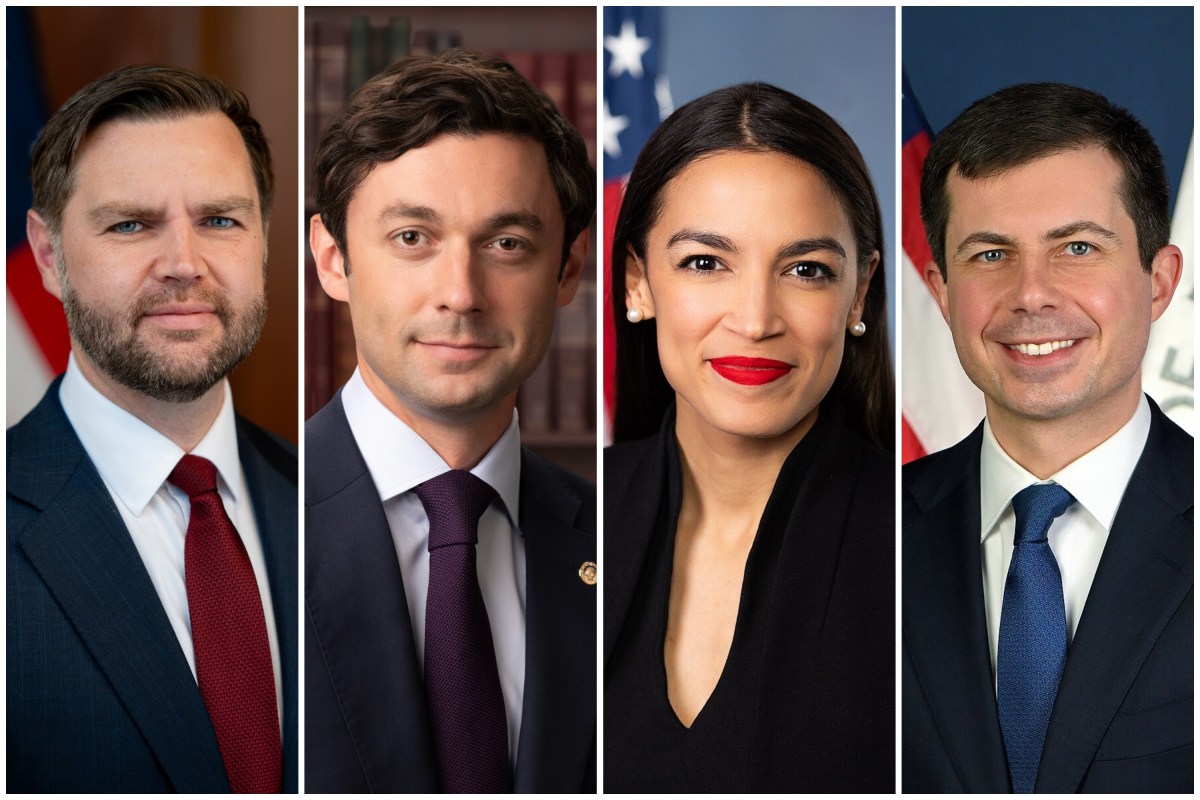
With the 2028 presidential election more than two years away, Vice President JD Vance is trailing four potential Democratic rivals in early general election polling and carries a narrow lead over one.
A polling average tracked by the analytics account Race to the WH shows former Transportation Secretary Pete Buttigieg and Democratic Georgia Senator Jon Ossoff leading Vance in hypothetical general election matchups. Buttigieg leads Vance 48.5 percent to 43.9 percent, while Ossoff has a similar lead, 48.5 percent to 44.1 percent. Ossoff has repeatedly said he has no interest in running for president in 2028.
Former Vice President Kamala Harris also leads Vance, 48.3 percent to 44.4 percent, while Democratic California Governor Gavin Newsom holds a narrower lead, 45.5 percent to 43.6 percent. Democratic Representative Alexandria Ocasio-Cortez is the only Democrat in the average who trails Vance, at 42 percent compared with Vance's 44.9 percent.
No candidate in either party has formally entered the 2028 race. The tracker lists Buttigieg, Ossoff, Ocasio-Cortez, Harris and Newsom among its most-polled Democratic names. On the Republican side, Vance has said he will wait until after November's midterm elections to discuss his own plans.
Buttigieg holds the widest lead of any Democrat tested against Vance in the Emerson survey behind the Race to the WH averages and the former transportation secretary is gaining ground. Eight percent of voters were undecided in that matchup.
Buttigieg was also the only Democrat in the poll with an identical five-point lead in a hypothetical matchup against Secretary of State Marco Rubio, the Florida Republican often viewed alongside Vance as a potential top 2028 contender. Ossoff and Newsom saw their leads over Rubio narrow to three points and two points, respectively, while Harris trailed Rubio by five points despite leading Vance.
A year earlier, the picture looked different. Emerson's July 2025 poll had Vance ahead of Buttigieg by a single point, 44 percent to 43 percent, with 13 percent undecided.
"A key takeaway from the ballot tests is that about 13% of the electorate remains persuadable, while the other 87% have already settled on a party preference," Spencer Kimball, Emerson's executive director, said at the time.
Buttigieg's numbers track with his standing in a hypothetical Democratic primary. Emerson showed him leading the field with 19 percent in July, and Quantus Insights put him at 25.7 percent in August, ahead of Ossoff at 21.3 percent and Ocasio-Cortez at 15.3 percent. A Saint Anselm College Survey Center poll in New Hampshire showed him at 25 percent, again the highest of any potential candidate.
Ossoff has nearly the same lead over Vance as Buttigieg, and he leads Rubio by three points as well. His national profile has grown this year, after getting little attention from major pollsters last year.
Ossoff has seen strong numbers in recent polling. An August Quantus Insights survey had him at 21.3 percent among Democrats, third behind Buttigieg and ahead of Ocasio-Cortez. But he led all named candidates among voters who described themselves as only leaning Democratic, at 33.5 percent.
Prediction markets also see the Georgia senator—who is currently running for another term in the Senate—as a competitive name in the Democratic field, with Ossoff at 17 percent on Kalshi, followed by Ocasio-Cortez at 16 percent and Newsom at 14 percent. Polymarket has him at 17 percent, just behind Ocasio-Cortez at 18 percent.
Ocasio-Cortez is the only Democrat among those tested who trails Vance in the current average, and she was the only candidate in Emerson's August survey to lose to both Vance and Rubio.
Removing undecided voters from the Quantus poll narrows the gap to 51.9 percent for Vance and 48.1 percent for Ocasio-Cortez.
The Quantus crosstabs show a familiar coalition split. Ocasio-Cortez led among women, 48.7 percent to 37.1 percent, and voters aged 18 to 29, 53.4 percent to 24.9 percent. Vance led among men, 53.9 percent to 34.4 percent; among voters 65 and older by a similar margin, and among voters without a college degree, 52.9 percent to 36 percent. Ocasio-Cortez led among Black, Hispanic and Asian respondents, while Vance led among white voters. She also led among urban voters, 53.6 percent to 32.6 percent.
The one survey showing Ocasio-Cortez ahead came months earlier. A December poll from The Argument and Verasight had her leading Vance 51 percent to 49 percent. She posted the result on X with a single word: "Bloop!" Asked about the poll by reporters, she said, "Let the record show: I would stomp him. I would stomp him!"
Looking back at Emerson's numbers from 13 months earlier, there are notable changes.
Buttigieg gained six points on Vance, while Newsom gained eight. Ocasio-Cortez gained one point, a change small enough to fall within the margin of error in both surveys. Undecided voters fell from 13 percent to 15 percent in July 2025 to 7 percent to 8 percent in August 2026, with the shift favoring Democrats rather than splitting evenly. Ossoff was not included in the ballot test a year ago.
Vance's position among Republican primary voters also changed over the same period. He had 52 percent support in Emerson's February poll, but that fell to 36 percent by May, when Rubio was at 35 percent. Two months later, Vance led Rubio 39 percent to 38 percent. Emerson pollster Spencer Kimball described the race as having shifted "significantly" toward Rubio.
Vance has not offered a timeline on decisions about his future beyond the midterms.
"Usha and I will absolutely sit down and talk about what comes next for our family," the vice president told CBS Sunday Morning in June, adding that he expects President Donald Trump to be "very supportive" of whatever he decides.
Rubio, who has moved closer to Vance in the Republican primary polling, has said he does not intend to challenge him.
"If JD Vance runs for president, he's going to be our nominee, and I'll be one of the first people to support him," Rubio told Vanity Fair back in January.
Trump has continued to draw comparisons between the two, at one point calling a potential Vance-Rubio ticket "unstoppable" without saying who would lead it. He later told reporters that "JD is fantastic, and Marco is fantastic."
The broader political environment has also shifted during the period.
Democrats have led the generic congressional ballot by seven to 11 points in Emerson's surveys since the spring, while Trump's approval rating has remained in the high 30s to low 40s.
While JD Vance's odds of winning the Republican nomination are strong according to Kalshi and Polymarket, with him leading Rubio on both platforms, his odds of becoming the next White House occupant trail well behind in the 2028 winner market, with Kalshi rating it at 22 percent to 23 percent and Polymarket rating it at 20.7 percent to 20.8 percent.
Both numbers have fallen since the markets opened. When Polymarket launched its 2028 book in July 2025, Vance was priced at 56 percent for the Republican nomination and 27 percent to win the White House. He has since given up roughly five to six points in each race, ground that has mostly gone to Rubio, whose nomination odds have more than tripled on both platforms.
That number is part of a broader market view that already favors Democrats in the 2028 presidential race. Kalshi has Democrats at 60 percent to Republicans at 40 percent, while Polymarket has Democrats at 67 percent to Republicans at 34 percent.
Contact Newsweek editors on this story: Jason Lemon and Geoffrey Rowland.

