
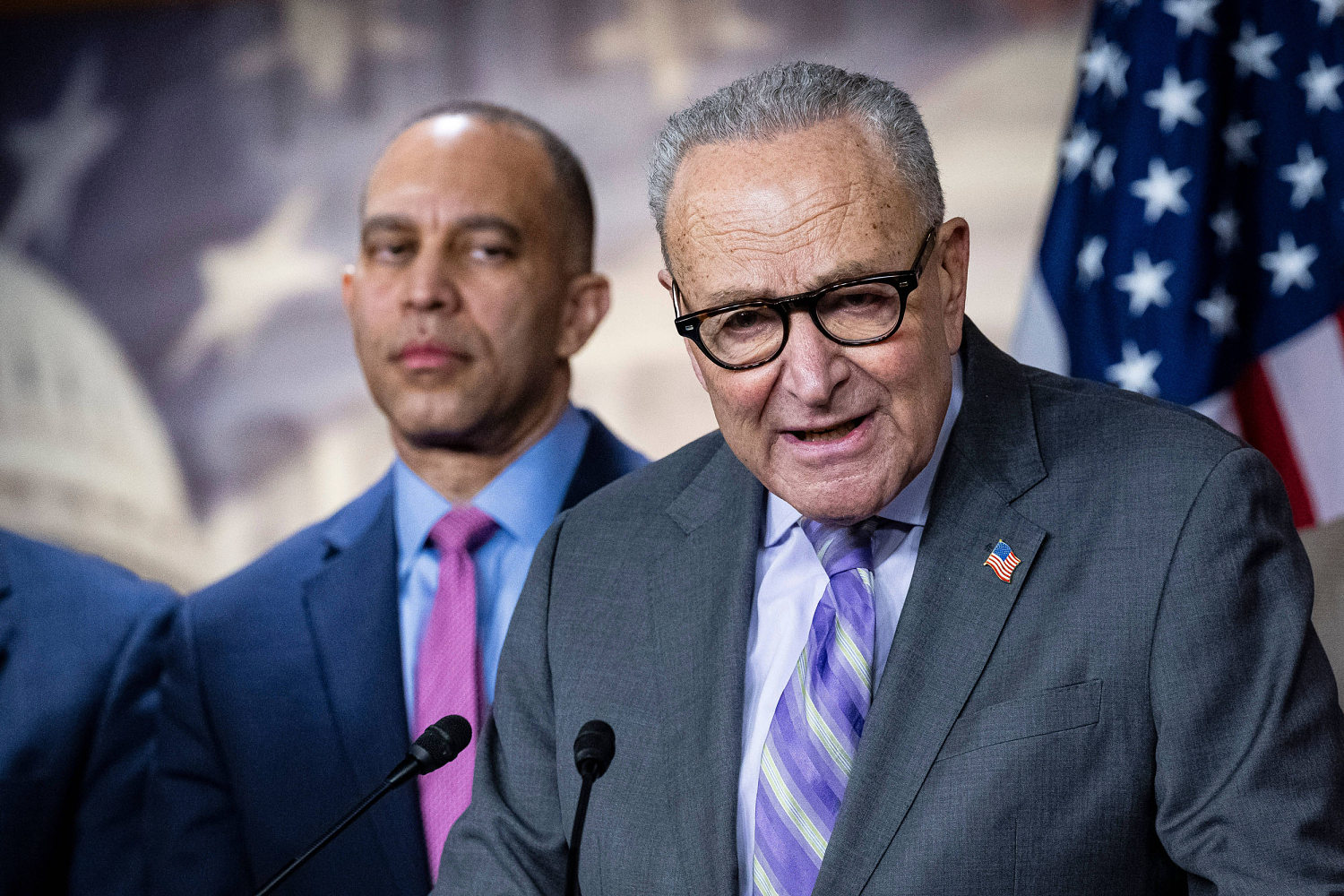
Jeffries and Schumer have plenty of critics – but no challengers: From the Politics Desk
Sen. Schumer says he's confident Democrats will re-elect him as Senate leader04:27Get more newsonShareAdd NBC News to GoogleNov. 12, 2026, 5:00 PM ESTBy The Politics DeskWelcome to From the Politics Desk, a daily newsletter that brings you the NBC News Politics team’s latest reporting and analysis from the White House, Capitol Hill and the campaign trail.
In today’s edition, Jonathan Allen explains why Hakeem Jeffries and Chuck Schumer don’t appear to be in much danger of losing their Democratic leadership bids. Plus, Henry J. Gomez has an exclusive behind-the-scenes look at how Amy Acton overcame Vivek Ramaswamy’s controversial ad in the Ohio governor’s race.
Rep.-elect Bob Brooks, D-Pa., was one of a handful of so-called Bernie-Dog Democrats — endorsed by both democratic socialist Sen. Bernie Sanders, I-Vt., and the House’s moderate Blue Dog Coalition — on the ballot this November.
I traveled to his district in Pennsylvania’s Lehigh Valley in August as part of a reporting trip to eight swing districts across five states — a venture that revealed the disillusionment of MAGA voters and the anger of Democrats heading into the midterms before ballots were cast.
At the polls, that anger was focused on voting Republicans out of Congress, and Brooks won by more than 12 points in a district that leaned marginally toward the GOP before. But some Democrats are also furious at their own party leadership for not being further to the left or not fighting hard enough against President Donald Trump.
So, when I ran into Brooks at the foot of the Capitol steps during freshman orientation this week, I asked what he planned to do with his vote for speaker of the House.
“There’s nobody else to vote for right now: It’s Hakeem Jeffries,” Brooks said of the New York Democrat who serves as minority leader and is so far running unopposed for the job. “I’m Team Hakeem right now.”
An observer of social media feeds on the left could be forgiven for thinking that Jeffries is in danger of not becoming the first Black leader of either chamber of Congress in January. Some have argued that he has been “bought” by special interests.
But interviews with lawmakers across the ideological and generational span of the Democratic caucus this week revealed no real schism over Jeffries.
“It’s interesting because the outside conversations don’t match the internal conversations,” said Rep. Jahana Hayes, D-Conn. “No one else is putting their name in, and he delivered the largest majority.”
It’s that last point that matters most for Jeffries, as well as for Senate Minority Leader Chuck Schumer, D-N.Y., who is facing even louder rumblings about his bid for majority leader. For all of the consternation among activists over the last two years about the failure of Democrats in Congress to take on the president effectively, it was Trump who lost touch with the American public — in part because Democratic leaders didn’t shoot their party in the foot.
Sen. Chris Van Hollen, D-Md., is gauging his colleagues’ support for a challenge to Schumer. Sanders and Sen. Elissa Slotkin, D-Mich., have said publicly that they don’t support Schumer’s bid. But the ambitions of Van Hollen and Slotkin, both of whom are often mentioned as potential 2028 presidential candidates — and Sanders’ tireless efforts to push the Democrats to the left — should not be confused with widespread disapproval of Schumer inside his caucus, even as several of the incoming freshman senators are opposed to him or noncommittal. He is on track to win a secret ballot for majority leader after Thanksgiving.
If either Schumer or Jeffries were truly vulnerable, there would be plenty of candidates climbing all over one another to run against them. So far, there are none.
Amy Acton’s running mate saw the ad first.
FOR SUBSCRIBERSDOJ charged Somali man to try to get information on Ilhan Omar, lawyer saysFOR SUBSCRIBERSThe Nvidia loophole: Chinese firms can use its top chips online — Washington has known for yearsFOR SUBSCRIBERSHow Amy Acton overcame big money and a vicious attack ad to make history in OhioFOR SUBSCRIBERSNvidia is at the center of the AI economy. What happens now?FOR SUBSCRIBERSThe House districts that remain uncalled after the 2026 midtermsFOR SUBSCRIBERSWave of Iran-linked plots raise security questions about American bases in BritainFOR SUBSCRIBERSJensen Huang agrees to brief Congress on interactions with alleged spy, lawmakers sayFOR SUBSCRIBERSRepublicans tiptoe around Trump as they process defeat in the 2026 electionsFOR SUBSCRIBERSHow suspected spy Alice Huang got involved with Nvidia’s CEOFOR SUBSCRIBERSOSU abuse survivors blast Jim Jordan’s election as House minority leaderFOR SUBSCRIBERSHow measles surged in the U.S.FOR SUBSCRIBERSHow a concerned mother says she helped rescue a missing Utah teen held captive in Oregon FOR SUBSCRIBERSLatino groups’ first demand of the new Congress: Subpoena Stephen MillerFOR SUBSCRIBERSHow American Legion halls are adapting to survive a shrinking veteran populationFOR SUBSCRIBERSCubans say their houses are collapsing on top of them but they have nowhere to goSlide 1 of 1For SubscribersFOR SUBSCRIBERSDOJ charged Somali man to try to get information on Ilhan Omar, lawyer saysFOR SUBSCRIBERSThe Nvidia loophole: Chinese firms can use its top chips online — Washington has known for yearsFOR SUBSCRIBERSHow Amy Acton overcame big money and a vicious attack ad to make history in OhioFOR SUBSCRIBERSNvidia is at the center of the AI economy. What happens now?FOR SUBSCRIBERSThe House districts that remain uncalled after the 2026 midtermsFOR SUBSCRIBERSWave of Iran-linked plots raise security questions about American bases in BritainFOR SUBSCRIBERSJensen Huang agrees to brief Congress on interactions with alleged spy, lawmakers sayFOR SUBSCRIBERSRepublicans tiptoe around Trump as they process defeat in the 2026 electionsFOR SUBSCRIBERSHow suspected spy Alice Huang got involved with Nvidia’s CEOFOR SUBSCRIBERSOSU abuse survivors blast Jim Jordan’s election as House minority leaderFOR SUBSCRIBERSHow measles surged in the U.S.FOR SUBSCRIBERSHow a concerned mother says she helped rescue a missing Utah teen held captive in Oregon FOR SUBSCRIBERSLatino groups’ first demand of the new Congress: Subpoena Stephen MillerFOR SUBSCRIBERSHow American Legion halls are adapting to survive a shrinking veteran populationFOR SUBSCRIBERSCubans say their houses are collapsing on top of them but they have nowhere to goSlide 1 of 1Shortly after 8:30 p.m. on a Monday night in mid-October, David Pepper was entertaining local Democrats over dinner at the Old Canal Smoke House in Chillicothe, Ohio, when he peeked at his phone. There in Pepper’s X feed was Acton’s long-estranged mother, in a 60-second video, calling her daughter a liar and urging Ohioans not to vote for her to be the state’s next governor.
To Acton and her advisers, the possibility that Republican Vivek Ramaswamy would enlist the help of Donna Arthur — a woman she had not seen or spoken to since her stepfather was charged with raping her as a young child — was revolting. But it was a scenario they had braced for, based on Arthur’s previous public criticism of Acton and on their low opinion of Ramaswamy’s principles. Fifteen days before Election Day, it had arrived.
Pepper, an experienced political hand who had chaired the state party and was now running for lieutenant governor, copied a link to the video in a text message to Acton and hit send.
The news quickly reached the key members of Acton’s team and upended their evenings. That night, a plan months in the making was activated. They already had Acton’s brother on camera recalling the abuse they had endured as children, footage that would be harvested to produce an immediate response ad. In the morning, police and court records that documented the rape case against Acton’s stepfather — which had long ago been obtained by the campaign’s researchers — would be shared with reporters and circulated online.
“We didn’t sleep a ton that night,” senior adviser Justin Barasky said. “It was one of those things that’s like, ‘Oh, God, these next few days are going to be brutal.’ But I think we seized on it.”
Two weeks later, Acton made history as the first woman elected as Ohio’s governor — and the first Democrat to get the job in 20 years.
This account of how she prevailed is based on interviews with more than a half-dozen people who worked on or closely with the Acton campaign, as well as others with firsthand knowledge of developments that shaped the race.


