
Johnny Depp attempts to re-enter Hollywood with ‘Ebenezer,’ but are audiences inclined to welcome him? - Toronto Star
After making films in Europe, the star is trying for a comeback in director Ti West’s adaptation of ‘A Christmas Carol.’
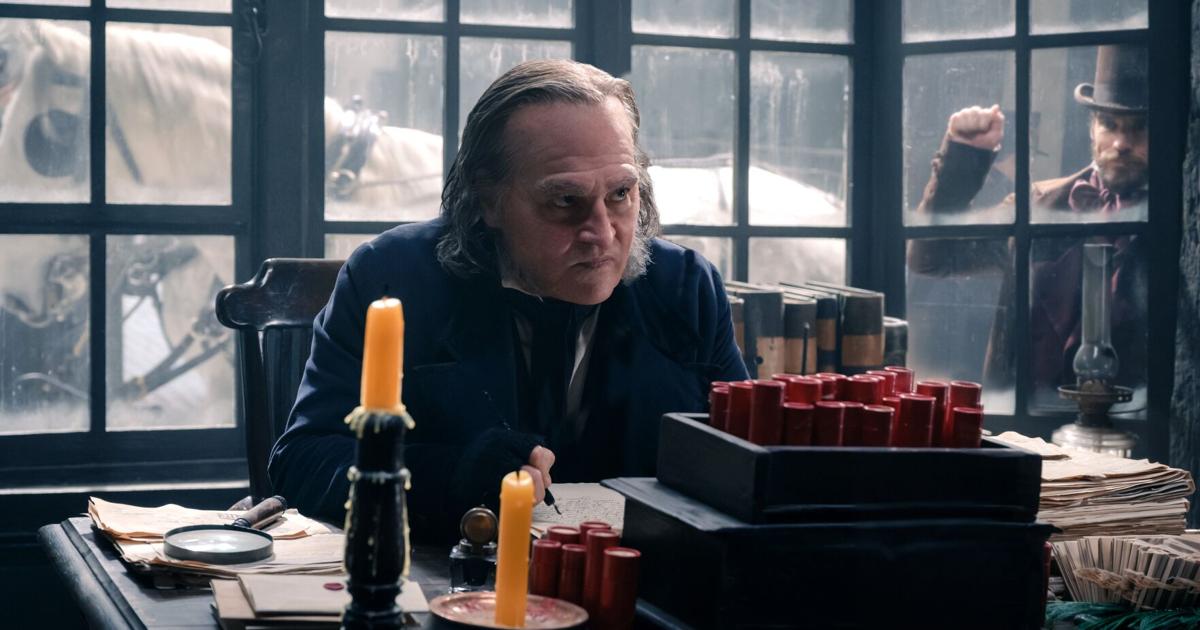
Johnny Depp stars as Scrooge in “Ebenezer,” his first mainstream movie role in years.
“It’s good to be back,” whispers Johnny Depp as the title character in the trailer for “Ebenezer.” The question of whether audiences feel the same way has a lot riding on it. Not just the relatively modest $40 million (U.S.) budget of Hollywood’s latest riff on Charles Dickens’s holiday classic, but also a more ephemeral sort of currency: that of dues paid.
The lasting appeal of “A Christmas Carol” lies in its suggestion that even the worst of us can be redeemed. For a disgraced A-lister trying to work (or worm) his way back into the good graces of an industry that had recently exiled him — literally to France — the role of Ebenezer Scrooge fits almost too snugly.
Consider the pernicious timeline that led to this moment.
In 2019, Depp sued his ex-wife, Amber Heard, over an op-ed she wrote in the Washington Post about enduring domestic violence; though she did not name him, he claimed that he’d been defamed. The ugliness of the ensuing legal battle — played out in the system and the court of public opinion, with damages awarded at different times to both parties — transformed the Oscar-nominated actor into an emblem of post-#MeToo male-celebrity toxicity.
The cancelled-to-comeback pipeline is jammed these days: just ask Armie Hammer, who shed crocodile tears over his coronation as an alt-right icon in “Citizen Vigilante.” The deep discomfort of the testimonies in the Depp-Heard trial was compounded by the way that conservative platforms pumped money and influence into social media campaigns designed to discredit Heard — and at the same time portray Depp himself as the victim of a smear campaign.
“Edward Scissorhands” was one of Depp’s many collaborations with director Tim Burton.
In 2022, the Daily Wire ran an article bemoaning “The Attempted Character Assassination of Johnny Depp” — a surprising turnabout considering that right-wing commentators had previously excoriated the actor for his portrayal of Donald Trump in a 2016 “Funny or Die” video aimed at scuttling his presidential campaign.
For his part, Depp never condoned — or commented publicly — on his unlikely new advocates. But he surely reaped the benefits of their efforts. “Truth never perishes,” said Depp in 2022 after the jury ruled in his favour in a defamation suit worth $10 million (U.S.). — perhaps not even if those who covered the case suggested that truth had been bent by the actor and his lawyers to within an inch of its life.
In the first part of his career, the actor portrayed a host of underdogs, outsiders and weirdos: Depp was a Gen X pin-up with the ability to stylize himself into a human special effect. Case in point: his breakout role in 1990’s “Edward Scissorhands” as a pale, part-mechanical misfit trying to fit into a society suspicious of his gifts.
In that film and his other collaborations with director Tim Burton, Depp fused brooding charisma to playful experimentation — the same alchemical formula that would later ignite his performance as the flamboyant anti-hero Capt. Jack Sparrow in 2003’s blockbuster “Pirates of the Caribbean.”
The subsequent franchise established Depp as more than an actor’s actor or a cult hero: he was a serious box-office draw, including and especially in big-tent, family-friendly fare like “Charlie and the Chocolate Factory,” “Alice in Wonderland” and “Fantastic Beasts and Where to Find Them.”
Depp became a serious box-office draw playing Capt. Jack Sparrow in the Pirates of the Caribbean franchise.
Depp’s departure from the latter franchise — in which he had starred as the villainous wizard Grindelwald — decisively marked a break in his bankability. Famously, he was asked by Warner Bros. to resign from “Fantastic Beasts: The Secrets of Dumbledore,” after he lost a libel suit against the Sun newspaper, which called him a “wife beater.” (He was still paid a reported $16 million for his trouble.)
From there, he continued performing with the rock supergroup the Hollywood Vampires (alongside Alice Cooper and Joe Perry) and migrated his career to (where else?) France, where he had previously purchased and lived in an abandoned village refitted as a private kingdom.
Exiled from Hollywood, Depp played the role of expatriate American celebrity to the hilt. In 2023, he starred as no less than Louis XV in “Jeanne du Barry,” which opened that year’s Cannes Film Festival amid protest. In interviews, Depp said he felt “perversely lucky” to have been cast in the film, which received a seven-minute standing ovation.
Depp starred as French King Louis XV in “Jeanne du Barry.”
For Depp to appear on the Croisette — or to direct a 2024 biopic of bad-boy sculptor Amedeo Modigliani — is one thing. His being front and centre in a mainstream holiday release is another.
At “Ebenezer”’s London premiere earlier this week, the star was all smiles and gratitude. That stories had been circulating about his possible return to the Pirates of the Caribbean series — with a mandate to “end things on a better note” — could only have helped his mood. (“Ebenezer,” which is directed by horror specialist Ti West — though, based on the ornate production design and Hot Topic vibe, one might swear it was Tim Burton — has received mostly positive reactions from critics.)
“I will live in the past, present and future,” vows Scrooge at the other end of his self-actualization. That’s easier said than done for fictional characters, to say nothing of the very real people tasked with playing them.
Adam Nayman is a Toronto-based critic, lecturer and author. He is a freelance contributor for the Star. Follow him on Twitter: @brofromanother.


