Jon Husted in Dead Heat Against Sherrod Brown as He Breaks With Trump - Newsweek
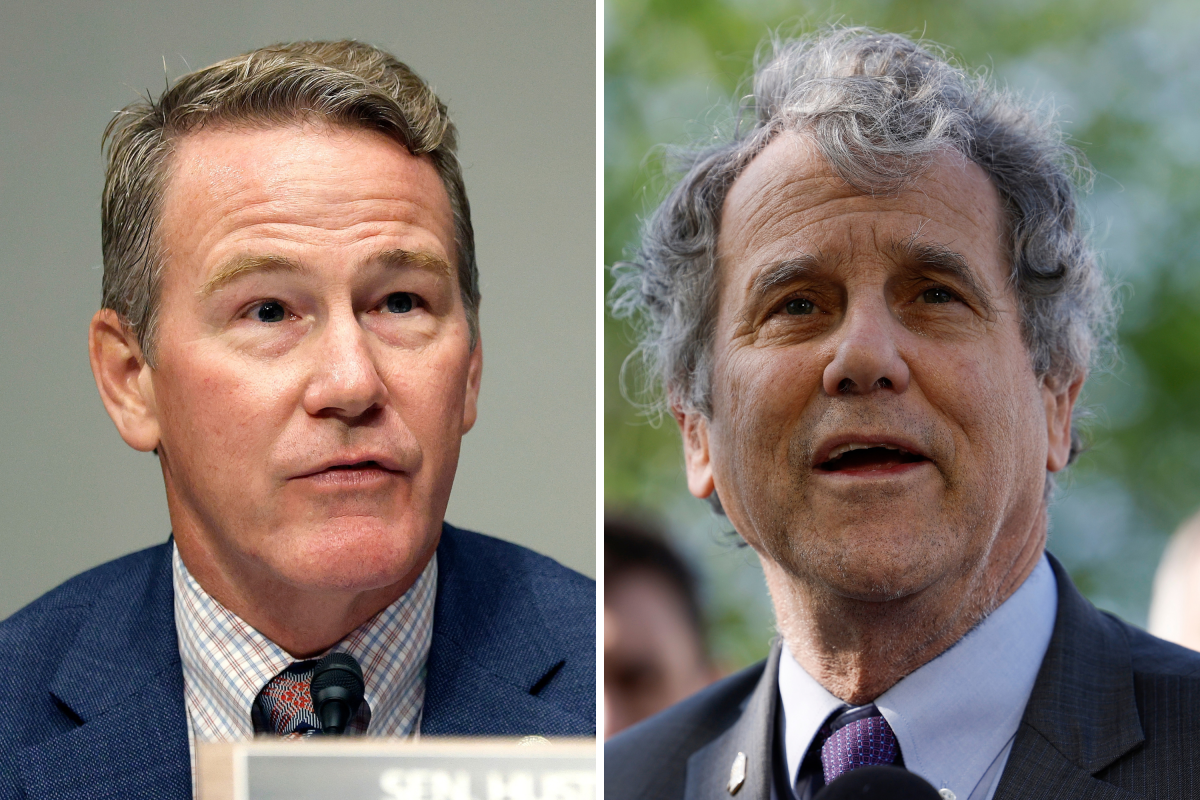
Republican Senator Jon Husted and former Senator Sherrod Brown, a Democrat, are locked in a dead heat in the latest poll of the Ohio U.S. Senate race released on Thursday.
The race is expected to be one of the most competitive races of this year's midterms and could end up deciding whether Democrats or Republicans win control of the upper chamber of Congress.
Although Ohio backed President Donald Trump by double digits in 2024, Democrats see the race as competitive due to a stronger national environment and the candidacy of Brown, who has won statewide in the past despite the state’s rightward drift.
The new poll pointed to a tight race. Brown’s support stood at 45.6 percent, while Husted had the backing of 45.3 percent of respondents—a statistical tie.
Other candidates received about 3.5 percent of the vote, while 5.5 percent were undecided, according to the poll, which surveyed 695 likely voters September 21-23 and had a margin of error of plus or minus 4.2 percentage points.
Brown had a large advantage among unaffiliated voters, winning by 17 points, 51 percent to 34 percent, the poll found.
The poll comes just days after Husted broke with Trump to call for an end to the Iran war, which has become a vulnerability for Republicans ahead of the midterms.
"The war needs to come to an end as quickly as possible so that we can lower gas prices," Husted told Politico on Tuesday.
Newsweek reached out to the Brown and Husted campaigns for comment via email.
The Ohio race is a special election after Husted was appointed to fill the seat previously held by Vice President JD Vance. Brown, who lost reelection in 2024, is running to make a comeback in Ohio, a former battleground that has become more conservative in the Trump era.
The Quantus Insights poll is in line with other recent surveys showing a competitive race, though most polls have given Brown a modest lead.
Brown was up by 3 points in a survey from Bowling Green State University and YouGov. He received support from 48 percent of respondents to 45 percent for Husted. It surveyed 1,000 likely voters September 1-10 and had a margin of error of plus or minus 4 percentage points.
An InsiderAdvantage poll gave Brown a 5-point advantage, 47 percent to 42 percent. It surveyed 1,200 likely voters September 8-9, with a margin of error of plus or minus 2.83 percentage points.
The Democratic candidate also led a Fox News poll, conducted by Beacon Research and Shaw & Company Research, by 8 points, 53 percent to 45 percent. It surveyed 1,008 registered voters August 6-10, with a margin of error of plus or minus 3 points.
However, Husted led an earlier poll, released by The New York Times and Siena University, by 3 points, 50 percent to 47 percent. It surveyed 601 likely voters June 15-28, with a margin of error of plus or minus 4.7 percentage points.
The race has drawn notable investments from the crypto industry. The crypto-backed super PAC Fairshake is set to spend at least $30 million against Brown in November, according to a report from The New York Times.
The investment comes after the Senate Democrats opposed a procedural vote on the Trump-backed CLARITY Act, which would create a federal regulatory framework for cryptocurrencies and other digital assets.
Patrick Eisenhauer, Brown’s campaign manager, said Husted was "for sale and the billionaires and corporations pouring millions into this race know it."
"Of course the special interests are panicking, they know Sherrod will fight the rigged system they’re feasting on to stand up for working Ohioans," Eisenhauer told Newsweek in an emailed statement.
Olivia Tripodi, press secretary for Husted's Senate office, told Newsweek that he believes the bill would establish clear rules for cryptocurrency, protect consumers and support domestic innovation and job creation.
"Senator Husted believes that, if the U.S., not China, is going to lead in global banking and digital assets, the U.S. needs a framework that is clear, practical and supports innovation and job creation here at home," Tripodi said, adding he was disappointed that Senate Democrats had blocked the measure.
Husted’s campaign announced in July that he raised $7.7 million in the second quarter of 2026, with more than $11 million cash on hand. Meanwhile, Brown’s campaign said he raised more than $17.1 million in the same period.
The race is one of a handful of toss-ups that could determine the balance of power in the Senate. Republicans hold a 53-47 majority that is seen as increasingly at risk in November. Democrats must flip four seats to win a majority, as Vance would serve as the tiebreaker in a 50-50 Senate.
Democrats are defending seats they hold in Trump-won states like Georgia and Michigan, as well as a seat in light-blue New Hampshire. They view GOP-held seats in Maine and North Carolina as their top targets.
But no other GOP-held seats are up for grabs in states that Trump won by single digits or outright lost, so Democrats have to turn to more conservative states to find those last two seats. Polls suggest their best opportunities are in states like Alaska, Iowa, Ohio and Texas.
If Democrats win Ohio, their path to a Senate majority becomes narrower, but if Husted wins, that means they would need to win in some of those other states to win control of the chamber.
Brown is hoping to reverse trends in Ohio that have favored Republicans over the past decade. For much of the 2000s, Ohio was a swing state willing to back members of both parties. It voted for President Barack Obama in 2008 and 2012, but went on to support Trump three times, including by 11 percentage points in 2024.
Trump made inroads with white, working-class voters who were previously more divided. His gains came from rural counties as well as the northeastern region near Cleveland. Democrats have gained some ground in Cincinnati and Columbus suburbs, but not enough to offset Republican gains in the rural areas.
But notably, Brown won reelection in 2018, Trump’s first midterm. He also overperformed former Vice President Kamala Harris in 2024, losing by fewer than 4 points. Democrats hope that a better national environment, fueled by growing disapproval of Trump, can help pull him across the finish line.
Ohio also has a competitive gubernatorial race this year, with polls showing a toss-up between Democrat Amy Acton and Republican Vivek Ramaswamy.
The Ohio Senate race is going to be watched closely over the coming weeks. It’s not clear whether Brown and Husted will face off in a debate before the election. Forecasters like the Cook Political Report and Sabato’s Crystal Ball classify the race as a pure toss-up.
Contact Newsweek editors on this story: Gabe Whisnant and Dave Siminoff.