Justin Ling: Canada’s partnership with the EU is a big deal. Who cares what we call it? - Toronto Star
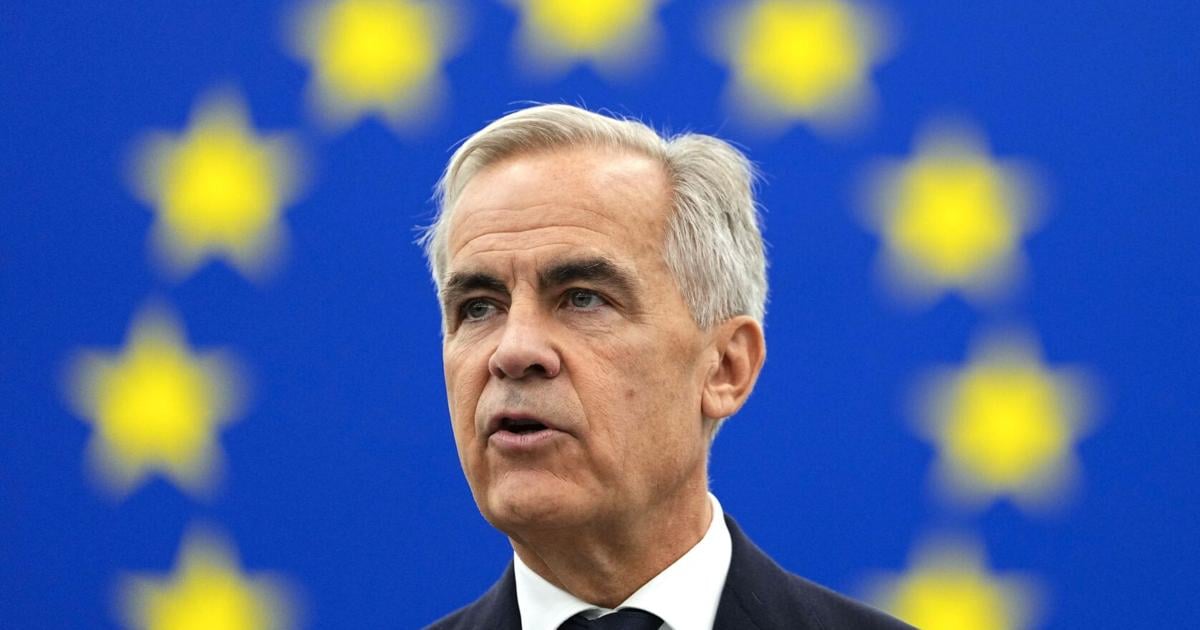
Prime Minister Mark Carney has announced Canada will pursue “associate membership” in the European Union.
Prime Minister Mark Carney, photographed during an address to the European Parliament in Strasbourg, France, is trying to unite the world’s middle powers.
Justin Ling is a staff columnist for the Star and an investigative journalist based in Montreal. Reach him by email: jling@thestar.ca
What does it mean to be a member of the European Union?
There are, of course, the bloc’s founding members, which built and now host the institutions of the alliance. There are the newer members, forced to jump through various hoops and comply with the myriad standards necessary to join the EU’s vast regulatory state. And there are nine countries vying to join the bloc, including Ukraine and Turkey. Finally, there’s the lone ex-member, the United Kingdom, trying to figure out how to be sort of European.
Once you’re in, there are lots of ways to be more in and less in. The Schengen Zone, Europe’s open-borders area, doesn’t include Ireland or Cyprus (but does include non-EU members Iceland, Liechtenstein, Norway and Switzerland.) The EU-Eurozone overlap is also confusing: Czechia, Denmark, Hungary, Poland, Romania and Sweden have all retained their national currencies rather than adopt the euro. Under the EU’s concept of a “multi-speed Europe,” members can opt in to all sorts of other things — a shared law on divorce, a unified patent process, even an EU-run public prosecution service.
And that’s just what they’ve got now. Talks are ongoing about a raft of new initiatives, including a shared military force.
You could lose your mind staring into Europe’s complex, fractal structure. Zoom out, though, and suddenly Canada’s nervous fretting over what we would call ourselves seems quite foolish.
Prime Minister Mark Carney announced Friday that Canada would, in fact, pursue “associate membership” in the European Union. This comes after months of kvetching and hand-wringing over the term, on both sides of the Atlantic.
Canada and the EU have signed agreements to pursue a much closer relationship. Both Prime Minister Mark Carney and European Commission President Ursula von der Leyen describe it as a step on the path to "associate membership" in the EU. (Oct. 30, 2026)
The Opposition here at home has decried it as a globalist plot to bring in more immigrants. European leaders have, more reasonably, worried about creating a new class of member, even as they struggle to manage the members currently hoping to join the EU.
But Carney, flanked by European Council President António Costa and EU Commission President Ursula von der Leyen, confirmed that Canada wouldn’t formally join the bloc. Ottawa won’t be skipping in line ahead of Kyiv, nor will it adopt the euro.
But creating something new — which, as its Byzantine structure makes obvious, Europe loves to do — is altogether more exciting.
“Our association will be the closest, the deepest, the most unique available,” Costa said Thursday.
The term doesn’t matter, he told the Montreal Council on Foreign Relations, because “we want to create something new.”
Sparked though it might have been by the trade war, this new deal “does not need to go through the United States,” Costa added. He stressed that the most significant parts weren’t negotiated in Montreal last week — they will be negotiated in years to come.
Asked whether the ocean between the North America and Europe would make closer ties difficult, Costa laughed: “I’m from Portugal; the ocean was never a barrier for us to come here and find cod.”
It would be easy to walk away from the two-day confab — which featured a dinner with business leaders, as well as some high-level negotiations and Der Leyen’s acceptance of a Juraj Slafkovský Canadiens jersey at Montreal’s second-best bagel shop — thinking it was more pizzazz than substance. This is illustrated by the fact that so much coverage was devoted to obsessing over the nomenclature that describes our partnership.
There’s a very good chance we will look back on this summit in a decade’s time and realize it had been the beginning of something genuinely transformative. But only if we have the ambition to, as Costa implored us, think creatively.
The EU itself began with the six-member European Coal and Steel Community. Now it is a 27-member bloc and emerging superpower.
The initial agreement signed Friday — which also establishes a security-oriented “Alliance for the Future,” potentially open to other liberal nations outside Europe — is just the first step. Carney and his officials will ping-pong back and forth across the Atlantic this spring to hammer out the details.
There’s a lot to figure out before Carney presents the plan to the European Council in June. AI regulations in Europe are a mess, while Canada’s environmental regulations have fallen behind the EU’s. France and Germany, facing growing far-right movements, are skeptical about agreeing to a broad new transatlantic pact.
But that’s the brilliant thing about what Canada and Europe are negotiating right now: we can partner with whom we like, mimic Europe where it makes sense to do so and call it whatever we want.
Error! Sorry, there was an error processing your request.
There was a problem with the recaptcha. Please try again.
You may unsubscribe at any time. By signing up, you agree to our terms of use and privacy policy. This site is protected by reCAPTCHA and the Google privacy policy and terms of service apply.
Opinion articles are based on the author’s interpretations and judgments of facts, data and events. More details
Justin Ling is a staff columnist for the Star and an investigative journalist based in Montreal. Reach him by email: jling@thestar.ca