Justin Ling: Mark Carney may appeal to vast swathes of the country, but there are some things about Canadians he doesn’t seem to get - Toronto Star
Rather than merely address global policymakers and CEOs, the prime minister needs to talk to more everyday voters.
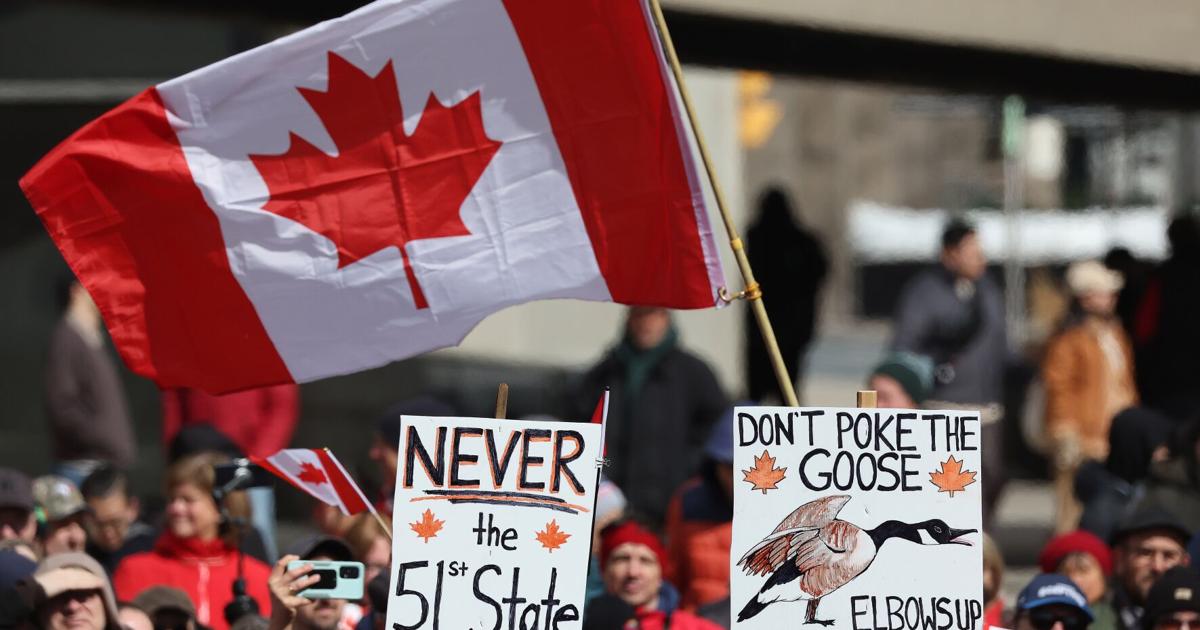
Hundreds of demonstrators gather in Nathan Phillips Square to protest U.S. President Donald Trump’s policies toward Canada, in Toronto, on March 22, 2025.
Justin Ling is a staff columnist for the Star and an investigative journalist based in Montreal. Reach him by email: jling@thestar.ca
“Even when Trump moves on, another Trump will eventually come along. That is why it is better to truly break free and become independent, even if it means suffering for a while.”
It’s a sentiment that has become ubiquitous among Canadians over the past year. It has bubbled up in coffeeshop chatter, in flags springing up on front lawns and in “elbows up” stickers slapped on car bumpers.
The version of it above was voiced by a regular Canadian, one who could well be your neighbour, as part of a nationwide consultation conducted by Global Canada.
This spring, the think-tank — which calls for greater international co-operation and is advised by a cross-partisan group of experts — ran a massive poll that asked some 7,500 Canadians to provide their opinions on the future of our trading relationship with the United States, oil and gas exports, immigration, defence spending, international diplomacy, foreign aid and much more.
It then brought together a representative sample of more than 400 Canadians, organized into small groups, that convened twice this summer. I sat in on some of their deliberations in June, and I was struck by just how sympatico their views were.
Without prompting, Canadians were well-versed on the challenges and opportunities ahead. They argued and bickered (civilly) and mostly found themselves on the same page — and they seemed as surprised by this as I was.
Perhaps we shouldn’t be so shocked. While Canada has been riven by polarization in recent decades, we can all sense the shift: my inbox is full of readers who, even when they disagree with me, appear to be unified in their sense that we are living through a moment of enormous change. Global Canada’s broad survey puts real data behind those vibes.
Its polling showed that, even before negotiations blew up in August, two-thirds of Canadians wanted to reorient our trading relationship away from the U.S., and barely a third believed Canada should make “significant concessions” to get a deal. This feeling was expressed plenty in the smaller focus groups.
“Personally, I just don’t like getting pushed around,” said one Canadian. “I don’t like the fact that we have to take tariffs for no reason.”
Recalibrating away from America is an easy one, but Canadians seem unified across a variety of once-thorny issues, too. They believe we should spend more on defence, exploit our oil and gas resources to sell to the world and extend our military presence to the Arctic — and their beliefs cut across political ideologies.
But because Global Canada dug deeper on those topics, we got some useful nuance. Around the table, Canadians were deeply concerned about the environment, worried about spending finite resources and steadfast that Indigenous sovereignty couldn’t be ignored.
The hours-long conversations, held across dozens of online chatrooms, also show that many Canadians are feeling bullish about their country’s prospects — perhaps even more so than the prime minister is. Well before Mark Carney’s recent visit to Strasbourg, where the idea of Canada becoming an “associate member” of the European Union was floated, Canadians were excited to forge better relations with the bloc. But their desire to engage with the wider world didn’t end in Europe: discussion participants rattled off several places they want Canada to engage with. Europe, yes, but also Mexico, Oceania, the Indo-Pacific, China, South America, Africa. The whole world, in essence.
This renewed appetite for globalism wasn’t limited just to Canadians’ views on commerce and trade relationships. Overwhelming majorities of those polled said they want Canada to get more engaged at the United Nations and World Health Organization, too. They also oppose cuts to global health and international aid, and they believe our country should do more to prioritize human rights and environmental standards abroad. When the roundtables discussed these topics, their opinions further solidified.
“I think it’s a great idea for Canada to be getting involved in coalitions of middle powers,” one Canadian said. But, they cautioned, “that doesn’t mean we have to give up on trying to help reform the UN and the WHO.”
This part maps on well to where the prime minister is at these days. But it also indicates where he’s considerably offside.
Since coming into office, Carney has slashed Canada’s international development budget by nearly $3 billion. He has sometimes alluded to the possibility of reinforcing those multilateral institutions, but little has come of it.
Around the table, the idea that Canada should retreat inward, fixing internal problems before sailing around the world in search of friends and allies, certainly came up. It is a reminder that our global ambitions are always in competition with domestic economic concerns. But the deliberations show that Canadians increasingly see internationalism as a complement to the task of improving lives at home.
“No one can achieve economic development by turning inward,” one astute observer remarked. Concerns about expanding relations with authoritarian China or with India, responsible for at least one assassination on Canadian soil, were generally shared in the conversations, but they were tempered by a pervasive pragmatism. “Good economics, good prosperity brings democracy, educates people,” one participant said.
Politicians and policymakers of all stripes should be poring over this data — all of which is freely available online. For one, these in-depth and thoughtful discussions fly in the face of received wisdom in Ottawa that Canadians do not care about foreign policy.
More than that, Global Canada’s report should serve a more meta purpose: it clearly shows that Canadians are informed and interested, and that they want to be engaged on these questions.
“When citizens receive balanced information and structured opportunities to consider competing arguments, their views do not simply shift in one ideological direction,” the report notes. “Instead, participants became more informed, more willing to express a position, and more confident in the democratic process.”
Carney has been keen to grab the lectern and discuss lofty issues — from Canada’s place in the world to the nature of global co-operation itself — at international forums such as the World Economic Forum and the European Parliament. But rather than merely address global policymakers and CEOs, he should talk to Canadians about these issues, too. Because the world can’t be changed by one man operating the machinery of one government: change comes from whole populations acting in common purpose.
More practically, politics is a game of political capital — and political capital must be earned.
As Leo Tolstoy wrote more than 150 years ago, “What causes historical events? Power. What is power? Power is the collective will of the people transferred to one person.”
Error! Sorry, there was an error processing your request.
There was a problem with the recaptcha. Please try again.
You may unsubscribe at any time. By signing up, you agree to our terms of use and privacy policy. This site is protected by reCAPTCHA and the Google privacy policy and terms of service apply.
Opinion articles are based on the author’s interpretations and judgments of facts, data and events. More details
Justin Ling is a staff columnist for the Star and an investigative journalist based in Montreal. Reach him by email: jling@thestar.ca