Justin Ling: The sooner the Tories can admit the Pierre Poilievre experiment has failed, the better for us all - Toronto Star
Still smarting from last year’s loss, the Conservatives seem resigned to another three years of Poilievre’s divisive politics.
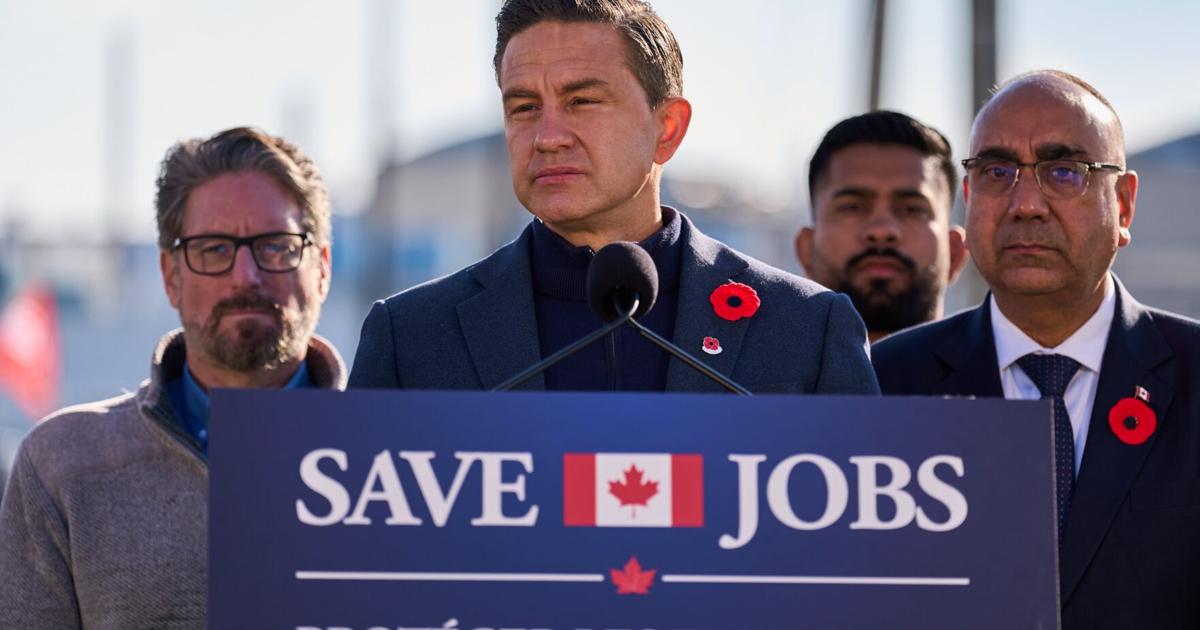
Conservative Leader Pierre Poilievre speaks to reporters near an idled Stellantis assembly plant, in Brampton, Ont., on Nov. 10, 2026.
Justin Ling is a staff columnist for the Star and an investigative journalist based in Montreal. Reach him by email: jling@thestar.ca
One of the great failures of Canada’s parliamentary democracy, wrote Hugh Segal, “is the speed with which we discard leaders.”
Losing leaders who lose elections, the respected scholar/staffer/senator wrote, means forgoing their “experience, judgement, constituency, and more textured understanding of the province, country, and body-politic.” Nobody better represented this tragedy for Segal than Robert Stanfield — “the best prime minister we never had” — who ran thrice against Pierre Elliott Trudeau and came up short each time.
“His conservatism was one of ideals and foundations,” Segal wrote, “not ideology and the politics of wedging Canadians apart by their differences.”
There are plenty of circumstantial similarities between Stanfield and Conservative Leader Pierre Poilievre. The biggest difference is that Canada lost something by Stanfield’s departure. Today, we are missing out because Poilievre won’t go away.
Still smarting from last year’s loss and more unpopular than ever, the Conservatives seem resigned to another three years of Poilievre’s brand of wedge politics. They should ditch the fatalism, I say. Better is, in fact, possible — and the Tories should consult their wastebin of discarded leaders for inspiration.
I’ve long had a bone to pick with the Poilievre style of paranoia politics. He piloted a nasty kind of conspiracism with spooky warnings about “global financial elites” and the World Economic Forum; he endorsed a particularly virulent sort of anti-government anger in the Freedom Convoy; and he contributed to social fragmentation by railing against journalists and favouring weirdo social media influencers.
All this is particularly frustrating because Poilievre has consistently offered stark assessments of the causes of Canada’s real problems. He yelped about reckless spending, anemic housing construction, mismanagement in the immigration system, and feel-good policies that accomplish little. It’s not fair, I suppose, that he was never rewarded for correctly diagnosing the root of Canada’s malaise.
Politics isn’t fair. Mark Carney ate Poilievre’s lunch in 2025 by identifying those same problems and proffering robust ideas as to how they might be solved. He did this while offering a unifying message, not one cloaked in bitter recriminations about a nefarious deep state.
Things, we know, got worse. Four Conservatives have crossed the floor since late last year, a fifth was appointed to the Senate and three others are on their way out. Few of them have much good to say about Poilievre’s leadership. In Brantford–Brand South, Poilievre refused to hold a nomination contest and hand-picked a candidate instead. Now, Poilievre’s choice is running against an independent candidate who’s been endorsed by two former Conservative MPs from the riding.
That candidate, Dave Carrol, is running on a platform that amounts to an implicit rejection of Poilievre: Carrol has cast himself as a grassroots conservative who puts community before party, calling himself “Captain Kindness.”
This summer, I surveyed some Conservative strategists and staffers and tried to diagnose the rot in the state of Toryland. There was a path ahead for Poilievre, I argued, but it would require him to show a bit of humility about his lot. He would need to accept that he would be relegated to the opposition benches for the next three years and start figuring out how to widen his appeal rather than to take the government out at the knees.
He’s done the opposite, and to little effect. Today’s Conservatives are an amorphous blob of a party, existing only in rejection of everything the Carney government is doing.
“After a year and a half of Mark Carney, everything’s worse,” Poilievre declared earlier this month. Polls show that Canadians disagree. When Poilievre rose to debate the government’s budget, he spoke as if he were robbing a stagecoach: “First, our demands.”
The government is spending too much, he insists, but also cutting too deeply. That’s why it needs to axe fuel taxes and waive the GST on million-dollar home sales. Poilievre has both backed Ottawa for walking away from trade talks with the United States and castigated it for not reaching a deal. He has also, for some reason, made repeated trips to Detroit to pitch his plan for a “Tariff-Free Auto Pact” that is indistinguishable from what Canada has been proposing for years.
Poilievre has reserved particular vitriol for Canada’s new immigration targets. The government’s plan will add 380,000 new permanent residents and bring in 370,000 temporary residents per year, although Ottawa is also racing to un-bungle current backlogs by giving permanent residency to hundreds of thousands of people already in Canada this year. All told, our population is set to increase by 0.6 per cent at year’s end.
Poilievre immediately began ranting about the Liberals’ “bonkers” plan for “mass migration,” drawn up at the behest of a shadowy cabal of “corporate powerbrokers.” This, too, is the apparent aim of Canada’s new trade relationship with Europe.
It’s tough out there for an opposition party — just ask the NDP. But Poilievre is being neither principled nor constructive. His knee-jerk policymaking is more populist than conservative, and Poilievre spends more time selling a vision of a dystopian Canadian hellscape than he does using his position in Parliament to propose actual solutions.
There are many ways to be an effective opposition leader that do not involve being a cheerleader for the government. Undoubtedly, the worst approach for Poilievre would be to spend every day for the next three years acting as if there were an election on Monday.
Amid the flailing, Poilievre has lost nearly all of his most senior and experienced staff. Last week, my colleague Stephanie Taylor reported that Aaron Wudrick, a policy wonk and one of the last veterans still standing in the opposition leader’s office, was quitting.
I don’t know a single Conservative staffer or MP who thinks things are going well right now. At best, they say, better times will come when Carney’s popularity wanes. But the Conservatives have been betting on Carney to fail for more than a year now, and they’re less popular than ever. Poilievre himself looks gassed, as he tries in vain to chase the dopamine rush he once got from going viral on MAGA-y Twitter.
This isn’t to say Segal was wrong. It is a tragedy that we tend to kick leaders to the curb when they still have plenty to give. It’s just that Poilievre clearly has nothing left — only the same tired tropes he’s been trotting out for years.
Conservatives often tell me the reason Poilievre is still around is that nobody wants to face the internal battles to come if he is ousted. No other politician, many have said, can unify the party’s Tory traditions with its Reform Party base. If Poilievre is replaced, I’ve been told, it will likely be with a hard-right, anti-immigration populist. (Imagine that!)
The Conservative Party does have one discarded leader who managed to bridge that divide without becoming a complete troll: Erin O’Toole.
A moderate at heart, O’Toole played up his right-wing bona fides successfully enough to win the party leadership and keep the Conservatives unified through the strangeness of the pandemic era (at least until he was pushed out by Poilievre). His 2021 election platform remains a bright star of thoughtful policy development: O’Toole proposed an ambitious German-style plan to install workers on corporate boards, as well as a clever tax credit to encourage small-scale investment in small businesses.
In his farewell speech to Parliament, O’Toole offered a not-so-thinly veiled swipe at his successor. I quote it all the time. Too many politicians, O’Toole said, “are becoming followers of our followers when we should be leaders.” (O’Toole included himself in his criticism.)
Out of office, O’Toole has been working on building Canadian-European economic and security ties, writing thoughtful policy papers and hosting a long-form podcast. Just this month, he took the stage in a friend debate with ex-Liberal leader Bob Rae.
O’Toole offers a vision for principled conservatism currently lacking in Ottawa — one that tamps down polarization instead of weaponizing it, that wants to rebuild trust in institutions instead of dismantling them and prefers conversation to incoherent screaming.
The former Tory leader has told me he’s very happy to be out of politics, and we shouldn’t hold our breath for him to return. But it’s hard not to feel wistful for an opposition leader whose judgment is based on sound ideals and solid foundations.
Conservatives should start thinking now about what they want their party to be. The slew of upcoming byelections will likely be brutal: the party will be lucky to retain one of the two seats it’s defending, which will no doubt raise renewed questions about Poilievre’s leadership.
But beyond the miserable poll numbers and the elections lost, Conservatives should really ask themselves whether Poilievre’s shallow, rage-inducing, opportunist politics is really how they want their movement to be defined for the next generation.
Error! Sorry, there was an error processing your request.
There was a problem with the recaptcha. Please try again.
You may unsubscribe at any time. By signing up, you agree to our terms of use and privacy policy. This site is protected by reCAPTCHA and the Google privacy policy and terms of service apply.
Opinion articles are based on the author’s interpretations and judgments of facts, data and events. More details
Justin Ling is a staff columnist for the Star and an investigative journalist based in Montreal. Reach him by email: jling@thestar.ca