
Keep mines out of park - Bangkok Post
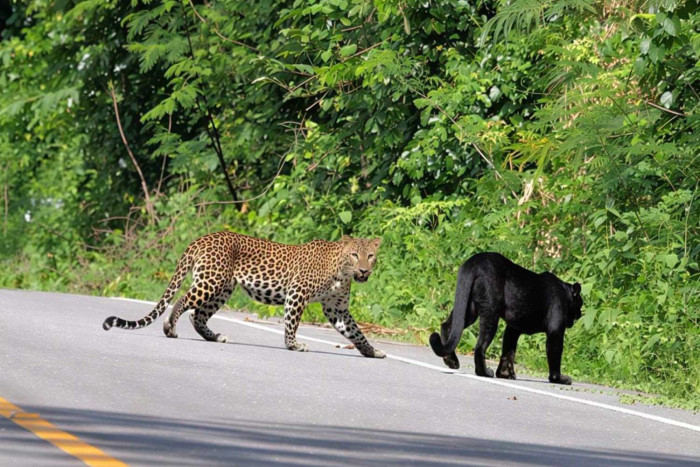
File photo dated Oct 25 shows two leopard cubs, one black and one spotted, along Ban Krang Road in Kaeng Krachan National Park. Courtesy of Natnalee Suraplanan A viral photograph of two leopard cubs crossing a local road in Kaeng Krachan National Park in Phetchaburi last month has rekindled public concern over threats to this Unesco World Heritage site.
The cubs were photographed crossing a road not far from an area where a company plans to develop a dolomite mine.
The firm is seeking concession rights to mine more than 540 rai in the Pa Yang Nam Klad Neua and Pa Yang Nam Klad Tai national reserve forests. Although the proposed site lies outside the World Heritage boundary, it is within a High Priority Support Zone considered important to the biodiversity and ecological integrity of the forest complex.
This is not the first attempt to open a dolomite mine in the area. In 2008, another developer applied for a mining concession but had to backtrack after facing strong opposition from local villagers.
This time is no different. Villagers and respected conservation groups, including the Seub Nakhasathien Foundation and the Bird Conservation Society of Thailand, have urged the government not to grant a permit.
Last week, the Protected Areas Regional Office 3, Phetchaburi Branch, under the Department of National Parks, Wildlife and Plant Conservation (DNP), wrote to the provincial governor opposing a mining project in tambon Song Phi Nong, Kaeng Krachan district. The operator has pledged to halve the proposed mining area, reducing it from 540 rai to 250 rai.
But the proposed site is just 2km from the World Heritage boundary. The DNP warned that forest clearance, road construction, blasting, dust and noise could fragment wildlife habitats and disturb wild elephants, potentially driving them towards nearby communities and tourist destinations. Excavation, mineral washing and groundwater extraction could also affect underground water levels, waterways and reservoirs.
The government must give environmental protection due weight. Successive governments spent more than two years persuading Unesco to inscribe Kaeng Krachan National Park on the World Heritage List in 2021. At the time, human rights groups and conservationists lodged complaints with Unesco over alleged rights violations by the government. Authorities had forcibly evicted Karen villagers who had lived deep in the forest, burning their homes.
In conservation terms, the Ministry of Natural Resources and Environment has also strived to protect Kaeng Krachan National Park and the Western Forest Complex, one of the region's last remaining intact forest areas. Any development -- especially mining, which is known for its destructive environmental effects -- should be kept away from the World Heritage site.
Thailand has learned bitter lessons from mining. They include toxic waste from lead mining in a forest reserve in Kanchanaburi, which contaminated Klity Creek three decades ago. The Pollution Control Department has yet to remove the toxic sediments. There was also gold mining in Phichit a decade ago, and more recently, toxic discharges into rivers in Chiang Rai and Chiang Mai linked to rare-earth mining in Myanmar's Shan State.
Mining is important to the economy, but it must not come at the expense of the environment -- let alone the ecology of a Unesco World Heritage site. Thailand's forests and natural landscapes are dwindling and vulnerable. They cannot survive a zero-sum model of development.
These editorials represent Bangkok Post thoughts about current issues and situations.
Email : anchaleek@bangkokpost.co.th

