King Charles dances in the Bahamas as calls for slavery reparations grow louder
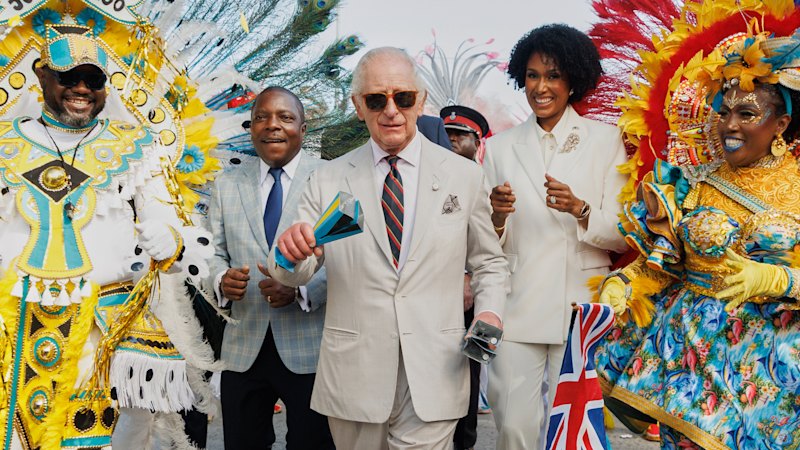
London/Nassau: King Charles danced in the street with a troupe of dancers in the Bahamas on Wednesday, the second day of a royal visit to the Caribbean that has been somewhat overshadowed by increasingly vocal demands for Britain to pay reparations for its role in the slave trade.
Wielding a pair of cowbells in the colours of the flag of the Bahamas, Charles took part in a traditional Junkanoo – a carnival event celebrating the island’s culture.
King Charles shakes traditional cowbells at the head of the Bahamian Junkanoo.APDressed in a suit and sunglasses, the King cut a dapper figure at the front of the parade among the feathered headdresses and colourful costumes of the dancers, and was met with cheers by the crowd.
He began the day by paying respects to fallen members of the Royal Bahamas Defence Force, laying a wreath at the Flamingo Monument, and later visited the Bahamas Boxing Academy, where he was presented with a T-shirt bearing an image of himself wearing a champion’s belt.
Arriving in the Bahamas on Tuesday for his first visit as King, Charles acknowledged the injustices of slavery, saying Commonwealth leaders would discuss the issue at their summit next week.
Charles meets a young boxer at the Bahamas Boxing Academy in Nassau.Getty ImagesSpeaking in the Bahamian capital Nassau at the start of a three-day trip, the King said it was “only right” to acknowledge “the great suffering and injustices of the past in these islands and beyond”.
Charles added that some of what was “best” in Bahamian culture today – “the most joyful, the most hopeful, the most bright” – was “born out of darkness”.
His remarks come before the Commonwealth Heads of Government Meeting (CHOGM) in Antigua and Barbuda next week, where regional leaders are expected to press demands for reparations for slavery and colonialism.
Jamaica recently took its claim for reparations to Charles, and the case has since been referred to the UK’s highest court of appeal for the Caribbean island. The British government, however, has consistently rejected demands for either an apology or reparations.
In Nassau, members of the islands’ Rastafarian community and others staged a demonstration near Clifford Park, where the King met local students, demanding reparations. “Pay us what you owe us!” one woman cried out. “I stand in memory of the horrors and the atrocities committed against black people.”
Members of the Ethiopian African Black International Congress stage a demonstration in downtown Nassau.APAdvertisementCharles will visit Guyana next before travelling to Antigua and Barbuda where he will be joined by his wife, Queen Camilla, for the biennial summit of the Commonwealth which comprises 56 nations, mostly former British colonies.
The issue of reparations has gathered momentum across the Caribbean recently. Last month, CARICOM, the regional bloc, said it wanted the matter on the agenda at the summit.
“The Caribbean has consistently asserted that reparations is fundamentally about justice,” CARICOM Secretary-General Carla Barnett said last month.
Buckingham Palace had indicated that the King would address the issue during the tour, but not offer a formal apology, in line with British government policy, which also rules out financial reparations.
Charles inspects an honour guard of the Royal Bahamas Defence Force.APA palace spokesperson said the visit would focus mainly on “modern partnerships and opportunities for the future” in the region, but added that for Charles it was also part of “a lifelong” effort to engage with and educate about “the most shameful aspects of our past”.
Campaigners and some Caribbean leaders have called on Britain to go further, including through an apology, reparations in the form of financial compensation and the return of cultural artefacts.
From the 15th to the 19th century, at least 12.5 million Africans were abducted and sold into slavery by European traders, with Britain transporting an estimated 3.2 million people across the Atlantic, making it one of the biggest slave-trading nations.
Get a note directly from our foreign correspondents on what’s making headlines around the world. Sign up for the weekly What in the World newsletter here.
You have reached your maximum number of saved items.
Remove items from your saved list to add more.
You've used all of your gift articles. 3 more will become available on the 1st of every month.