KKH is first public hospital in Singapore to offer flight oxygen test for children - The Straits Times
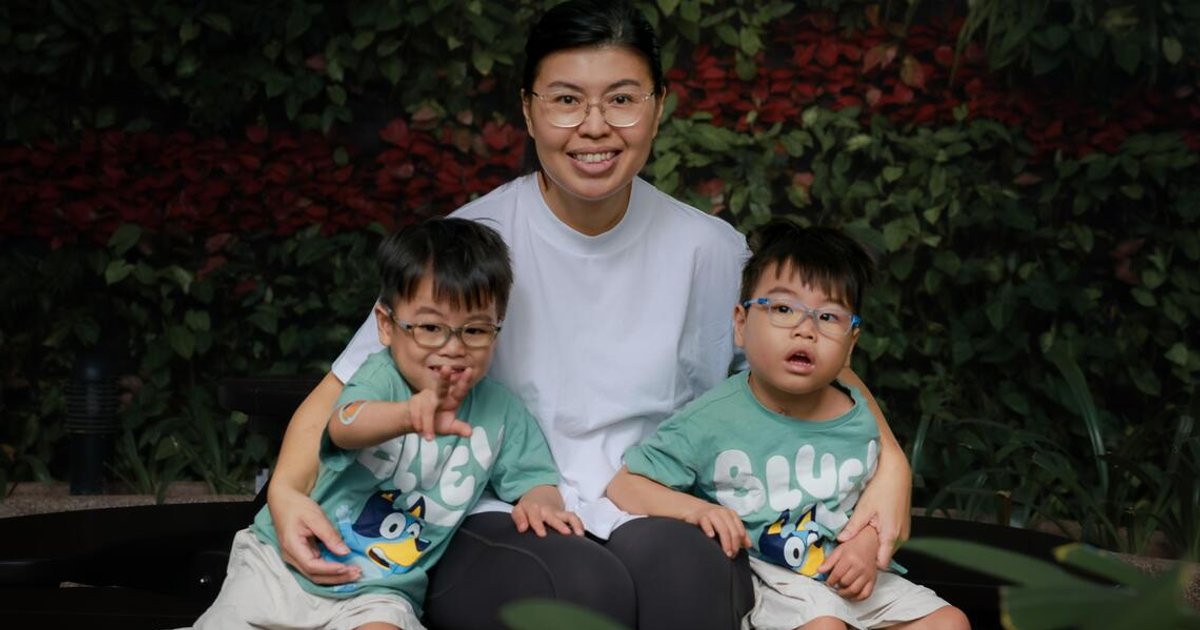
Cho Yoke Mei with her four-year-old twins, Eaman (left) and Eagen Ng, who underwent KKH’s hypoxic challenge test.
SINGAPORE – For children with chronic respiratory conditions, taking a flight can cause blood oxygen levels to drop dangerously as oxygen saturation in an aircraft cabin is lower than at sea level.
A hypoxic challenge test can help determine whether these children can fly without needing supplemental oxygen during the journey.
KK Women’s and Children’s Hospital (KKH) is the first public healthcare institution in Singapore to offer the test for children, says Biju Thomas, head and senior consultant at KKH’s respiratory medicine service.
“For families of children with chronic respiratory conditions, the prospect of air travel can bring as much anxiety as it does excitement. Without objective guidance, families of affected children often avoid air travel altogether, fly with in-flight oxygen as a precautionary step, or simply take a gamble and fly without precautions,” he says.
In the pressurised cabin of a commercial aircraft, the lower air pressure reduces the amount of oxygen available with each breath, potentially causing blood oxygen levels to fall.
While most people can continue breathing normally, children with chronic lung disease or respiratory muscle weakness may experience a significant drop in blood oxygen levels, which can be life-threatening.
For Cho Yoke Mei, 43, the prospect of flying with her four-year-old twin boys, who have chronic lung disease of prematurity, was particularly worrying.
Eagen and Eaman Ng were born at 27 weeks and one day of gestation, weighing 1.1kg and 690g respectively. They were repeatedly hospitalised with respiratory infections and breathing difficulties during their first two years.
Eagen’s condition was particularly severe. He required ventilator and oxygen support, and had a tracheostomy for about three years before it was removed in January 2026.
When Cho began planning their first overseas trip, a 30-day stay in China for intensive rehabilitation for their cerebral palsy, she worried about how they would cope with the lower oxygen levels in an aircraft cabin.
“I was thinking: ‘What if his oxygen levels drop on the plane?’ He would just turn blue instantly,” she says of Eagen.
“I was worried about being in the air, far from immediate medical assistance if either boy developed breathing difficulties,” she adds.
The hypoxic challenge test simulates aircraft cabin conditions as the child breathes air containing 15% oxygen concentration for 20 minutes.
She learnt about KKH’s test through a WhatsApp support group for parents of children with tracheostomies. She then raised it with Thomas, who recommended that both undergo the test.
Both boys were assessed at three years old in 2026. They passed, maintaining oxygen saturation levels of above 90%.
“Instead of constantly wondering whether the boys could cope with lower oxygen levels in the plane, we had an actual test result to guide us,” says Cho, who was reassured by the results. The test cost about $265 a child after government subsidies.
The family travelled to China in June and returned about a month later.
The test simulates aircraft cabin conditions by having the child breathe air containing approximately 15% oxygen concentration for 20 minutes. The child’s heart rate and blood oxygen saturation levels are monitored continuously.
If the child maintains blood oxygen saturation at or above 90% throughout the test without supplemental oxygen, he or she is considered fit to fly without it.
If oxygen at a flow rate of two or four litres per minute is needed to maintain safe saturation levels, the child may still fly, but supplemental oxygen at the required flow rate is recommended.
If safe oxygen saturation cannot be maintained, even with oxygen at four litres per minute, air travel is not recommended.
KKH’s Biju Thomas with mother Cho Yoke Mei and her twins, Eaman (left) and Eagan Ng.
A doctor’s memo detailing the results and recommendations is issued after the test, allowing parents to make arrangements with the airline.
For children older than four, the test is usually conducted using a Venturi mask connected to purified nitrogen gas. Younger children aged four and below, and children with special needs, typically undergo the test with a parent in an enclosed chamber.
The appointment takes about an hour, including a briefing, 20 minutes of simulated in-flight air and 15 minutes of post-test observation in ambient air.
It is offered to infants and children with a history of severe chronic neonatal lung disease, severe respiratory disease or respiratory muscle weakness.
Those who may benefit include children with blood oxygen saturation below 95% at rest or during exercise, persistently low lung function or a history of long-term oxygen therapy, and children with hypercapnia, an abnormally high level of carbon dioxide in the bloodstream.
KKH rolled out the test in February 2025. Fifteen children have taken it.
“We are working closely with specialities that care for at-risk children and we expect a growing demand for this test in the coming months,” says Thomas.
The test is offered as an outpatient service at KKH’s respiratory laboratory.
Assessment by the hospital’s respiratory medicine service doctors is recommended beforehand, though direct referrals from other paediatricians and community healthcare professionals are accepted with a detailed referral letter and comprehensive medical assessment.
Thomas advises families to undergo the test at least two weeks before travelling to allow time to arrange for supplemental oxygen with the airline if needed.
If a child develops serious breathing difficulties mid-flight, the limited medical facilities on board may mean the aircraft has to divert or make an unscheduled stop for emergency assistance, he says.
“The test exists precisely to prevent such emergencies. Without the test, families lack objective data to guide their decision-making and may unknowingly expose their child to serious health risks mid-flight that may warrant emergency medical care,” says Thomas.
Amrita Kaur is a journalist at The Straits Times, where she covers the evolving healthcare landscape in Singapore, including mental health and wellness.