KZN teacher who helped establish rural schools turns 100 - IOL
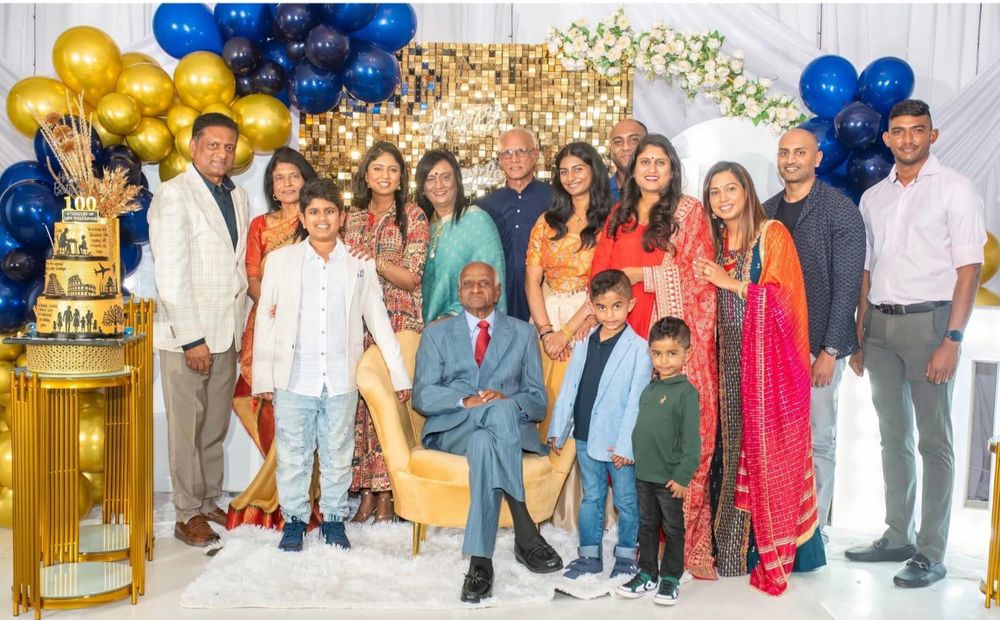
With his family including some of his grandchildren and great-grandchildren, at his 100th birthday celebration.
Retired principal Veerasamy Appiah Rama, who helped establish schools in rural KwaZulu-Natal and Durban, has celebrated his 100th birthday with family and friends.
Rama, of the Bluff, celebrated his milestone birthday on August 17, surrounded by family and friends at a party honouring him at the Bluff Eco Park.
His journey, from humble beginnings, is a testament to resilience and dedication.
Rama was born in 1926 to indentured parents and grew up on a sugar estate in Beneva, on the South Coast of KwaZulu-Natal.
As a child, he worked in his family’s vegetable gardens on the estate and was later instrumental in building the first school in the area.
Rama, the fourth-born of seven children, said his parents came to South Africa from a village in Srikakulam, India.
His dad, Rama Appiah, was a labourer before being appointed as a sirdar (foreman), and his mother, Muniamma, was a housewife.
“We lived a simple life, but everyone was hardworking, even the children. I spent a lot of time gardening by helping my parents plant and harvest, or playing football with other children. However, life changed after my mother passed away when I was nine.
“My elder sister, who was 12, and I took care of our younger siblings, who were aged six, three, and six months. Our elder brother was married and left home, while the other elder brother passed away. Our father worked long hours, so we had that responsibility. It was difficult without our mother,” said Rama.
Veerasamy Appiah Rama celebrated his 100th birthday. He proudly stands beside a portrait done by a pupil while he was principal at Protea Secondary School.
Rama at his graduation with his Bachelor of Arts degree.
He said his dad was progressive and emphasised the importance of education.
With no schools in Beneva at the time, Rama walked to Esperanza Government-Aided Indian School, a 14km roundtrip.
He completed Standard 6 (Grade 8) and thereafter attended Sastri College.
His cousin’s father-in-law was a principal, and his sons attended Sastri College. Seeing how well Rama did in school, arrangements were made for him to attend the same school.
Now living with his cousin’s family in Clairwood, Rama travelled by train to Berea Station and then walked to Sastri College in Winterton Walk, Musgrave.
After completing Standard 8 (Grade 10), Rama decided to find a job and returned to Beneva, where he worked as a volunteer teacher at Esperanza Government-Aided Indian School.
“After a few months, a vacancy became available, and I was appointed a teacher earning one pound a month.”
Rama said he remained concerned about the long distance children had to walk from Beneva to Esperanza, and felt he needed to do something.
“Even though I was only about 17 at the time, I told my father that we should try to get a school built in Beneva. We approached the sugar estate owners, and they gave us a plot of land and told us we could build a school. I headed the building committee with community members, and we started to build the school.”
They only worked on Sundays because that was the only day they did not work in the fields.
“With the bricks we had to make, we eventually built six classrooms, which we called Beneva Government-Aided Indian School. It opened in 1942 and was a proud moment in my life.”
At the opening of the Beneva Government-Aided Indian School in 1942. He is seated third from left.
Over the years, Rama served as a teacher, vice principal, and principal at schools on the South Coast.
This included Umzinto High School, Port Shepstone Primary and High School, and Engar Memorial Primary School. He was instrumental in building a school in Marburg in Port Shepstone.
“Several Indian farmers lived in the community, and their children walked several kilometres to attend Port Shepstone Primary School, where I served as the vice principal.
“I approached a businessman, and after negotiating, money was allocated for the school to be built. I was appointed as the acting principal of Engar Memorial Primary School, which opened in the 1960s. It later became a high school.”
Rama then relocated to Durban and served as the principal of Junagarth Primary School in Merebank, before being appointed principal of a new school, “Chatsworth 40”, now known as Montarena Secondary School.
“I was in India when my wife wrote to me about the appointment. The school was being opened as more people were being moved into Chatsworth due to the Group Areas Act.
“Upon my return, I immediately opened the school and, with the approval of the education department, changed the name to ‘Montarena’ because it served the communities of Montford and Arena Park,” he said.
Rama thereafter served as the principal of Protea Secondary School, where he retired in 1987 after serving 42 years in the education field.
“I loved being a teacher. I even went beyond the call of duty by providing extra classes on Saturdays to ensure the children were prepared for their examinations. Many of my former pupils achieved success in their careers, which makes me proud.”
While teaching, Rama completed matric and a teacher's diploma, and thereafter his Bachelor of Arts and Bachelor of Education degrees part-time via the University of South Africa.
He married Parvathee (now late) on July 6 in 1952. They lived in Beneva before moving to Port Shepstone and later settling in Merebank.
They had two children, Don Rama, 72, a retired school principal and author; and Kumarie Naidoo, 66, a retired teacher. Rama has six grandchildren and seven great-grandchildren.
With his wife, Parvathee, now late.
He has travelled extensively with his friend Poobie Naicker, a teacher, to 52 cities around the globe in 1982; and with Parvathee, their family and friends, he has been to the Okavango Swamps and the Amazon Forest, as well as countries including Japan, China and Fiji.
His most memorable trip was to India, where he visited the village where his parents lived.
Rama, who wrote memoirs that appeared in his son’s book, Beneath the Straw Roof and Children of the Straw Roof, said his secret to longevity was due to living a fulfilling life.
“I don’t believe it was due to anything specific, but just doing all the things I enjoyed, including walking about 5km a day and learning to swim at age 65.”
While he does not have chronic illnesses, he does have slight hearing and sight impairments.